
 E-Paper



Himachal: Focus on giving rural economy a boost, says CM
At an event in Kupvi subdivision where he dedicated developmental projects worth ₹81.83 crore, the chief minister distributed ₹97.69 lakh among 2,171 women of Kupvi area in Shimla district.


Chief minister Sukhvinder Singh Sukhu on Friday said rules under Indira Gandhi Pyari Behna Sukh-Samman Nidhi Yojana would be modified to ensure women of Kupvi area in Shimla district receive a monthly allowance of ₹1,500.
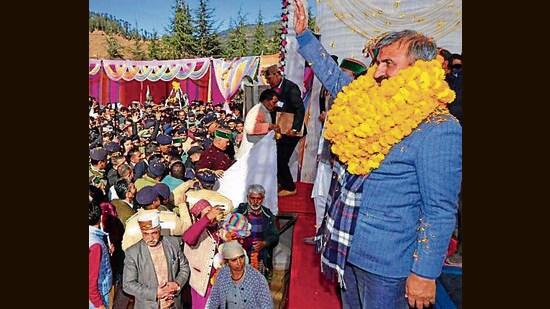
At an event in Kupvi subdivision where he dedicated developmental projects worth ₹81.83 crore, the CM distributed ₹97.69 lakh among 2,171 Kupvi women. He said that under the revised scheme, all women in this region, excluding working women, would receive a monthly allowance of ₹1,500.
The CM said that the state government was working with the motto of vyavastha parivartan (change in the set-up) in the state. He said that the state government has implemented many schemes and programmes with the aim of strengthening the rural economy. “For the first time in the history of the state, minimum support price (MSP) for milk purchase has been fixed,” he said.
He further stated that efforts would be undertaken to establish Kupvi as a separate ward within the zila parishad. Additionally, the sub-dvisional officers (SDOs) of the IPH and PWD departments in Kupvi would be granted the powers of an executive engineer to ensure more efficient administration.
He said that the possibility of opening an Industrial Training Institute (ITI) in Kupvi would be explored. He assured that adequate medical staff, including qualified doctors, would be deployed to improve healthcare services in the region.
He said that the state government was committed to delivering top-quality education and healthcare services. “Efforts were being made to strengthen the education system in rural areas, while model health institutions have been established with specialist doctors to ensure quality healthcare is accessible in remote regions.”


