
 E-Paper



Himachal wants landslide zone mapping expedited
Unlike neighbouring Uttarakhand, state has no sinking zones at present but it has a growing number of landslide zones, which are a concern

 Prefer HTon Google


The Himachal Pradesh government has urged the Geological Survey of India (GSI) to accelerate the mapping of landslide zones in the state, particularly in the ecologically vulnerable Lahaul and Spiti, Chamba and Kinnaur districts.
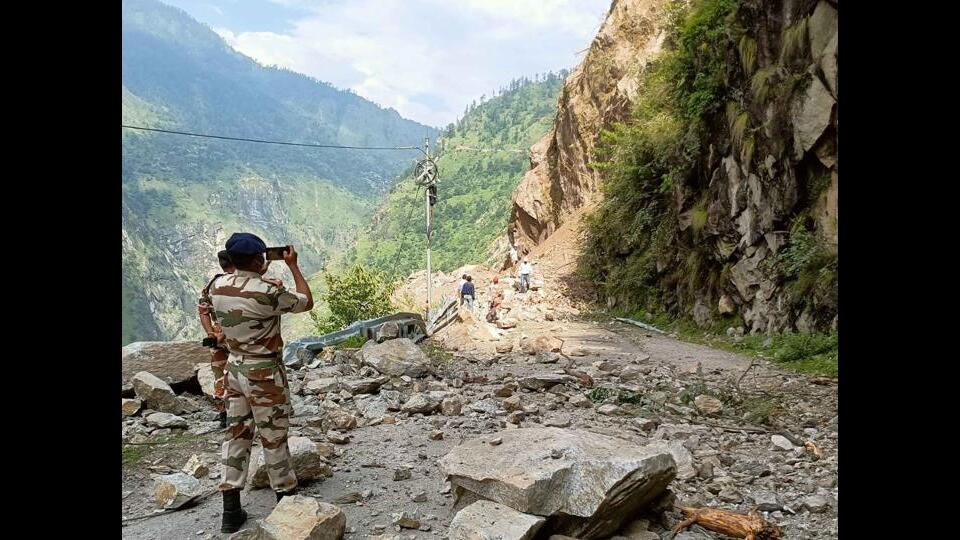
“Unlike Uttarakhand, Himachal Pradesh has no sinking zones at present but we certainly have land-sliding zones, which is equally worrying. We have asked the GSI to speed up the mapping of land-sliding zones and complete the exercise before the monsoon so that construction activity can be planned accordingly,” State Disaster Management Authority director Sudesh Mokhta said on Wednesday.
The GSI has identified 17,120 land-sliding zones in Himachal Pradesh. The state government had urged the GSI to map the sinking zones after the landside in Nigul Seri in Kinnaur left 28 bus passengers dead in 2021.
Bilaspur district has 446 sites prone to landslides, Chamba 389, Hamirpur, which is in a low-lying area has 137, while biggest district Kangra has 1,779 slide prone areas. Kinnaur, known as the powerhouse of the Himalayas due to its hydel projects, has 1,595 sites. Kinnaur is also in seismic zone 5. Kullu is equally susceptible to landslides with 1,337 such sites. Lahaul and Spiti has 2,295 sites, Mandi 1,799 sites, Shimla 1,357, Sirmaur 2,559, Solan 1,036 and Una 391 such sites.
Impact on power projects
There were 117 incidents of landslides in the state last year, Mokhta said.
After the increased incidence of landslides in the Batseri and Nigulseri areas of Kinnaur, local residents launched the ‘no-means-no’ campaign against hydel power projects given the fragile ecology.
“Over the past year, all power projects that have come up in Kinnaur got a no-objection certificate not only from government agencies but villagers, too. It’s time the government assess the impact on power projects,” said state tribal development and revenue minister Jagat Singh Negi.
Environmental concerns grew after cracks were seen in houses at the village located near the 180 MW Bajoli-Holi hydroelectric projects in Chamba district. “There is extensive use of explosives in building roads and tunnels that loosens the soil strata. Construction companies building power projects should use tunnel boring machines,” said Negi.
Onus on Centre, state
Environmentalists have sought a moratorium on large dams in the Himalayas. “The writing is on the wall. We don’t need scientific correlation that certain type of construction disturbs the geology, hydrology and ecology in mountains and will have long-term, often irreparable, consequences. The accountability lies squarely with the international financial institutions, central and state governments who are pushing this infrastructure in the name of development,” said Manshi Asher, an environmentalist and researcher.
Himdhara Environment Research and Action Collective, an advocacy working on environmental justice and forest rights in the Himalayas, carried out a study from 2012-16 on the impact of hydel projects on the environment. The study found that of all Himalayan states in the Indian subcontinent, the pace and magnitude of hydropower development in Himachal Pradesh was the fastest. It said that the highest identified potential of hydropower among the five river basins of Himachal Pradesh lies in the Sutlej valley and if all projects materialise, 22% of the river would be dammed and 72% flowing in tunnels.
Kinnaur, located in the upper reaches of the Sutlej basin, is the state’s hydropower hub. It has 53 hydel projects, of which 17 are large with a generating capacity of above 25 MW. Fifteen projects of varying capacities, totalling 3,041MW, are already operational. This is the highest among all districts in the state.


