
 E-Paper



Inner realms | Tibetan prayer flags and world peace
The blue flag symbolises the sky or heaven, representing purity and healing. Meditating on this flag is said to turn anger to wisdom. The white flag symbolises air and is said to turn ignorance to light. The red flag symbolises fire and provides energy for our endeavours


During my first-ever visits to Dharamshala and Ladakh, I was pleasantly struck by the strings of coloured flags adorning almost every place. Upon enquiring from one of the Buddhist monks, I got to know that there are five flags in every set. They are always displayed in the same order from left to right i.e blue, white, red, green and yellow. These five colours represent the five main directions: north, south, east, west and centre, and also the five wisdoms in Buddhism: compassion, wisdom of sight, harmony, kindness and perfect wisdom.
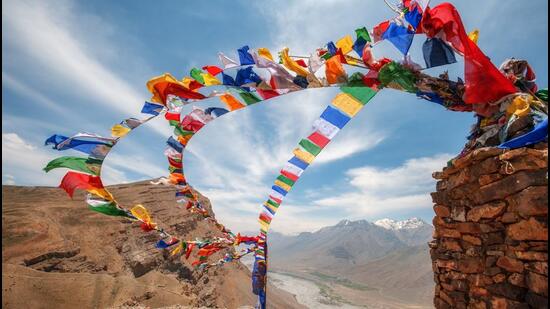
The blue flag symbolises the sky or heaven, representing purity and healing. Meditating on this flag is said to turn anger to wisdom. The white flag symbolises air and is said to turn ignorance to light. The red flag symbolises fire and provides energy for our endeavours. The green flag is symbolic of nature or the flow of water and is said to get rid of jealousy. Finally, the yellow symbolises earth and together all the colours represent the essential balance of our minds.
The annual Saga Dawa festival of Tibet commemorates the enlightenment of Sakyamuni (Buddha). One of the most significant events of Saga Dawa is the replacing of the famous Tarboche Flag pole, draped in Tibetan prayer flags, that stands on the sacred mountain of Kailash.
According to Buddhist legend, the first prayer flags were used by Gautam Buddha, the founder of Buddhism. Devas, or angels, would carry flags that had Gautama Buddha’s prayers written on them into battle with asuras or dark angels. Some scholars say that the roots of these flags lie in India, where sutras originated. Sutras are short pieces of text, written on cloth and derived directly from Shakyamani Buddha’s discourses in India 2,500 years ago. Still others say that these flags can be traced to the pre-Buddhist traditions of Tibet. They were used in shamanistic healing ceremonies and were placed around streams and lakes to appease the local spirits.
In Tibetan, these flags are known as ‘lungta’ and are square or rectangular in shape; to be hung horizontally as a string. The ‘Dar Cho’ flags are meant for vertical placement: dar meaning to increase life, fortune, and health, and cho meaning all sentient beings.
A unique feature of the lungta flag is the image of a powerful wind horse with flaming jewels or three ratnas. This represents ill fortune turning into good inner enlightenment. The wind horse is a mythical animal from pre-Buddhist Tibet that is supposed to have carried prayers from earth to heaven with the speed of the wind and the strength of the horse. The energy is a blessing for all humanity.
Anyone can hang these flags, but it is important to respect them and to possess self-transcendence. Tibetans believe that such flags send out positive energy, with the aid of the wind bringing happiness and well-being to all.
It’s a good omen to receive them as a gift.
After they become old and worn, they should be burned so that the prayers within them can be released and the smoke may carry their blessings to the heavens.
These flags are commonly put up on the third day of the Tibetan New Year, ‘Losar’ and on occasions like marriages and other important functions.
The flags also embody the cycle of life. New flags replace the old ones as the new order replaces the old in life. Flags tell us that life’s changes need to be embraced.
One of the revered mantras we often find on the flag sets is the‘Om Mani Padme Hum’, where Om is the “the sacred syllable”, Mani the “Jewel”, Padme the “Lotus” and Hum embodies the “Spirit of enlightenment”. It signifies that there is only one unity, the true divine spirit resplendent within each one of us. This omnipotence is a priceless jewel and all can be achieved through the awakening of this power. As we embark upon this inner journey and rise above the mundane, we receive enlightenment and self-realisation.
The mantra also celebrates the interconnectedness of all life.
Old prayer flags are replaced with new ones annually on the Tibetan New Year.
Fading colour of the flags is considered auspicious the faded colour symbolises that the breeze had indeed carried prayers.
(Disclaimer: The views expressed in this article are the author’s own).
The author is a ‘Professor of Eminence” and a former principal chief commissioner income tax. He has also written a best-selling book “The Six Secrets of Life.”


