
 E-Paper



‘Wazwomen’ look to master Kashmir’s gourmet delights
In what is believed to be the first women-only “waza” (cook or chef) group, the young members braved biases, social stigma and ridicule, in pursuit of their passion for cooking and Kashmir’s cuisine


Breaking the glass ceiling, a group of Kashmiri women has forayed into traditional and the erstwhile male-dominated local cuisine “Wazwan” — famous for its culture specific dishes prepared during engagement ceremonies, weddings, religious functions and even births and deaths.
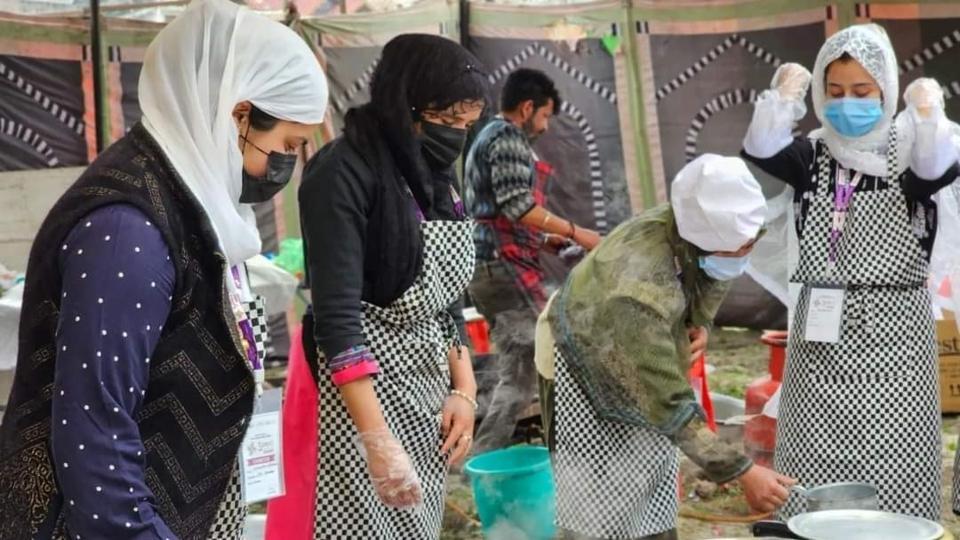
In what is believed to be the first women-only “waza” (cook or chef) group, the young members braved biases, social stigma and ridicule, in pursuit of their passion and have begun to make their presence felt in the Valley’s culinary circuit.
“For the past year, we have prepared wazwan for five to six events. The beginning was tough. People would say ‘kya ladko wala kaam ladkiyan kar rahi hai (what’s with the girls doing a man’s work.). Some women would tell us we should marry and cater to our homes,” Akhter Jan, 26, one of the group’s members from Ganderbal who is pursuing master’s in rural development, said..
The initial social opposition to the group stems from the realm of wazwan being synonymous with men.
And while these women are yet to cook at a grand Kashmiri wedding, known for its mutton and chicken-based wazwan courses, but for the year or so, the group from central Kashmir’s Ganderbal district has cooked during smaller functions like engagements, firsaal and religious feasts like niyaz.”
Jan said their persistence paid off when their acquaintances and fellow villagers gave them a chance to prepare wazwan for them. “We started cooking for functions like engagements and Firsaal. Then people realised that we have talent,” Akhter said.
The wazwan is not a simple meal, but involves days of planning and hours of cooking in its making and serving. Traditionally the meal ranges from anything between 7 to 36 courses, most of which are prepared from meat cooked overnight on raging cooking fires involving a spread of huge copper vessels, mounds of mutton, chicken, fish, vegetables and heaps of spices and other ingredients.
Starting small
The 10-member group came into being in June 2022 with the help of National Rural Livelihood Mission drawn from various self-help groups with an aim to help women earn a livelihood in central Kashmir.
They first started cooking vegetarian food for Amarnath yatris in a rural hut. “After that, we thought why not do something different and something grand. We often cook in our homes and Wazwan is cooking on a grand scale,” she said.
The group, though learnt the skills from some traditional wazwan chefs, was also provided five-day training by NRLM at Solina in Srinagar as well.
The group leader Humaira, also from Ganderbal, said they were apprehensive initially since the work involves heavy manual labour too, including handing big cauldrons. “Only men would do such work before. We took the work reluctantly but when 10 people came together, we found our strength,” she said.
The group said that their families were very helpful but there were people who would talk behind their backs. “People would always talk. There is no work which a woman can’t do. The only thing is that one should have the courage to do it,” Humaria said.
The prominent wazwan dishes include rista, rogan josh, tabak maaz, waza kokur and the ultimate dish gushtaba.
The group created a buzz, among youngsters in particular, after participating in an 11-day mela under Sale of Articles of Rural Artisans Society last month in Srinagar. The group established a stall and served wazwan, and also allowed people to take home the dishes. “Now we have come into the limelight,” Humaria said.
Akhter, meanwhile, noted that many mothers have shown interest in their daughters taking up the work. “They tell us to teach our daughter as well. They want them to grow,” she said.
Challenges ahead
The group now braces to cook at weddings, a challenging task, given the scale. “We want innovation in wazwan and are thinking of introducing some new dishes,” Akhter said.
The group also intends to hire men for the hard manual work like carrying cauldrons.
Prominent writer and poet Zareef Ahmad Zareef said wazwan, which made its way into Kashmir from central Asia some 700 years ago, has remained a man’s domain. Hopeful of that changing, he said, “These young women have taken initiative which will boost our traditional practice of cooking. People need to accept them wholeheartedly.”


