
 E-Paper



Legislature v/s Judiciary: Haryana House decides not to reply to HC notice
If the assembly’s procedure is illegal and unconstitutional, it would be open to be scrutinised in a court of law – Supreme Court


Haryana Vidhan Sabha’s Friday decision to ignore a Punjab and Haryana high court notice has triggered a fresh debate on the powers of the courts to scrutinize the validity of proceedings inside the legislative chamber. The state assembly on Friday resolved that it would not respond to a notice sent by Punjab and Haryana high court on a writ petition filed by Indian National Lok Dal (INLD) legislator Abhay Chautala on the grounds that it interfered with the state legislature’s functioning.
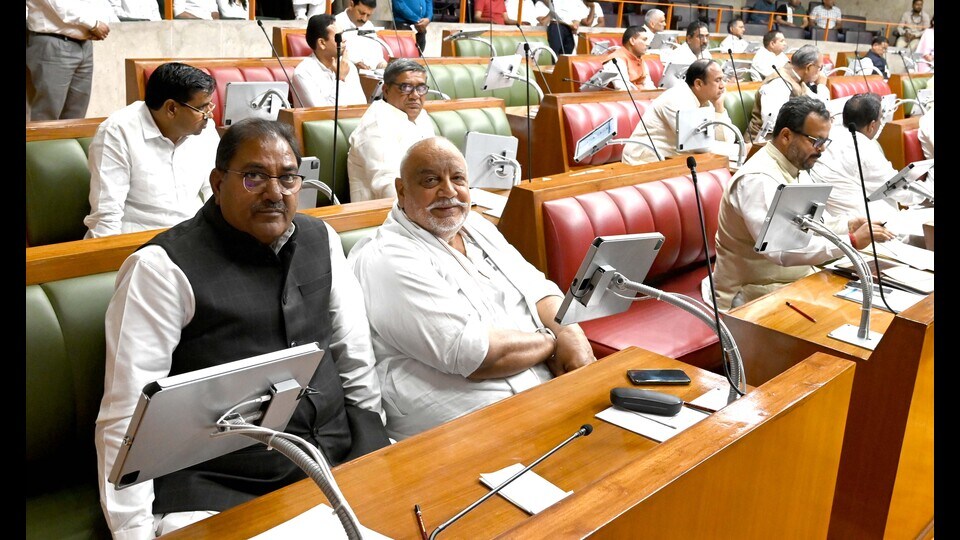
The INLD MLA had on February 22 petitioned the HC seeking the setting aside of Speaker, Gian Chand Gupta’s “illegal” order to name him and temporarily remove him from the House for two days for disorderly conduct. An HC bench of Justice Vinod Bhardwaj while issuing a notice of motion for March 23 to Haryana Vidhan Sabha Secretariat had sought its response to Abhay’s plea.
Speaker Gian Chand Gupta on Friday said in the House that the HC notice should be ignored and not replied to since it was not in accordance with Article 212 of the Constitution. Gupta said that as per Article 212 and various court orders, the courts cannot inquire into the proceedings of the legislature. Parliamentary affairs minister Kanwar Pal moved a resolution in this regard seeking the approval of the House which was passed by a voice vote.
SC defined irregularity & illegality
Construing Article 212 in its proper perspective and drawing a distinction between ‘irregularity’ and ‘illegality’, a five-member Supreme Court bench headed by then chief justice YK Sabharwal in a 2007 judgement had held that Article 212(1) seems to make it possible for a citizen to call in question in the appropriate court of law the validity of any proceedings inside the legislative chamber if his case is that the said proceedings suffer not from mere irregularity of procedure but from illegality.
A seven-judge bench of the Supreme Court, headed by the then chief justice PB Gajendragadkar had in 1964 also given an opinion to this effect on a special reference by the President in the UP Assembly case. The President had decided to make a reference to the Supreme Court under Article 143(1) formulating certain questions pertaining to the powers of courts vis a vis the legislature on which he desired advice. The SC in its opinion said: “If the impugned procedure is illegal and unconstitutional, it would be open to be scrutinised in a court of law, though such scrutiny is prohibited if the complaint against the procedure is no more than this that the procedure was irregular.’’
The INLD MLA in his petition before the HC has contended that the Speaker’s February 21 order to remove him from the House for two days was illegal and against Rule 104-B of the Rules of Procedure and Conduct of Business of the Haryana legislative assembly.
Speaker’s argument pertaining to interference by courts
The Speaker while reading out Article 212 on Friday said that the validity of any proceedings in the legislature of a state shall not be called into question on the ground of any alleged irregularity of procedure.
The INLD MLA, however, asked the Speaker whether his decision to name and remove him for two days was as per the Rules of Procedure of the assembly. “I went to the high court against an illegality. Your decision was illegal,’’ he told the Speaker. The INLD MLA said the rules say that the Speaker can name an MLA for one day but need to bring a motion for the approval of the House if the naming was for more than a day.
The resolution being brought here also amounts to infringement of the court’s notice, Abhay Singh said.
HT had last month highlighted how Abhay Singh’s temporary removal did not seem to be in accordance with the Rules of Procedure and Conduct of Business in the Haryana legislative assembly as a motion (a proposal) to suspend him was not brought in the House. The Speaker, however, did not agree to the contention to bring a motion before the House and had told HT that for naming a member, a motion is not required to be brought before the House.
As per Rule 104-B, the Speaker can name a member of the House who disregards the authority of the chair or abuses the rules of the House by persistently and wilfully obstructing the business on a motion being made forthwith.
The rule further says that the Speaker shall put the question that the member (naming him) be suspended from the service of the House for a period not exceeding the remainder of the session.


