
 E-Paper



Guest Column: Longowal, a statesman who dared to be a saint
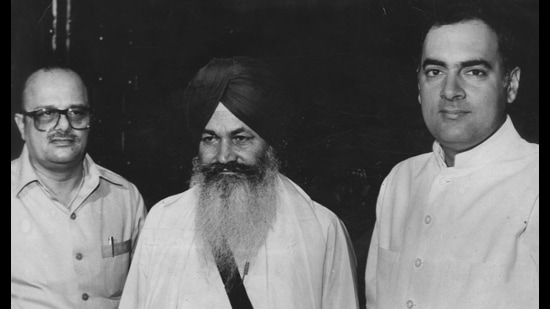
The Rajiv-Longowal accord had brought to center stage a simple and relatively innocent figure - Sant Longowal - who would take huge political and personal risks because he believed that it had become a moral necessity for him to try and put an end to the bloody bitterness between the two sisterly communities in Punjab


Exactly 37 years ago, July 24 was an exceptionally and unexpectedly sunshine day for a love-bereft and peace- starved Punjab. For those who had seen that day and had endured the seemingly endless dark night that preceded it, it was a long wait all day yesterday to see if anyone in the state still would still care to remember the past and its painful lessons. Would someone among us care to remember the pain of a dream betrayed – someone especially from among the principal dramatis personae of a tragedy that had seemed deceptively to end in hope? Do people and their leaders still care to spare a thought for those who staked their heads on the block so that others could be rid of the unending torture of life without hope?
This was – or should have been - an important question before Punjab yesterday because, as the saying goes, a society that does not remember and respect its history is doomed to repeat it.
There were and are leaders from across party lines who kept and keep talking about the non-fulfilment of dreams which this day in 1985 had promised to realise - dreams such as Chandigarh, river waters, release of Sikh detenues and so on. I had thought that someone from among us would care to remember with sorrow and regret the agony of seeing that dream brought to dust. Not just remember it but also remind us of it.
When the Government of India rolled tanks into the holy precincts of Shri Harmandar Sahib in June 1984, it seemed to have killed forever every chance to allow sanity to prevail in Punjab and in the rest of the country. The horrendous failure of the then government to attempt a less painful option to a crisis seemed to have buried whatever chance there was of someone attempting to end the cycle of insane hatred in Punjab. The tragedy was deepened by the fact that the government then had itself allowed this crisis to reach an explosive climax. The cataclysmic event of the Operation Bluestar merely confirmed what was widely believed already: that like the climax, the genesis of the Punjab’s tragedy lay outside Punjab, and that there was nothing anyone in Punjab could do to end it.
The Rajiv-Longowal accord
But one man was still willing to defy this stark truth. He was still willing to attempt the impossible. Sant Harchand Singh Longowal paid for his daring to believe that an effort to have pious dreams fulfilled is always worth dying for. He signed an accord with Rajiv Gandhi, the then PM . The meaning and significance of the accord went far beyond what was written into it. That Chandigarh was to be transferred to Punjab on January 26, 1986, without any Punjabi speaking areas from Punjab going to Haryana was the strongest vindication ever of Punjab’s case that the state had till then been discriminated against on this and other issues. The, there was the issue also of Bandi Singhs , called the Sikh detenues at that time. The clauses on the river waters dispute still left room for controversy.
But what the accord had actually acknowledged was something that successive governments since and after this accord have been refusing to acknowledge – that the Punjab problem exists because Punjab has a case, and not just because Punjab politicians need a cause to whip up passions. Politicians will always do what politicians always do. But using that as an excuse to deny that a problem indeed existed had itself become a problem bigger than what it was supposed originally to address.
The accord had many flaws but if it was still a momentous event in history, it was because the spirit it symbolised is still the only recipe available for resolving conflicts. It is that spirit that has been missing since January 26, 1986.
Huge political and personal risks
The accord had brought to center stage a simple and relatively innocent figure - Sant Longowal - who would take huge political and personal risks because he believed that it had become a moral necessity for him to try and put an end to the bloody bitterness between the two sisterly communities in Punjab. History is witness that politicians create problems for statesmen to solve. But in that era, history had gone a step further: it produced a statesman who dared to be a saint. From the few meetings that I had with Sant Longowal after his release post the army assault on Harmandar Sahib , it had become clear to me that he knew that he was taking terrifying risks by trusting the then Prime Minister. Longowal seemed sure of the cross that awaited him and he seemed to determined to kiss it - if only it would ensure that June and October-November 1984 are never repeated in the history of the Sikhs and the country.
His last act was his greatest – the act of choosing to die for opting for sanity. That he was betrayed merely re-emphasises the purity and the innocence of his intent.
A cry of the heart
Yesterday, the country he strove to restore sanity to and the state and the party he strove to salvage from destruction treated the day of his last act with deafening silence. But tearing through this silence was a cri de coeur - a cry of the heart -of someone anguished by what befell the innocence of a statesman who dared to be a saint. It is history’s revenge against Rajiv Gandhi that his birthday August 20 - will always coincide with the day on which the man he betrayed was martyred – because he trusted Rajiv Gandhi. Perhaps, it is just as well that the country did not remember the Sant yesterday, for there would have been a heavy guilt in that homage.
bains.bains@gmail.com
The writer is the principal adviser to Shiromani Akali Dal president. Views expressed are personal


