
 E-Paper



Malwa to see sharp uptick in stubble fires this week
Harvesting of the kharif crop in the south Malwa belt is expected to gain momentum from this week. With this,stubble fires in Punjab may see a sharp spike in the next few days


Incidents of paddy stubble burning in Punjab may see a sharp spike in the next few days as harvesting of the kharif crop in the south Malwa belt is expected to gain momentum from this week.
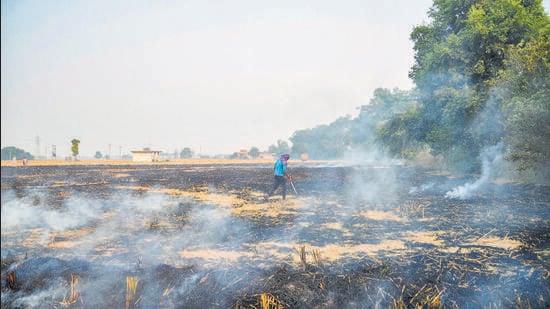
Analysis of the Punjab Remote Sensing Centre (PRSC) data says since 2016, seven districts of the southwest region of the state contributed between 42% and 53% of total cases of burning of organic waste in the state.
Till Thursday, Punjab reported 7,974 farm fire cases and the semi-arid belt contributed 24% or 1,269 fire events.
This kharif season, Ferozepur has recorded 495 stubble-burning cases, the highest in the region, cases to date followed by 196 in Bathinda and 193 in Moga.
Officials of the state agriculture department said on Thursday that major rice-producing districts like Bathinda, Moga, Mansa, Muktsar and Faridkot have recorded only 20-40% harvesting and in Ferozepur, farmers have harvested 65% area of paddy.
In Fazilka, most farmers sow basmati varieties and its residue are used as animal fodder and thus not burnt.
Farmers are expected to clear fields by November 10 to start wheat sowing.
Chief agriculture officer of Ferozepur Tejpal Singh said of 1.86 lakh hectare under rice cultivation in the district, over 65% area is covered under environmentally hazardous parmal rice variety of PUSA-44.
“It takes 145-150 days to mature which is up to 30 days more than other recommended parmal rice (PR) varieties. This variety gains notoriety for requiring 5-6 extra cycles of irrigation than other types of paddy. Post-harvest organic waste generation is also higher in this variety which further contributes to pollution when stubble is burnt. We have taken enough measures to motivate farmers to shun burning by providing enough support for stubble management,” said the official.
As per the data, the stubble burning in these seven districts in rampant since 2016 and experts say the number may witness a surge in the coming days.
Bathinda CAO Dilbag Singh said out of 1.94 lakh hectares area under rice, harvest is completed only in 25% area.
“Last year, the district saw over 4,400 cases and we hope this time farm fire will reduce significantly,” he said.
Rice grower Buta Singh from Bathinda’s Bhokra village said in the next few days it would be clear if farmers shun the practice of burning crop residue.
“I cleared my entire 7 acres without burning. I did not pay anything to the stubble entrepreneur from Amritsar. As harvesting will expedite from this week, it is to be seen if farmers avail stubble management or not,” he added.
In the 2021 kharif season, Punjab recorded 71,304 stubble-burning cases out of which 44% or 31,442 cases were from seven districts of the region.
South Malwa contributed to almost half of farm fires in 2020 and 2019.
The region had a share of the highest 53% of total stubble-burning cases in Punjab in 2018 while it was 42% in 2017 and 45% in 2016.
Sanyukt Samaj Morcha leader and farmer rights activist Prem Singh Bhangu said stubble burning would see a surge as the Punjab government has failed to provide any financial support to paddy growers.
He said it is unjustified to penalise farmers for causing air pollution as the government is unable to provide viable options to small and marginal landowners.
“A delay in sowing paddy and untimely rains delayed harvesting paddy crop. It further reduced the time of completing paddy harvesting and wheat sowing and farmers are left with no choice but to burn stubble. If wheat is sown after November 10, it would have a direct impact in yield that farmers cannot afford,” said Bhangu.


