
 E-Paper



Nishan Sahib in Golden Temple dons basanti
The Shiromani Gurdwara Parbandhak Committee (SGPC) on Friday changed the colour of Nishan Sahib in the Golden Temple complex from kesri (saffron) to basanti (xanthic), days after the Akal Takht issued an edict in this regard.


(Slug: Days after Akal Takht’s edict)
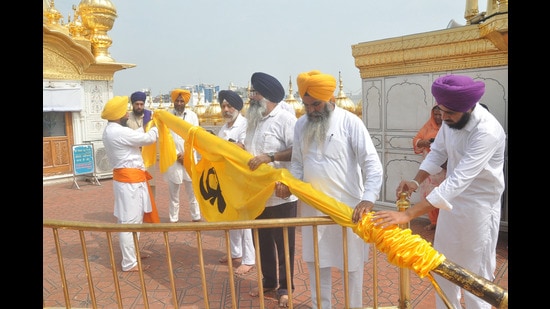
The Shiromani Gurdwara Parbandhak Committee (SGPC) on Friday changed the colour of Nishan Sahib in the Golden Temple complex from kesri (saffron) to basanti (xanthic), days after the Akal Takht issued an edict in this regard.
Before starting the process, ardas (Sikh prayer) was performed outside Gurdwara Jhanda Bunga where the historic twin Nishan Sahibs, symbolising Miri-Piri (a concept which means religion and politics go together in the Sikh faith), are hoisted. The attire of these Nishan Sahibs was changed after which that of the Nishan Sahibs on top of the sanctum sanctorum and the Akal Takht building were also replaced.
The Rumala Sahib (clothes on Guru Granth Sahib) and Chandoa Sahib (a sort of a canopy made of highly decorated cloth for the Guru Granth Sahib) used on Friday morning at highest Sikh temporal seat were also basanti in colour.
During a meeting of Panj Singh Sahiban (Sikh clergy) on July 15 at the highest Sikh temporal seat, a resolution was passed amid confusion over the colours of the Nishan Sahib. The SGPC was directed to end this confusion in light of Panth Parwanit Sikh Rehat Maryada (Sikh code of conduct approved by the community), as per which the Nishan Sahib can have either basanti or surmai (grayish blue) colour.
In compliance with the decree, the SGPC authorities issued a circular to the gurdwaras managed by it and religious preachers to create awareness about it among the community. “Every Sikh should obey Akal Takht Sahib’s edict. All gurdwara committees should comply with it as this is maryada of Khalsa,” said SGPC secretary Partap Singh.
The process of changing the colour of the Nishan Sahib in other gurdwaras is going on. This practice is being termed as restoration of the original colour that was used in old times.
While most of the gurdwaras have kesri-coloured Nishan Sahib presently, the gurdwaras managed by Nihang groups and their chhavnis (cantonments) have it in surmai colour.
A section of the Sikh community has been asserting for a long time that the kesri colour is not the original one of Khalsa (the core section of Sikh community) and it should be replaced with the ones mentioned in the maryada.
While most of the Sikh organisations and gurdwara managements have welcomed the move, a few quarters of Sikh seminary Damdami Taksal expressed disagreement. Amrik Singh Ajnala, head of a Taksal faction, opposed it while Baba Banta Sahib, a noted Sikh preacher owing allegiance to Taksal, said in a social media post that they would follow the Akal Takht edict but acceptance of Kesri should also be considered.


