Around 40,000 electricity department employees on Thursday began a three-day strike against the entry of a private power distribution company in Gurugram and Nuh, leading to disrupted supplies in several residential and industrial areas due to unattended breakdown complaints.
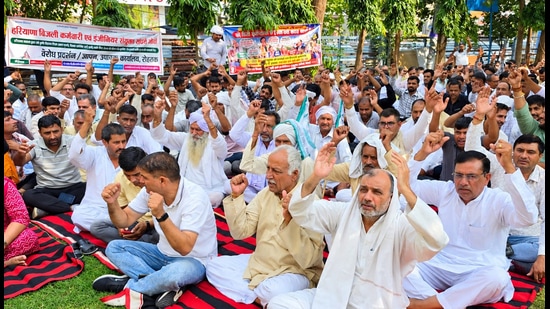
The Haryana Electricity Employees and Engineers Joint Struggle Front called for a three-day strike after the state’s power sector regulator, Electricity , on October 19 granted a licence to a private company to supply electricity in Gurugram and Nuh districts along with the existing state-owned discoms.
The impact of the strike was particularly severe in urban areas and industrial feeders, where outages disrupted household water supplies, office work, and students’ preparations for competitive examinations. The strike, called from October 22 to 24, began at 10pm on Wednesday.
The employees have warned that they will not attend to routine breakdowns during the agitation, raising concerns over the restoration of supply wherever technical faults occur. With a large section of the workforce joining the agitation, several 33-kV and 11-kV feeders suffered breakdowns.
Also read: Power restored in many parts of Gurugram after strike over private licence triggered blackouts
Unions and farmers’ organisations extend support to agitation
{{/usCountry}}Also read: Power restored in many parts of Gurugram after strike over private licence triggered blackouts
Unions and farmers’ organisations extend support to agitation
{{/usCountry}}Meanwhile, constituent organisations of the Samyukt Kisan Morcha, the Sarv Karamchari Sangh Haryana and several trade unions, including CITU, AITUC, INTUC, and AIUTUC, extended their support to the strike and staged demonstrations at various locations across the state.
In Rohtak, the district helpline had received 1,022 complaints by Thursday morning, while several villages reported power cuts and faults on urban and rural feeders. In Sirsa, however, officials claimed that alternative arrangements had helped limit the impact. Superintending engineer Ashutosh Kumar Panchal, posted in Sirsa, said staff from other departments had been deployed. Of approximately 900 feeders in the district, 30 were reported to be non-functional at the time of the assessment.
In Gurugram, residents of Sector 7 reported outages beginning Wednesday night, with exhausted inverters, disrupted water supplies and internet connectivity problems.
In Charkhi Dadri district, the closure of Sanjarwas and Ghasola power houses and faults on 11-kV lines affected electricity supply to dozens of villages. Kurukshetra also witnessed significant disruption, with power cuts affecting nearly half the city, according to local reports.
Also read: Power supply hit in Gurugram, Faridabad and Nuh as workers strike over privatisation
State activates contingency arrangements
The state government has activated contingency arrangements to maintain essential services during the strike. The Uttar Haryana Bijli Vitran Nigam (UHBVN) deployed senior engineers from its Panchkula headquarters to monitor operations across Haryana.
Meanwhile, the power utilities have also restricted leave for employees and directed personnel deployed in different areas to report for duty. In Kaithal, police personnel were seen handling complaints at electricity offices, while private contractors were being used to repair faulty feeders.
Also read: Gurugram on outage alert ahead of power workers’ strike
Saini appeals to power staff to call off strike
Meanwhile, chief minister Nayab Singh Saini held a review meeting with senior officials ahead of the strike and appealed to them to call it off, assuring them that the government stood with them and that the doors for dialogue remained open.
The strike has been called in protest against the HERC’s decision to grant a 25-year parallel electricity distribution licence to Eleven Power Private Limited for Gurugram and Nuh districts.
The employees’ unions have described the move as indirect privatisation and argued that it could undermine the state-owned power utilities, threaten employees’ interests and increase the financial burden on consumers.
Jagdish Nirala, legal adviser to the protesting Front, alleged that the government was pursuing privatisation through the back door. He claimed that handing over distribution in high-revenue areas to private companies could adversely affect consumers and farmers who depend on affordable electricity.
The state government, meanwhile, has announced that it will challenge the HERC decision before the Appellate Tribunal for Electricity (APTEL), seeking a stay on the order.
Also read: Indian states seek extra power to avoid outages as nighttime supply tightens, officials say
Vij calls strike unnecessary, says govt too seeks stay on licence order
Haryana energy minister Anil Vij termed the three-day strike by electricity employees unnecessary, saying the state government was challenging the HERC’s decision before the APTEL.
Vij said the government had strongly opposed the licence before the regulator by engaging a senior lawyer but the decision went against it. He maintained that HERC was an autonomous body and the government had not invited applications for privatisation.
INLD demands cancellation of HERC’s parallel power distribution licence
Former Haryana finance minister and INLD patron Sampat Singh also criticised the BJP governments at the Centre and in Haryana for pursuing with privatisation.
Demanding immediate cancellation of the licence, Singh urged the CM to invoke Section 108 of the Electricity Act, 2003, to issue a written policy directive in the public interest. He termed the government’s proposed appeal against the HERC order a diversion from the need for immediate intervention.