
 E-Paper



Overcrowded Haryana gaushalas await funds & fodder
Since 2014, the number of stray cattle in gaushalas increased to over 5 lakh from 1.75 lakh, while the number of shelters increased from 215 to over 700. Gaushala committees generally depend on donors to meet their daily expenses of upkeep and fodder.


Funds, fodder, shelter, land, and salaries of staff are among the major challenges faced by most of the gaushalas (cow shelters) in Haryana. With the number of stray cattle swelling every year, many gaushalas are struggling for space.

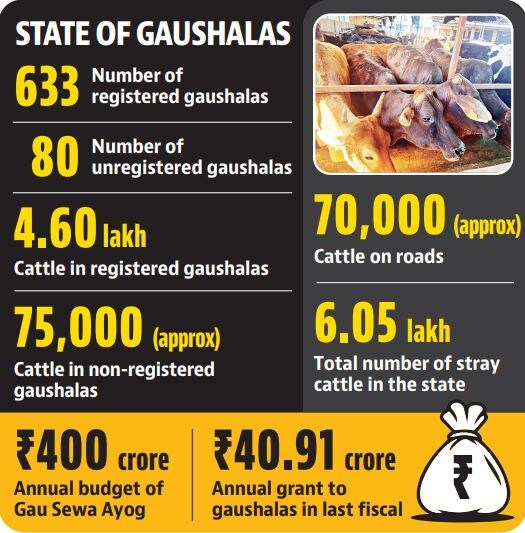
The total number of stray cattle in gaushalas in the state has seen a three-fold jump in the last five years. There are over 713 gaushalas in the state as per 2022 figures, including 633 registered. But these gaushalas are still not sufficient to accommodate all the stray cattle. Most of them are overcrowded. As per an estimate, there are around 5.10 lakh stray cattle – including 4.60 lakh in registered gaushalas, while around 70,000 still roam free on the roads.
Around 50,000 stray cattle are brought to these cow shelters every year making it difficult for the gaushala committees to accommodate and take care of all the animals.
Funds, fodder a challenge
The Haryana Gau Sewa Ayog allocated a total of ₹25.92 crore to 562 gaushalas of the state which comes to around ₹4.61 lakh per gaushala. The gaushala staff members said that comes to around ₹600 per cattle and with around 4.62 lakh cows in shelters, the fund per cattle is not sufficient to provide basic facilities of fodder, medic and shelter to cows for one year.
“The number of stray cattle in our gaushala has increased to 2,200 from 1,800 in the past two years and now we don’t have space to accommodate more cattle as we need more land and sheds for them”, said Rajpal, manager of Shantivan Gopal Gaushala of Taraori of Karnal.
“The grants from the government are not sufficient even to pay the salary of staff and we depend on donations to meet our expenses which is around ₹1 lakh per day,” he added.
Gausamvardhan Act led to a rise
The population of stray cattle exploded after the BJP-led Haryana government passed the Haryana Gauvansh Sanrakshan and Gausamvardhan Act, 2015 which has increased the number of stray cows and oxen. The Act made cow slaughter and smuggling punishable with rigorous imprisonment of up to 10 years.
“In 2014, when the BJP government took over the state had only 1.75 lakh stray cattle in 215 gaushalas. But now the number of stray cattle has increased to around 6 lakh, and gaushalas have reached over 700, but still, around 70,000 cattle are on roads of the state”, said a senior functionary of the Haryana Gau Sewa Ayog, pleading anonymity.
Falling buffalo population
Dairy farming experts are of the view that the shift from buffaloes to cows has also led to a rise in the number of stray cattle as figures from the 2019 livestock census revealed a 24% decline in the buffalo population in the state. Another factor is that the low fertility rate among cows of foreign and cross breeds has led to people abandoning these animals faster as these are considered a liability once they stop producing milk. The situation is getting severe. In the Panipat district for example, where almost all the gaushalas are overcrowded, the number of cows and bulls has increased to over 25,000 in 33 gaushalas. After all this, around 4,500 cows are still on the roads in the district.
Even the officials from the Haryana department of animal husbandry and dairy are of the view that bulls are of no use since the introduction of tractors, and cows are abandoned after they fail to produce milk completing the reproductive life which is around eight years. The experts feel that while there is no ban on the slaughter of buffaloes, with the ban on cow slaughter the dairy farmers generally abandon the animal once it stops producing milk.
Even the government had introduced tagging the cows to track the record of the deserted animals but the initiative failed as farmers started abandoning the cows after removing the tags also tracking of tags of thousands of cattle is not practical, said the officials.
“Farmers abandon cows after they do not produce milk as upkeep of animals has become a costly affair thanks to an unprecedented rise in the prices of fodder”, said a dairy farmer Mukesh Kumar of Yamunanagar.
A 10-fold increase in budget
Haryana chief minister Manohar Lal Khattar has fulfilled his promise made at a state-level programme at Panipat earlier this month, by announcing a straight 10-fold increase ( ₹400 crore) in the annual budget of Haryana Gau Sewa Ayog.
Cow sanctuaries a solution?
Thrilled with the 10-fold increase in the annual budget, the Haryana Gau Sewa Ayog has a long list of plans to deal with the problems of stray cattle. “We are going to set up at least one cow sanctuary in every district and the state’s first will be opened in Panchkula. For this we will take Gaucharand land and if required more gaushalas will be set up but there will be no stray cattle on the roads,” said Sarwan Kumar Garg, chairman of Haryana Gau Sewa Ayog.
He said that they will also ensure that gaushalas are made self-reliant and a research centre is being set up in Panchkula to provide training to gaushala staff to generate income from cow dung and milk.
“A gaushala with around 2,000 cattle can generate around 2.5 crore bags of manure from cow dung annually, besides more options like biogas plants and products of cow dung to increase respect of cow”, he added.


