
 E-Paper



Paddy sowing: Punjab agri dept misses target to double area under DSR technique
Officials say the target was ‘exaggerated’ and ‘unrealistic’ as it was set without taking the ground realities into account

 Prefer HTon Google


Chandigarh : The Punjab agriculture department has failed to meet the target of doubling the area under the direct seeding of rice (DSR) technique for paddy sowing this kharif season against the last year’s 6-lakh hectare mark even as 90% of paddy sowing, including the aromatic premium variety basmati, is over in the state.
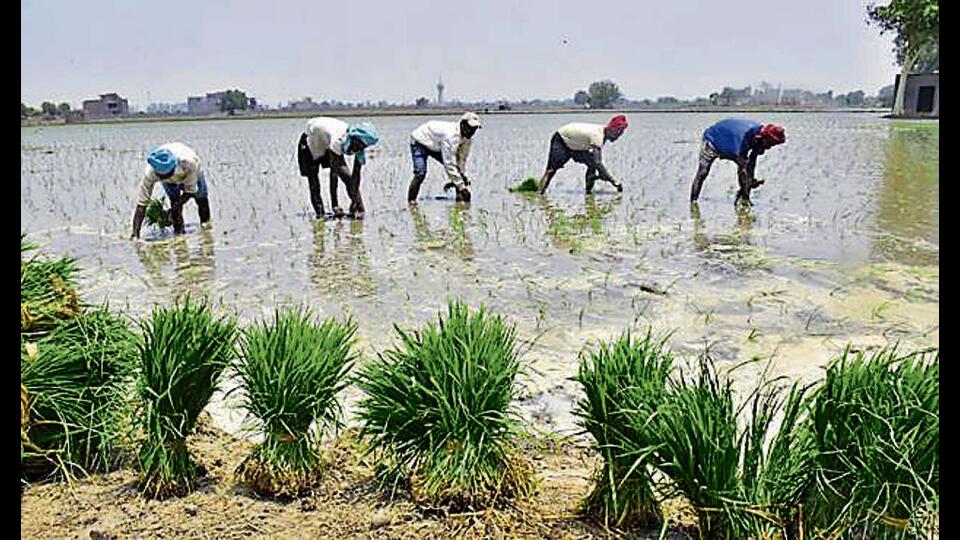
With DSR, paddy seeds are sown directly with machine. The agriculture department had fixed a target to bring 30 lakh acres (12 lakh hectares) of paddy under the DSR technique during current kharif season, but the unconventional method of cultivation could cover only 82,500 hectares in the state.
Experts, however, say the target was “exaggerated” and “unrealistic” as it was set without taking the ground realities into account. The larger area under the DSR was proposed to save subsoil water as experts say that with the non-conventional method, at least 30% water is saved. In the conventional method, a kilogram of rice guzzles 3,367 litres of water.
As per figures procured from the state agriculture department, the area under the coarse variety paddy that is sold by the state to the central pool on minimum support price (MSP) has touched 22.9 lakh hectares while area under basmati has touched 2.21 lakh hectares.
The data of the land cultivated under basmati in Muktsar, Barnala and Fazilka is yet to be compiled, but officials say it would be around 1.5 lakh hectares more than the last season taking the total to near 4 lakh hectares. The total area expected under the paddy cultivation in Punjab is pegged at 29-30 lakh hectares.
‘Farmers didn’t get adequate power supply’
Giving reasons for the low response to the DSR technique in the state, agriculture department director Gurvinder Singh said that during the peak time of sowing (through DSR method) in May-end and early June, farmers did not get adequate power supply required for irrigating their fields for “tar-watar”. Canals were also shut for repairs in parts of south and south-west Punjab.
Though the top management of state’s power distribution utility Punjab State Power Corporation Limited (PSPCL) differed, the agriculture department officials said that the mandatory six-hour supply for DSR sowing was not given, and the state government has allowed paddy sowing by non- conventional method in the puddle fields from June 15, when the power supply for eight-hour started.
“Despite best efforts to give extension services to the farmers, we were unable to reach out to all paddy growers in the state due to staff shortage,” said a state department official, requesting anonymity. The farmers, he said, were unable handle the problem of weeds in the paddy sown by the DSR method.
Last year’s DSR figures ‘fudged’
Agriculture department officials said the target for sowing paddy through DSR method was unrealistic. The department suggested Punjab CM Bhagwant Mann to double the area from last year’s 6 lakh hectares to 12 lakh hectares in the current season. “The last kharif season’s figures were fudged, as on July 27 last year, the area under DSR was shown as 6 lakh hectares, without taking into account the ground realities,” said an official.
Though the director agriculture refused to comment on the last year’s figures, he said the names of farmers, land cultivated with the DSR method and the location of the farm has been recorded to keep the figures genuine this year.
Rain boosts paddy cultivation
Rain over past one week has helped boost paddy transplantation in the state. “Almost entire state has received rain by now and we expecting a good monsoon season for a few weeks from now,” said Manmohan Singh, director of the state meteorological department.
Meanwhile, agriculture minister Kuldeep Singh Dhaliwal will meet the department officers to take stock of kharif season crops, including quality control for pesticides and agro-chemicals, procurement of green gram and area under paddy cultivation with DSR method, across districts of the state.


