E-Paper



Punjab logs nearly 70% farm fire spike in a week
The cumulative count of 174 incidents is 48 higher than the count during the corresponding period last year, according to the figures provided by the Punjab Pollution Control Board (PPCB)

 Prefer HTon Google


Punjab recorded 51 stubble-burning incidents in the past 24 hours, the highest single-day count of the paddy harvesting season so far, taking the season’s tally to 174 as of October 13, according to the latest report of the Commission for Air Quality Management (CAQM).
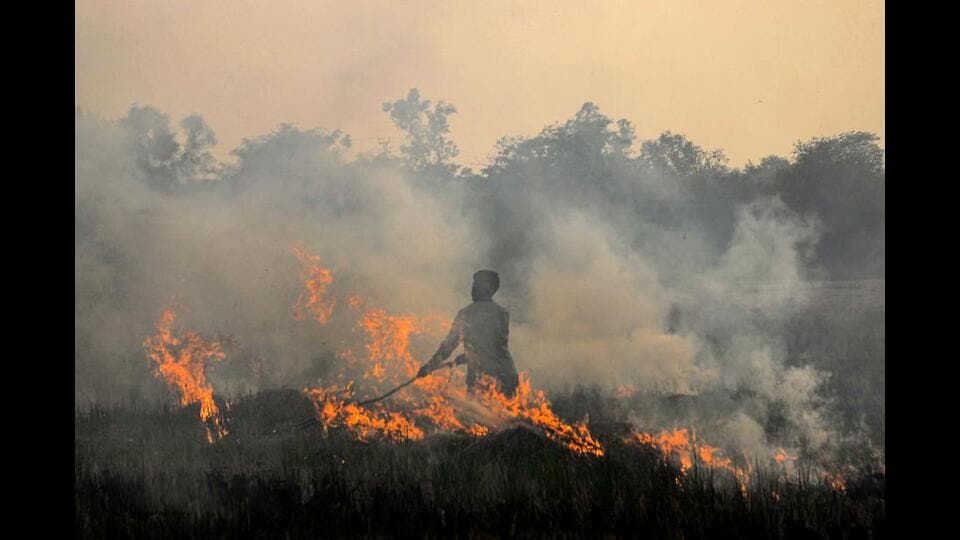
The cumulative count of 174 incidents is 48 higher than the count during the corresponding period last year, according to the figures provided by the Punjab Pollution Control Board (PPCB). Punjab had recorded 126 farm-fire incidents by October 13 last year. The state had crossed the 100-incident mark on October 8.
District-wise data showed that Amritsar and Tarn Taran accounted for the bulk of the incidents reported so far this season. Amritsar recorded 77 cases, while Tarn Taran reported 61, taking their combined tally to 138. Ferozepur reported eight incidents, followed by Gurdaspur and Muktsar with five each. Moga, Patiala and Sangrur recorded three incidents each. Most incidents have been reported from districts where early-maturing paddy varieties have been sown. In several districts and areas, harvesting is yet to begin.
The districts of Barnala, Bathinda, Fatehgarh Sahib, Ludhiana, Mansa, Pathankot, Rupnagar and Malerkotla reported no incidents as of October 13, the report said.
The farm-fire tracking period begins on September 15 every year, with paddy procurement starting on October 1. Last year, the state recorded 5,114 cases of stubble burning, down from 10,909 in 2024.
Stubble burning is considered a major contributor to pollution in northwestern India and the Delhi-National Capital Region (NCR). Multiple studies have suggested that farmers tend to set their fields ablaze after 3pm to evade satellite detection, prompting the government to call for intensified ground-level monitoring.
Air quality in Delhi and the NCR starts worsening from mid-September, with stubble burning contributing to the onset of winter pollution. Smog chokes the Capital every winter. Fireworks during the festive season, especially around Diwali, further worsen the situation despite restrictions that are violated every year.
The spike in farm fires comes a day after Union environment minister Bhupender Yadav, at a joint review meeting on Tuesday, stressed the need to intensify ground monitoring and enforcement to prevent stubble burning, particularly fires set after 3 pm.
Yadav called for special focus on Sangrur, Tarn Taran, Amritsar, Patiala, and Gurdaspur in Punjab, and Kaithal, Karnal, Kurukshetra, Ambala, and Fatehabad in Haryana to assess crop-harvesting trends.
States have started deploying drones for the first time to monitor stubble burning in real-time. In July, the CAQM issued a standard operating procedure (SOP) and framework for using drones in Punjab, Haryana, Uttar Pradesh and Rajasthan this winter to detect crop-burning incidents.
28 red entries, 16 FIRs registered
The enforcement data showed that field inspections had been conducted in 121 of the 174 reported cases, and crop burning had been physically verified at 48 sites. Environmental compensation (EC) was imposed in 44 cases, with a total of ₹2.30 lakh levied. Of this, ₹1.15 lakh had been recovered as of October 13.
The report also highlighted action against those involved in stubble burning. A total of 28 red entries had been made in farm records, while 16 FIRs had been registered under Section 223 of the Bharatiya Nyaya Sanhita (BNS).
Meanwhile, 42 warning or show-cause notices had been issued to nodal and supervisory officers in connection with the monitoring and enforcement of measures to curb field fires. However, the report recorded no suspensions or prosecutions of nodal or supervisory officers under Section 14 of the CAQM Act.