
 E-Paper



Punjab’s progressive farmers offer hope, shun paddy stubble burning
Hindustan Times profiles some such farmers who have not only bucked the trend but also succeeded in initiating the beginning of the end of the malpractice.

 Prefer HTon Google


It’s that time of the year when Punjab is again grappling with the problem of paddy crop residue burning and resultant poor air quality index (AQI). Yet, some progressive farmers of the agrarian state have stood up for the cause of the environment and steered clear of stubble burning by adopting in-situ management techniques. Hindustan Times profiles some such farmers who have not only bucked the trend but also succeeded in initiating the beginning of the end of the malpractice. Here are their accounts and benefits reaped from managing paddy waste, including improved soil health and input cost cut.
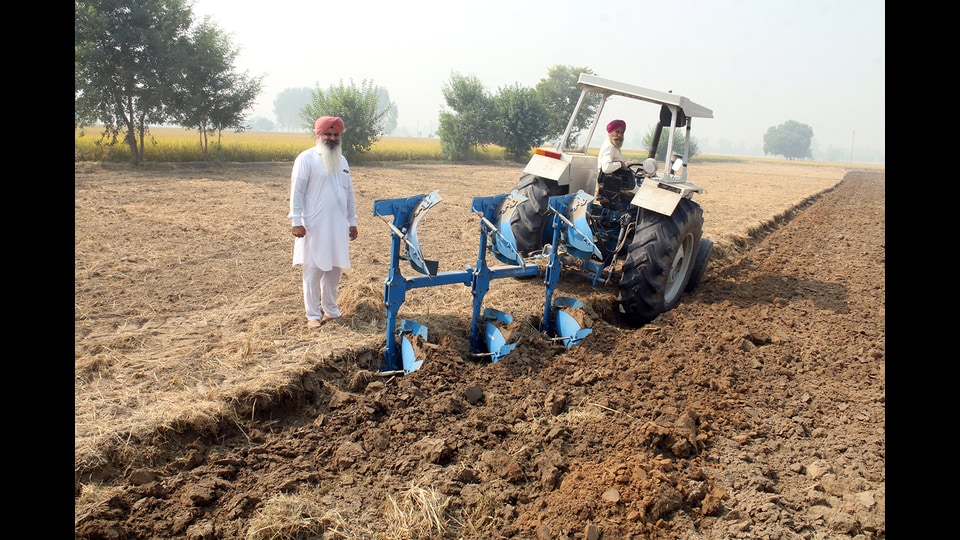
Smart seeder game changer for Bathinda village
For 47-year-old progressive farmer Sukhpal Singh from Gobindpura village in Bathinda, in-situ management of paddy waste has turned out to be a game changer as it not only improves soil health but also reduces farm input cost.
A graduate, Sukhpal Singh sows rabi crops of potato and wheat after harvesting paddy in his 40-acre field. An enterprising farmer, he works in association with the state agriculture department to encourage growers to adopt environmentally friendly ways to manage paddy residue.
“When I took to farming on my ancestral land two decades ago, I started looking for an alternative to the then prevalent practice of burning crop waste. Back then, there were fewer implements and a lack of awareness about residue management. I stopped burning organic waste completely in 2008. I believe in conserving ‘mittar keet (friendly insects)’ that protect the crop,” he says.
He sows non-basmati varieties of PR 131, CR 212 and PR 126 and uses paddy stubble for mulching. Mulching involves the use of decaying stubble, barks and leaves to cover the ground, enriching the soil and insulating it from temperature variation. “After harvesting paddy, I cover the field with the residue. This technique has led to increased yield of rabi crops,” he says.
Sukhpal Singh uses the smart seeder, a farm machine that manages paddy residue by incorporation and surface mulching. The machine, which offers the benefits of both the Happy Seeder and Super Seeder, has been provided by the agriculture department.
In 2023, the average paddy yield from Sukhpal Singh’s field was 22 quintals an acre, while other farmers in the area managed to reap only 14 quintals due to inclement weather.
“Besides, mulching retains soil temperature and boosts plant growth. Against the average use of 180kg of urea an acre, my field needs 100kg due to the in-situ paddy residue management. Similarly, I use 110kg urea per acre, half of what other farmers use in paddy fields,” he says.
A sizeable number of farmers of Gobindpura have now taken a cue from Sukhpal to manage crop residue.
Sharing tech to empower marginal farmers
Six years after switching from cotton to paddy, Malkeet Singh, 55, is helping 50 farmers from his arid village of Gehri Devi Nagar and four adjoining rural areas in Bathinda district to shun the practice of burning crop residue.
Malkeet, who had a stint in teaching social science in schools in the ’90s, is a member of a group of seven resourceful villagers that joined hands to buy farm implements in 2018.
“We have a chopper, a mulcher, a Happy Seeder and a zero drill that we use for managing paddy residue in our fields and sow wheat with ease. These implements can be used with a 50-horsepower tractor. We ensure not a single straw is burnt,” he says.
Malkeet grows paddy on 16 acres that is a joint family holding. Another two acres are used to grow cotton. Wheat is the only rabi crop he sows.
“Earlier, cotton was the main kharif crop but over the years, we faced losses and were forced to shift to paddy. The soil in our area is sandy. Mulching residue helps in growing paddy with lesser water and lower requirement of urea and pesticides,” he says, pointing to sand dunes in the village.
He admits that in-situ paddy residue management is challenging for a marginal farmer. “Farmers with land holdings of less than five acres cannot afford to buy these implements to manage crop waste. Our group volunteered to share our implements with 50 farmers for free at Gehri Devi Nagar and four adjoining villages for managing paddy stubble on about 400 acres,” he says.
Bathinda chief agriculture officer Jagsir Singh says Malkeet Singh is a role model in the drive against stubble-burning and hopes this season, more farmers will follow suit.
With Happy Seeder, he keeps 7-year vow
Nazar Singh, 63, from Balipur village in Patiala district had a change of heart in 2017. A graduate, he has been managing paddy stubble in his 10-acre farm without burning it ever since. “Air pollution is a concern, and I didn’t like the fact that I was contributing to it by burning stubble. I decided to use in-situ machines seven years ago and there’s been no looking back,” he says.
He uses the Happy Seeder to simultaneously pulverise the paddy stubble into the soil and sow wheat, saving time and money. “When stubble is burned, the soil loses significant nutrients. The Happy Seeder enables in preparing the field for wheat sowing immediately after the paddy harvest,” he says.
The Happy Seeder is a tractor-mounted machine that cuts and lifts paddy straw and sows wheat in a single pass. It drops the straw back as mulch, thereby conserving water and preventing the growth of weeds.
By farming without burning stubble, Nazar Singh has been able to cut down fertiliser use by 50% and reap a better harvest. Incorporating the stubble in the soil not only reduces weeds but also enhances the soil’s water-retention capacity.
“I plan to stop using chemical fertilisers in the next few years and urge all farmers to adopt stubble management practices to boost soil fertility and secure the environment for future generations,” he adds.
Sustainable farming enriching experience
Amarinder Singh, 44, from Khakata Khurd in Patiala district, has been effectively managing paddy straw in his 19-acre farm for six years.
Incorporating paddy stubble back into the soil, he says, is akin to adding ghee to food as the practice enriches the soil and next crop yield. “In-situ management of paddy straw has improved soil fertility and reduced dependency on chemical fertilisers. It has strengthened the wheat crop, protecting it from strong winds and enhanced the soil’s ability to retain water,” says Amarinder Singh.
By choosing in-situ techniques of mulching and Happy Seeder to mix stubble back into the soil, he has seen significant benefits. “Mulching is cost-effective and requires minimal machinery. After six years, I can confidently say input costs have decreased and yields increased,” he says.
He has received recognition from the Patiala district administration for his commitment to sustainable farming.
An advocate of rainwater harvesting, he has built a 100-ft-wide and 15-ft-deep pond on his farm to collect and store rainwater, reducing reliance on groundwater for irrigation.
Doaba farmer leaves it to balers to bail him out
It’s been a decade since Sukhdev Singh Atwal, 54, of Jalandhar’s Charhake village has been getting balers to clear his 35-acre field of paddy crop residue after harvest.
“I simply contact those involved in making stubble bales with the help of big machines. They earn profit by selling the bales to nearby sugar mills and power plants and in return, my fields are cleared for free and ready for ploughing,” Atwal says.
Asked why he never thought of making bales of his own, he says it would’ve incurred the cost of buying and running the machine and eventually selling the bales to stakeholders, while now he was getting the job done for free.
Atwal follows a three-crop cycle as after harvesting paddy varieties that mature in 90 days, he sows potatoes before going ahead with wheat sowing in December. “The removal of paddy stubble with the help of balers saves a lot of money on diesel and labour for potato sowing. Earlier, I had to plough fields five times to prepare land for potato cultivation but now only two rounds are enough,” he says.
“Seeing my environment-friendly and no-cost model of getting the field cleared, farmers have started contacting baler owners after paddy harvesting,” he says.
On the reluctance of farmers to go in for in-situ management of paddy straw, Atwal says it is because results start coming after three years of stopping stubble burning.
“Earlier, I used to harvest 17-18 quintals of wheat per acre but the output has now gone up to 23-24 quintals due to improved soil nutrition,” he says.
Though he does not charge the balers for clearing his field, he says a farmer can earn up to ₹4,000 from the stubble per acre as 25-35 quintals of residue are produced in an acre and biomass plants buy stubble bales for ₹130- ₹150 a quintal.
Yield up after giving up stubble burning
Gurdev Singh, a 42-year-old farmer from Bhoewali village of Amritsar district, has experienced better crop yield since he has taken up eco-friendly methods to manage paddy straw. “In a joint family, my brother and I own 10 acres of land and we till 12 acres on lease. This year, we sowed basmati varieties on the entire land holding. Agriculture is our family occupation. I began taking it up in 1998 when I was student,” Gurdev said.
He never opted to burn stubble owing to its health hazards and damage to the soil and next crop. “I have been experimenting with all the eco-friendly methods of managing crop straw. Earlier, I used rotavator (machine). For some years, I have been using a Happy Seeder to mix stubble back into soil,” he said.
Gurdev said, “My experience suggests it increases the crop yield. Particularly, if the weather gets hotter, our fields see higher yields than those which see stubble burning.”
“Guidance of Amritsar’s incumbent chief agriculture officer (CAO) Tajinder Singh has helped me a lot in successfully adopting eco-friendly methods. Besides, I remained in contact with experts of Punjab Agricultural University in Ludhiana. I have been attending workshops, seminars and fairs of the department and university for a long,” he said.
Despite being an ordinary farmer, he has become a role model in his village. “With the passage of time, more than 60% farmers of my village have started following me and refrained from stubble burning,” Gurdev added.
He procures crop residue from others for his farm
A former Punjab agriculture officer, 63-year-old Sukhdev Singh of Chamyari village of Ajnala block of Amritsar district has dedicated his life to organic farming and practising eco-friendly methods of straw management. He has been discouraging people from burning stubble. He even takes crop residue from other farmers to use it as mulch in his fields as, according to him, it dissuades others from putting stubble on fire. He is known in the area for producing organic sugarcane crop and processing gur (jaggery).
“I own 13 acres of land. Since 1984, I have never burnt crop residue. I also don’t use pesticides and insecticides which are very dangerous to human health. This year, I sowed basmati on two acres. Wasting stubble is sin as it is good for soil health,” he said.
Sukhdev said, “I add turmeric to the paddy residue before mulching it in the soil. This method ensures almost double crop yield.” According to him, others termed him “mad” when he took up organic and eco-friendly methods in agriculture, but he silenced them by tasting success. So far, the 63-year-old has imparted training in organic farming to hundreds of farmers. ‘Gur’ processed by him is famous is in great demand, he adds.


