E-Paper



With 122.7 mm rain, Chandigarh logs wettest July day in 17 years
IMD issues orange alert for heavy to very heavy rain in Chandigarh on Sunday; cyclonic circulation, a strong Western Disturbance and the monsoon system causing the downpour

 Prefer HTon Google


The city recorded 122.7 mm rain on Saturday, making it the wettest July day in 17 years and also the wettest day of the year till now, as per the India Meteorological Department (IMD)
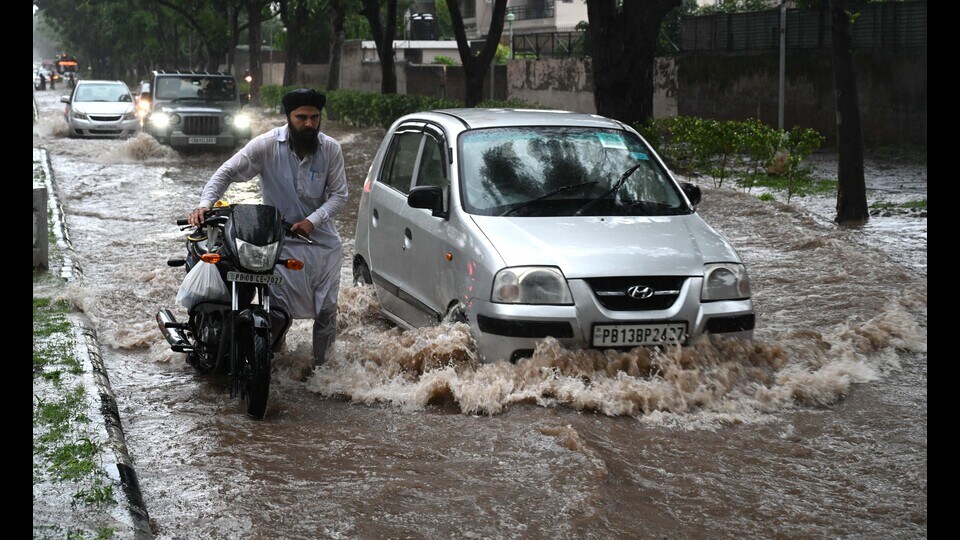
The only time it rained more in the month last was on July 26 in 2006, when Chandigarh received 142 mm showers.
A total of 23.3 mm rain was recorded till 8.30 am and another 99.4 mm rain till 11.30 pm.
Chances of heavy rain will continue on Sunday as well with a cyclonic circulation and a strong Western Disturbance (WD), along with the monsoon system, affecting the region.
IMD has also issued an orange alert for heavy to very heavy rain in the city for Sunday. Orange alert is the second highest of the four-level alerts issued by IMD. Under orange alert, residents are advised to stay alert and be prepared. The rain intensity will decrease from Monday onwards, but chances of light to moderate rain will continue.
Speaking about the rain on Saturday, AK Singh, who currently holds the charge of IMD Chandigarh director, said, “While the monsoon system has remained active, there is a strong WD in the region that primarily led to the showers on Saturday. Similar rain will continue on Sunday, but it is expected to slow down around night.”
The frequency of WDs decreases during the monsoon. Hence, as per Singh, it is peculiar that a strong WD has hit the region around this time of the year. “Climatology is changing. Even in May we saw very frequent WDs that was not common in previous years. WDs don’t behave in a predictable manner as the monsoon system,” Singh added.
A total of 300.1 mm rain has been recorded in July so far, which is still lower than 473.3 mm rain recorded in July last year.
Coldest July day since 2015
Because of the rain, the maximum temperature plunged from 34°C on Friday to 26.5°C on Saturday, 8 degrees below normal. This is the lowest that the maximum temperature has gone in July since 2015, when it was 25.5°C on July 12. At 26.5°C, this was the fifth coldest July day since IMD started keeping records in the city since the 1950s.
As per Singh, the temperature dropped due to the incessant rain. “Because the rain has cooled down the ground, we expect that the day temperature can dip further on Sunday if it rains during the day,” he said.
The minimum temperature also went down from 26.2°C to 25.6°C, one degree below normal. In the next three days, the maximum temperature will remain between 27°C and 32°C, and the minimum temperature between 24°C and 25°C.
Two men rescued from Sukhna Lake
Two youths were rescued from the regulatory end of Sukhna Lake near Kishangarh on Saturday evening after they fell into the water amid the rain.
Police said the youths, Amit Samwal, 25, and Sumit Ramola, 25, hail from Uttarakhand, but currently live in Sector 24 and Nayagaon, respectively.
While Amit is a student, Sumit works as a wedding planner at a hotel in Sector 35. They told the police that they were sitting on the lake’s bank, when sand caved in.Their friend informed the PCR, following which police rescued the duo. They were given first-aid at GMSH, Sector 16.
Sukhna Lake’s water level nears danger mark
Sukhna Lake’s water level went up to 1161.70 feet around 9 pm on Saturday, just a notch lower than the danger mark of 1163 feet. As per the UT engineering department officials, due to heavy rains in the lake’s catchment area, one of the floodgates of the lake may be opened soon. Last year, the floodgates were opened as many as four times even before the water level had hit the 1163 feet mark to keep the situation under control.
Meanwhile, as the water level of Kaushalaya Dam in Pinjore breached the danger mark of 1,568 feet, its gates were opened on Saturday night.
Landslide blocks Chandi Mandir-Morni Road
The road connecting Chandi Mandir and Morni was blocked owing to a landslide that caused a part of the road to cave in. The authorities pressed a JCB machine to remove the boulders that came tumbling down the hill, blocking the road. A tree collapse near Bhuri village also blocked the road between Morni and Panchkula for a few hours. The villagers removed the tree to restore traffic on the road.