
 E-Paper



Revisiting Golden Temple 40 years after Op Bluestar
Time heals wounds but scars remain, finds HT’s Surjit Singh as he tracks change at the Golden Temple complex in Amritsar over the past four decades since the army action in June 1984.

 Prefer HTon Google


The first week of June this year marks the 40th anniversary of Operation Bluestar and the Akal Takht, the temporal seat of the Sikhs, has called for observing the sombre occasion on a large scale. Exactly four decades ago, the army action to flush out Sikh militants, led by then Damdami Taksal chief Jarnail Singh Bhindranwale, from the Golden Temple complex in Amritsar turned an inflection point in Punjab’s history, triggering a chain of violent events, including the assassination of then Prime Minister Indira Gandhi on October 31, 1984, the anti-Sikh riots and the dark decade of militancy.
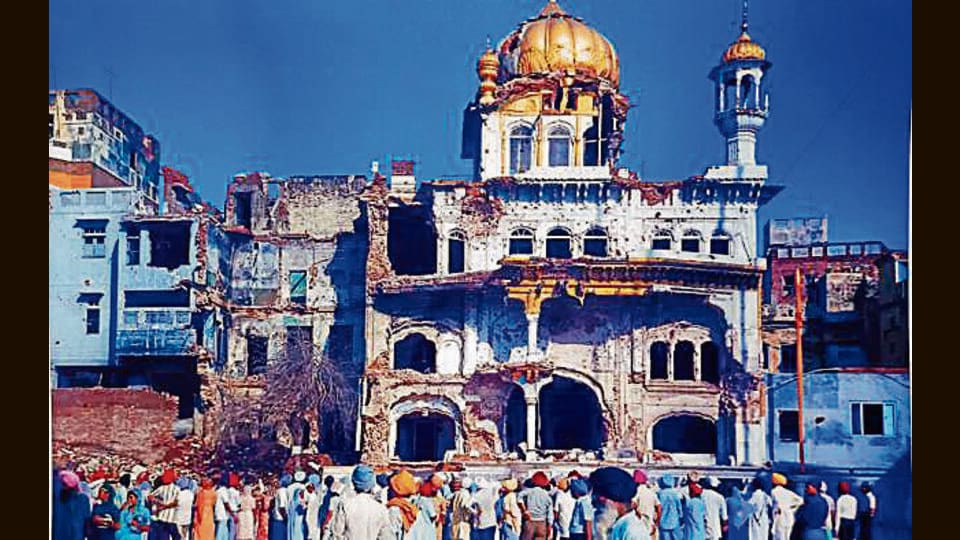
All while the 16th century shrine bore mute witness to irreversible change with several buildings, including the one housing the Akal Takht, significantly damaged and structures attached to it razed. It was only after the Sarbat Khalsa (grand Sikh assembly) in 1986 that the Akal Takht building was rebuilt through kar sewa (voluntary service).
Since the Golden Temple was surrounded by narrow lanes and markets, a galliara (corridor) project was introduced in 1988 after the remaining pro-Khalistan Sikh militants were cleared from the complex under Operation Black Thunder. Under the project, the central government acquired and razed the bazaars and buildings adjoining the shrine complex with the aim to build a corridor with a green belt around. The work came to a halt when militants assassinated an engineer and was resumed only after the Beant Singh-led Congress government took charge in 1992.
Buried in history
Sikh scholar Davinderpal Singh, age, recalls: “There used to be markets, such as Bazaar Manyara, Katthian Wala Bazaar and Darbar Da Chowk, near the Akal Takht Sahib. There was even a big publishing market called Bazaar Mai Sewa. The galliara scheme destroyed all of them.” Davinderpal’s family has been running a Sikh literature shop for about a century outside the shrine.
A former information officer of Golden Temple and veteran columnist, Narinderpal Singh, age, recalls how Shaheed Market near Gurdwara Baba Atal Rai Sahib was lost to the galliara project. “The Shiromani Gurdwara Parbandhak Committee was able to bring Gurdwara Shaheedi Asthan Baba Gurbaksh Singh and Gurdwara Thara Sahib within the Golden Temple complex. Doors of these gurdwaras opened in the complex and rooms were built for carrying out Akhand Path,” he says.
Davinderpal recalls how before the galliara project was executed, a small market was situated where the Akal Takht secretariat stands today. “The deori (entrance) towards it was not opened. Recently, while digging to build the jora ghar (shoe store) and cycle stand in the area, the remains of Bunga Gianian Da, which was buried during the galliara project, was found. In 1984, the entrance of the Sangal Wala Akhara was situated in the Darbar Sahib complex only to be excluded after the project,” he says.
Repair and rebuilding
Sikh organisations, including the Birmingham-based Guru Nanak Nishkam Sewak Jatha, undertook the task of coating the sanctum sanctorum with fresh plates of gold. Work started in February 1995 and was completed in April 1999.
The damage to the Sikh Reference Library, a repository of rare manuscripts of Guru Granth Sahib and other Sikh scriptures, is an important chapter of the 1984 operation, during which the army took away precious articles. “In 2008, this library was expanded in terms of space, arrangements and number of articles,” says Bagicha Singh, the librarian.
In 1984, there was only two serais, Sri Guru Ram Das Niwas and Sri Guru Nanak Niwas. A small building of Akal Rest House, where activists of All India Sikh Students Federation (AISSF) set up a morcha during the operation, was adjoining the Sri Guru Ram Niwas. Since 1995, the SGPC has opened new serais. The Akal Rest House has made way for Sri Guru Arjan Dev Niwas, while the building of a small hospital and an office of the Akali Dal near Gurdwara Das Baba Atal Rai Sahib has been replaced with Sri Guru Hargobind Niwas. The SGPC took possession of the Shiromani Akali Dal (Amritsar) office and built the Mata Ganga Jee Niwas.
The Guru Nanak Niwas, where Bhindranwale and his aides camped before going to the Akal Takht building, has been merged with the SGPC office.
The Sri Guru Ram Das Langar, the world’s largest community kitchen, and its terrace from where Bhindranwale used to address his followers, has been expanded while retaining its heritage look.
Memorial to militant past
In 2013, the Damdami Taksal set up a memorial of Operation Bluestar in the form of a small gurdwara between Gurdwara Thara Sahib and the entrance of the Akal Takht secretariat. In its basement, a Shaheedi Gallery was set up by the Sikh seminary to display portraits of Sikh militants.
During the artillery action, the twin towers of the historic Ramgarhia Bunga in the complex were damaged. In collaboration with Ramgarhia Sikh associations, the gurdwara body has restored one of the bunga, making it the centre of attraction these days.
A concrete shelter has been built at the historic Manji Sahib, while its diwan hall, where gatherings of Akalis were held during the Dharam Yudh Morcha, has been extended.
Heritage Street and tourism
In 2016, the Shiromani Akali Dal-BJP government’s Heritage Street between the Town Hall and Golden Temple was completed. A dream project of then chief minister Parkash Singh Badal, it was built at a cost of ₹160 crore and has emerged as a tourist attraction. The street lined with shops in uniform, red sandstone facade opens to a white marble expanse on the Ghanta Ghar side of the shrine. An interpretation centre has been set up by the Punjab government in the basement. The design of the entrance has been changed and its dome gold-plated by kar sewa. Sikh scholars termed it a distortion of the standard design.
With the growing footfall of tourists, hotels and guest houses have mushroomed in the vicinity of the Golden Temple complex, many in violation of norms, adding to the burden of amenities in the area.
Bullet marks bear testimony
The Khajana Deori on right side of Akal Takht is the lone untouched structure in the complex. The bullet-riddled bricked palki on the top bears testimony to the onslaught of the operation 40 years ago.
The Teja Singh Samundri Hall, which houses the SGPC headquarters, was also left untouched with bullet marks on its façade serving as evidence in the ₹1,000-crore suit filed by the SGPC in the Delhi high court against the military action. The building was renovated in 2016 but the bullet marks were protected with metallic cases.
The bullet marks on Darshani Deori are also preserved.
Guru Granth Sahib’s holy saroop, which was enshrined in the sanctum sanctorum during Operation Bluestar and received a bullet of security forces, is put on display on the operation anniversary. Besides, gold sheets that were removed from the Golden Temple during renovation and carried bullet marks have also been preserved.
“This is necessary to create awareness among coming generations about what happened with the community in the past,” says SGPC president Harjinder Singh Dhami.


