
 E-Paper



Roundabout: Meandering memory lanes of Malerkotla
Much has been said about the city of Malerkotla since the CM announced the creation of a new district; without going into the political implications, one looks back at this quaint town, which has many stories waiting to be told in its lanes and by-lanes


One has to begin somewhere and when it comes to the lore of Malerkotla, a city established in 1454 AD by Sheikh Saradruddin-i-Jahan of Afghanistan and ruled by his Sherwani descendants, I choose to begin with the narrative of a community theatre artiste late ‘Mast the Bhaand’ — a popular performer in a left-wing theatre group in Barnala who had many admirers through the 60s.
What follows was recounted to me by a dear friend Manmohan Sharma — a theatre technique the reminiscent of the Mirasi-bhand tradition of feudal Punjab, used with great finesse!
“I was out in the fields to bring home some fodder when Gaindarh Singh came running. “Hey you buffoon!,” he shouted at me, “You are making merry in the fields here, and out there, in Sirhind, the two younger sons of our 10th Guru are being bricked alive!”
Hearing this, my heart sank and we made our way to Sirhind. Hundreds of people had assembled there, in the city that was being swept clean, and spent the night awake.
“Next morning, the durbar assembled and the two Sahibzadas were brought there. What do I tell you, the older one was just like our Pappu, the landlord’s son, who studies in the English school, and the younger one so like that tubby little Gholu in the village. The Sirhind-wala Nawab asked them to change their faith and they would live. Even before the older one could speak, the younger one cried out, “We will not change our faith.”
Puffing with rage, the Nawab ordered that the two children be bricked alive. At this the Malerkotla-wala Nawab got up and raised his voice: “This is unjust!” I too raised my arm and cried out: “It is absolutely unjust!”
Island of peace
It is this protest of the Nawab of Malerkotla that was to forever endear the Sherwani dynasty of the town to the Sikhs, which is why the Sikhs, Hindus and Muslims have lived here without a single act of violence during the holocaust of the Partition and the days of militancy. Thus, enjoying special status as the volatile states ‘island of peace’!
In my long years in journalism as a roving correspondent of sorts there were many Punjab towns that I camped in doing stories but somehow, I never encountered the mystique of Malerkotla firsthand. In fact, the narrative of two writer friends of Samrala about Malerkotla made me feel that this was the city I must visit. During my many visits there, I learned from Punjabi fiction writer Mohammad Goria, who shared his birthplace with the great Saadat Hasan Manto in Papraudi village, now a part of Samrala town. He told me how his father, a simple unread oilman for a farmer was saved simply by moving to Malerkotla where Muslims were safe even in the blood-soaked times of Partition riots. Samrala poet Lal Singh Dil’s was a more colourful journey of unfulfilled dreams when he went to Malerkotla after covering to Islam to get a burqa made as he hoped that a Muslim girl would marry him.
The city of dreams
So, I was in the city of dreams many years ago when a publisher assigned me a book of essays on Punjab and I decided to open the book with the Malerkotla story. The journey began from Chandigarh to Fatehgarh Sahib with its picturesque gurdwara marking the place where the two Sahibzadas met their brutal end. Then a change of bus on a narrow road lined on the sides with shisham and kikar trees to Malerkotla. In Punjab, the modern exists side by side with the medieval. But that is not so strange for a country like India where Lord Rama of mythical fame can be resurrected so powerfully from myth.
All I had was the contact of a young Akali leader, Azad Siddiqui, born and bred in Malerkotla. He was jubilant that the Akalis were back in power, and he told me his rags-to-riches story. His father was a poor man who repaired bags, but he educated his son till Class 10 and now Azad owns a couple of shops, a school and heads several NGOs.
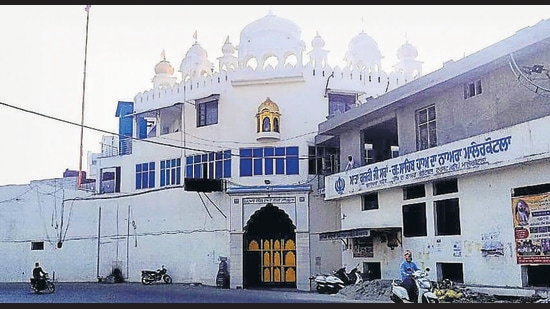
The next day, everything was laid out for me from Gurdwara Haa Da Naara where the Malerkotla Nawab protested against the inhuman deaths meted out to the young sons of Guru Gobind Singh, to a meeting with the elderly widow of the late Nawab of our times. I was provided literature aplenty on the Sherwani dynasty. And of course, the Dargah Hyder Shaikh in Malerkotla, which does not have as many devotees among the Muslim population as among the Hindus and Sikhs who visit it for wish fulfilment. But the bazaars of the city fascinate me with their exquisite zardozi embroidery as they make badges on contract for the police and the army.
Then a story unfolds of the celebrities the town has known from Dharmendra who worked as a tubewell operator and played badminton in colourful shirts. His pictures for the Bollywood Talent Contest were clicked at the local John’s Studio and boy didn’t he make it. And trailblazing in music is another Malerkotla boy, Irshad Kamil — a famous poet and lyricist who did his birthplace proud.
But one wish remains unfulfilled for when I ask Azad the Akali guide that I would like to have a glass of frothing malai milk in the bazaar, a speciality of the town, he rules it out. “We cannot take you there. It is not proper. This is a Muslim town and women stay in purdah.” So now I resolve that once the lockdowns end, I am going to Malerkotla sans a guide to have a frothing glass of malai milk in celebration of it now becoming as district and perhaps complete the book that is still not written!


