
 E-Paper



Roundabout: Nasser’s songs dance to the music of his soul
Born to a rich legacy of legends -- his father, a renowned freedom fighter, his uncle none other than the poet’s poet Majaz Lakhnavi, and Salman Akhtar and Javed Akhtar his first cousins, Nasser Harvani chooses to sing his heart out


The story of two legendary brothers, poet Majaz Lakhnavi and freedom fighter Ansar Harvani, began in the early years of the 20th century in Rudauli, a small town in the Agra and Awadh provinces of British India. They were born to a cultured and educated family of landowners, although not overly rich. However, their’s was a wealth of the proverbial courtesy and largesse of the Ganga-Jamuni ‘tehzeeb’ (culture) which believed in the togetherness of different religions, besides regard for keeping pace with the changing world through education.
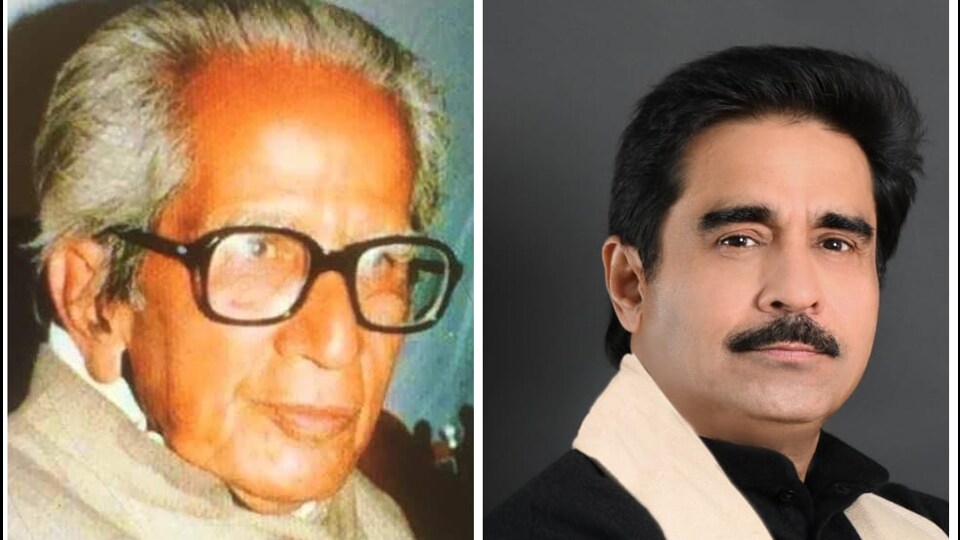
Majaz Lakhnavi was a legendary poet in his lifetime and more so after his tragic death at the age of 44 in 1955. Writing of romance and revolution, his verses are still embedded in the Indian hearts. His fan-following was such that university girls, it is said, kept his picture under their pillows even though they heard his oration and poetry in purdah in classrooms. It was Majaz who dreamt of a better morrow and gave it words, but it was his younger brother Ansar Harvani, who growing up midst of poets and writers, for his two sisters were authors of merit too, chose to become a freedom fighter, a close friend and confidant of Netaji Subhash Chandra Bose. A prominent student leader, he was able to draw fresh young blood into the ‘naara-e-azadi’ (cry for freedom). Starting his career as a vocal journalist, he went on to be elected as a parliamentarian thrice and authored significant books, published internationally. These include ‘Before Freedom and After’ and ‘Gandhi to Gandhi’.
Talking of his father, singer Nasser Harvani, who sings the song true, says, “He was a person of principles and had strongly opposed Partition of India. He was jailed for six years in his 20s and shared a barrack with Maulana Azad. Such were the values that made him.” As the youngest child inheriting his mother Gauhar’s sonorous voice, Nasser grew up in ‘Dilli ki Galian’, studying in St. Columba’s and then moving to Lucknow to complete schooling in La Martiniere. But soon after he returned to Delhi University to study history.
The quintessential romantic
But his true soulmate remained music. Talking of his musical journey, he says sans aplomb: “It just happened. I was singing on stage at school and then in college festivals and friends suggested that music was my calling”. His is a rich legacy from the lanes and legends of Lucknow and his favourite poets.
Ghalib, Meer, Firaaq and of course Faiz. Nasser recounts, “I grew up listening to some amazing singers like Mehdi Hassan, Ghulam Ali, and Amanat Ali. But one singer I was most influenced by and internalised was Mehdi Hassan. He was in a league of his own.” Then, adds this ever-young singer, handsome as they come, that to sing such melodies, one has to be a quintessential romantic!
Trained under Ustad Mohsin Khan for some years, he has sung for TV serials ‘Urdu shayari ki kaynaat’ and ‘Khak e watan’. He
performs regularly in India and abroad. His album ‘Saaf Kehdo’ on the poetry of Salman was received with great applause with its mesmerising couplet ‘Ishaaron se nahin suljhenge ye uljhe hue rishte, Tumhe mujhse mohabbat hai tou dekho saaf kehdo’ (Glances alone will not change entangled ties, if you love me, then spell it out). The two are now planning a second album together.
A soul of stage shows, Nasser is just as alluring with his sonorous voice singing the famous Majaz ghazal, a song long ago by Talat Mahmood, ‘Ai gham-e-dil kya karun’ sans musicians at a friend’s home with only a spontaneous tap of his pointed shoe and the tenor of his voice for percussion and casts a spell. To praise or applause, he humbly responds with the lines from Majaz: “Unka Karam hai, Unki mohabbat, Kya mere naghme, Kya meri hasti!” (It is all your bounty, your love, that makes me and my songs).


