
 E-Paper



Roundabout | Shimla hills resound with multilingual words
As the plains sweltered in the June heat, around 450 writers from across India and abroad were invited to a mountain getaway at the Unmesha Literature Festival at the revamped Gaiety Theatre Complex in Shimla


With around 450 illustrious littérateurs coming together for a grand literature festival in the Queen of Hills, one could not help but muse about the significance of the figure. Why 450 and not any other number? Is it a charmed number as far as numerology goes or did some revered swamiji in saffron robes suggest it? Turns out, it is the capacity of the newly restored British-era theatre, Gaiety.
Established in May 1857, the year most remembered for the First War of Independence, the Gothic-style theatre has inspired a number of poets, and storytellers over the years. It was only apt that the Unmesha Literature Festival, which was organised by the ministry of culture and Sahitya Akademi in Shimla as part of the 75-week grand celebrations to commemorate as many years of Independence, be hosted here.
The who’s who of the literary world made it to the festival, including the latest star on the literary horizon, Booker Prize-winner Geetanjali Shree.
Asked how apt it was to look at life afresh at 70, the author said her novel, Ret Samadhi, which is incidentally the first novel in Hindi to win the esteemed International Booker Prize, had made her to come alive, prompted her to take a fellowship, travel, and experience life all over again.
Storytelling, songs in cinema
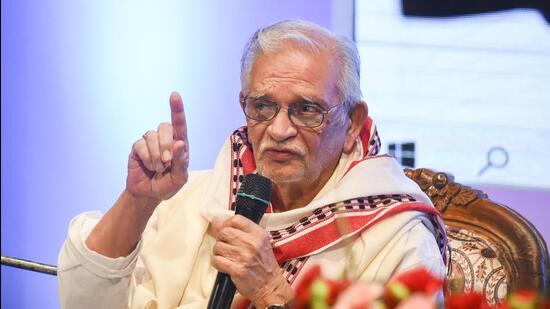
Arguably, one of the most appreciated sessions was the one featuring poet, filmmaker and lyricist Gulzar. The delightful jugalbandi between Gulzar and music director Vishal Bhardwaj made it all the more memorable. Gulzar, who started his innings as a lyricist with music composer SD Burman in the 60s, created contemporary masterpieces such as Chappa Chappa Charkha Chale’ and ‘Beedhi Jalaaile’. It was a treat to hear Gulzar speak about his lyrics, and Bhardwaj not just describe music, but also sing to the audience.
Sai Paranjpye, a well-known theatre director and filmmaker known for movies such as Katha, Sparsh and Chashme Baddoor, chaired a lively session on ‘cinema and literature’ with IRS officer Nirupama Kotru, well-known Gujarati poet and fiction writer Prabodh Parekh, poet and lyricist Prasoon Joshi and poet and cinema scholar Yatindra Mishra giving their valuable comments. What delighted the audience was Paranjpye, in lighter vein, posing a question to Gulzar when she spotted him in the audience. She declared that she was making it public that Gulzar had sought a fee of ₹20 per word to tell the meaning of the Urdu words she was using in Chashme Baddoor. Gulzar, who was asked to confirm or deny the same, playfully asserted: “I had even left a money order form, but the money never reached me!”
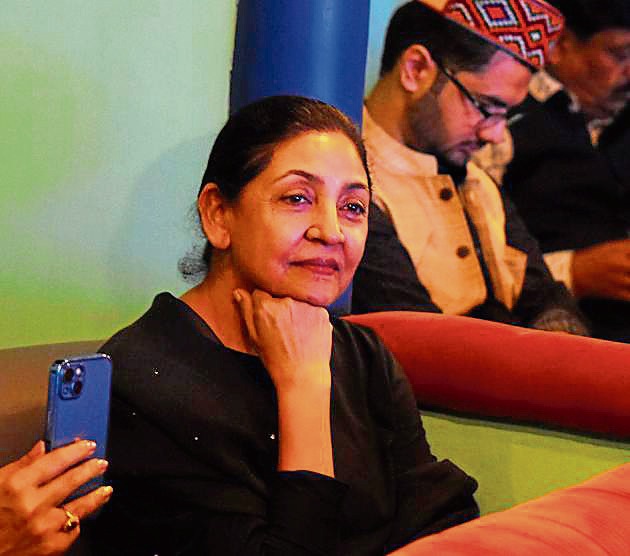
Remember the Chamko girl in Chashme Baddoor, who had charmed her way into the hearts of the people? She was none other than Deepti Naval! In a well-attended session, Naval, reflected on her journey as an actor, photographer, poet and storyteller. She also revealed that her new book on her memories from childhood will be released next month in Chandigarh. Set in Amritsar, her book is called. A Country Called Childhood.
Guru Nanak, Waris Shah & Gurdial Singh
Two interesting sessions were held on literary classics. In a session chaired by novelist Namita Gokhale, translator Nirmal Kanti Bhattacharjee, writer Paul Zacharia, translator Rana Nayar and author Srinath Perur held forth on classical gems of their choice.
Gokhale asked participants to name their three favourite classics and give reasons for their choice. Pertinently, Nayar, an avid translator of texts from Punjabi to English, had on his list Hymns of Guru Nanak, Heer by Waris Shah and Parsa by Gurdial Singh.He said, “My favourite quote on translation is by Italian writer Italo Calvino who says a classic is cultural text in which cultural memories resound.”He added that the three works he named from Punjab had been penned during the worst socio-economic and political times.
Renowned professor Harish Trivedi, too, gave a brilliant presentation on the theme, holding the audience spellbound as he explained what a classic meant to him.Multilingual poetry sessions were the mainstay of the festival, which dwelled on women’s empowerment, issues being faced by the LGBTQ+ , freedom struggle and literature.Cultural performances of dance and music led by celebrated veteran Sonal Mansingh held the audience in a thrall. All this in idyllic surroundings, the chaos and confusions were overlooked in the spirit of celebration.
nirudutt@gmail.com


