
 E-Paper



Stubble burning cases | Punjab starts making red entries in revenue records
Till October 7, Punjab has logged 692 cases of stubble burning, out of which over 62 were recorded on Friday alone. Most of the farm fires have been reported from the border belt of the Majha area. Amritsar tops the chart with 25 stubble burning cases so far. Once a red-entry is made, a farmer may not be able take a loan against the said land, mortgage it or sell it.


With stubble burning cases rising in Punjab, the state revenue department has started making red-entries in the revenue records of farmers indulging in the illegal practice.
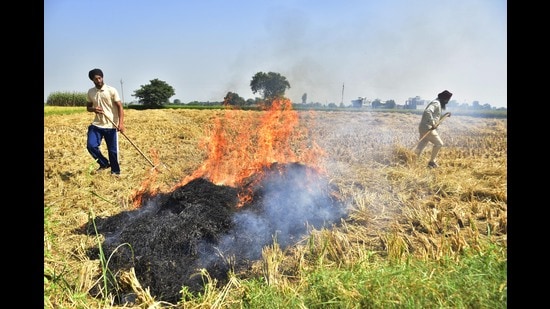
Once a red-entry is made, a farmer may not be able take a loan against the said land, mortgage it or sell it.
Till October 7, the state logged 692 cases of stubble burning, out of which over 62 were recorded on Friday alone. Most of the farm fires have been reported from the border belt of the Majha area. Amritsar tops the chart with 25 stubble burning cases so far.
Sources in the department revealed that at least 35 red-entries have been made so far, majority of which are in Amritsar and Tarn Taran as these two districts have the maximum farm fire cases as of now.
“A number of other cases are in the process of verification,” said an official, requesting anonymity.
“We are trying all methods to desist farmers from burning paddy straw. We are pursuing them, helping them with machinery for in-situ management of the crop stubble and would take action in case the farmers don’t stop,” said an official of the revenue department.
This season, the state government is in the process of giving 32,100 subsidised machines for in-situ (mixing in soil) management of paddy stubble, for which the Centre has allocated ₹245 crore.
It is pertinent to mention that the commission for air quality monitoring (CAQM) and the National Green Tribunal (NGT) has asked the governments of three paddy-growing states – Punjab, Haryana, and Uttar Pradesh to stop the farm fires. Last week, the Centre had also raised questions over Punjab’s seriousness towards stopping stubble burning.
A revenue department official revealed that last month, a communication was sent to deputy commissioners across the state directing them to keep a record of farmers indulging in the burning of crop residue, by making a red mark in their land records. He said the number of red entries can’t be revealed as it is evolving and dealt with by the DCs.
The Punjab state remote sensing started monitoring farm fires on September 15, according to the protocol set by the CAQM, as per which the three paddy-growing states are to follow the same set of systems and schedules.
Owing to the small window between paddy harvest and wheat sowing, farmers burn paddy crop residue to get the farm ready for wheat sowing. Large-scale burning of straw is considered the contributing factor to smog over north India, particularly the nation’s capital New Delhi leading to public health and environmental hazard.
Small farmers burn stubble out of compulsion: BKU
In the meeting with Punjab CM Bhagwant Mann, leaders of the Bharatiya Kisan Union (BKU)’s Ekta-Ugrahan faction asked the government not to penalise farmers who burn farm residue out of compulsion.
“We told the CM that farmers set ablaze paddy straw out of compulsion and not by will,” said the faction’s general secretary Sukhdev Singh Kokri Kalan. He added that small and marginal farmers with 2 to 5 acres of land holdings can’t buy heavy machinery and they own tractors of smaller horsepower which can’t pull heavy machinery for in-situ management of stubble.
“The CM has assured us of no such action against the farmers and also asked us to motivate farmers who can afford machinery for stubble management. We also told him (CM) that we want to bring the (farm) fires to a zero level,” adds Kokri Kalan. In the meetings held on Thursday, the leaders of other farm organisations also raised the matter.
“But our dharna outside CM’s Sangrur residence will start from December 9 and it would only be lifted once we see promises are a reality,” he added. Farmer bodies have handed over a list of demand charters to the CM, which includes compensations for damage to different crops in the past and incentives for adopting the direct seeding method of paddy cultivation.
The state government had started marking red-entries in the land records in 2019, however, no action was initiated. “We are apprehensive that the government could take action as and when it decides to do so,” said a farm leader.


