
 E-Paper



Super seeder leads Punjab’s push to curb stubble burning
Of the 18,190 subsidised farm machines provided to farmers so far this season, 12,384 — or nearly two-thirds — are super seeders, making the machine the most popular option under the residue-management programme, officials familiar with the matter said

 Prefer HTon Google


The super seeder has emerged as the most sought-after machine among Punjab farmers availing subsidies under the Centre-supported crop residue management (CRM) scheme, as the state intensifies efforts to curb paddy stubble burning during the ongoing kharif harvest season.
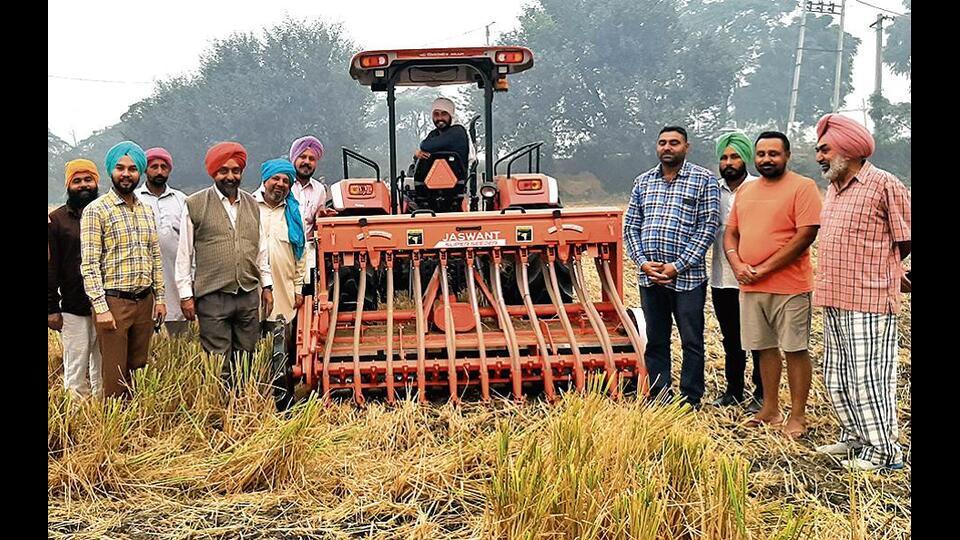
Of the 18,190 subsidised farm machines provided to farmers so far this season, 12,384 — or nearly two-thirds — are super seeders, making the machine the most popular option under the residue-management programme, officials familiar with the matter said.
The super seeder is considered particularly useful because of its multiple functions. It can chop paddy straw, incorporate the residue into the soil, prepare the field for the next crop, sow wheat and other rabi crops and apply fertiliser. Agriculture department officials said the machine helps farmers save time during the short window between paddy harvesting and wheat sowing. The machine comes in different variants and costs between ₹2.45 lakh and ₹3.25 lakh.
“Besides its multiple uses, the machine best serves the purpose of stubble management and eases the cultivation of the next crop after paddy harvest,” said an official of the Punjab agriculture department.
State expected to generate 190 lakh tonnes of straw
Punjab is expecting a bumper paddy crop this season, with total production estimated at around 210 lakh tonnes. Of this, around 180 lakh tonnes is expected to reach mandis for procurement, while the quantity of paddy straw generated is estimated at least 190 lakh tonnes.
The huge volume of residue has traditionally posed a major environmental challenge. With farmers facing a narrow window to prepare their fields for wheat cultivation after harvesting paddy, many resort to burning the leftover straw to clear their fields quickly.
Paddy straw burning in Punjab and neighbouring Haryana has long been associated with the deterioration of air quality in the National Capital Region, particularly during October and November.
Farm fires decline in recent years
The Punjab government has reported a significant decline in farm fires in recent years. The number of recorded incidents fell from 36,636 in 2023 to 10,090 in 2024 and further to 5,114 in 2025. We are focusing on bringing farm fires to a negligible level,” said agriculture director Gurjit Singh Brar.
Additional source of income
Officials said paddy straw is increasingly being viewed as a potential source of additional income for farmers rather than merely agricultural waste. At the beginning of the paddy harvesting season, straw is being sold for around ₹350 per quintal, while prices can rise to approximately ₹600 per quintal during the off-season.
“Now we are focusing on generating wealth for farmers from the waste,” said Brar, adding that farmers could potentially increase their income by 10-15% through the sale of paddy straw.
₹600-crore CRM programme
The Centre has sanctioned an outlay of ₹600 crore for crop residue management in Punjab. The Centre will bear 60% of the cost, with the remaining 40% being contributed by the state government.
“So far, we have received ₹150 crore, and the state has added ₹100 crore. A subsidy of ₹188 crore has been sent into farmers’ accounts,” said Jagdish Singh, joint director, Punjab agriculture department.
Under the scheme, individual farmers are eligible for a 50% subsidy on eligible residue-management machinery. Custom hiring centres (CHCs), including agricultural cooperative societies, village panchayats and farmer or food producer organisations, are eligible for an 80% subsidy.
The government is increasingly focusing on CHCs, which allow farmers who cannot afford expensive machinery to hire equipment for residue management.
1.65 lakh machines supplied since 2018
The scheme for in-situ management of paddy straw was launched in 2018, following growing concern over severe winter air pollution in the NCR and the contribution of agricultural fires in Punjab, Haryana and western Uttar Pradesh.
Since the launch of the programme, around 1.65 lakh subsidised machines have been supplied to farmers in Punjab. Officials said around 50% of these machines have now been declared redundant, having completed their estimated five- to six-year lifespan.
Between 2018 and 2025, subsidies worth approximately ₹1,800 crore were provided to farmers under the programme.
Huge demand for bailers
While the super seeder dominates demand among residue-management machines, there is also a growing requirement for bailers, which compress paddy straw into manageable bales that can be transported and utilised by industries and other users.
At least 18,500 farmers applied for bailers under the subsidy programme, but only 765 machines could be supplied.
Officials attributed the shortfall partly to limited manufacturing capacity in the country. The high demand, however, is also creating a new rural enterprise around the collection, aggregation and transportation of paddy straw.
According to agriculture department officials, it could take several years for domestic production of bailers to catch up with the growing demand.


