
 E-Paper



Textile Park near Mattewara Forest scrapped: Environmentalists welcome move, industry disappointed
After almost two years of relentless protests, the Public Action Committee (PAC) finally achieved its objective as Punjab chief minister Bhagwant Mann on Monday scrapped the proposed textile park project at Koom Kalan village near the Mattewara forest in Ludhiana district


After almost two years of relentless protests, the Public Action Committee (PAC) finally achieved its objective as Punjab chief minister Bhagwant Mann on Monday scrapped the proposed textile park project at Koom Kalan village near the Mattewara forest in Ludhiana district.
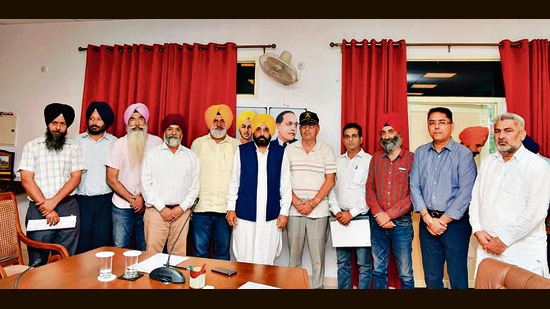
PAC had stated that the land on which the textile park was proposed to come up is a flood plain and recharges groundwater. They added that by scrapping the project, the government also saved the Sutlej river and protected the eco- sensitive zone of Mattewara forest from erosion.
PAC member Dr Amandeep Singh Bains of RBS Roots said Mattewara forest has a special place in Sikh history as both Guru Nanak Dev, the founder of Sikhism, and Guru Gobind Singh, who was wounded after the Battle of Chamkaur Sahib in 1704, had stayed in the forest.
The Public Action Committee, the NGO spearheading the agitation against the mega Integrated Textile Region and Apparel Park along the Sutlej river, said the land on which the textile park was proposed to be developed had witnessed three major floods in 1978, 1988 and in 1993. Further, the embankment along Sutlej River in the area was man-made, and there have been instances of major breaches, especially in Garhi Fazal village, in 2010, 2016 and 2019.
The Mattewara forest protects the city of Ludhiana from floods in the Sutlej and is also a source of oxygen and clean air, said Gurinder Kaur, former professor from the department of geography at Punjabi University, Patiala.
“The industrial park near Mattewara forest could have been dangerous for forest cover. Dry acid particles settle on leaves, twigs, flowers and fruits of all types of vegetation in the vicinity of industrial units. Wet acidic deposition in the form of acid rain causes severe damage to vegetation,” said Kaur.
PAC core team member Kapil Arora cited the example of pollution in Buddha Nullah.
“The government has spent crores, but failed to clean the Buddha Nullah, which further pollutes the water in the Sutlej. Malwa has become a cancer belt just because of effluents discharged from industries in Ludhiana. Why is the pollution control board or other monitoring authorities not taking action.”
While the PAC members were euphoric following the decision, industrialists and residents of Machhian Kalan and Ghari Fazal expressed regret over the decision. The area residents said nearly 1,000 acres of acquired land should not be left in neglect and used constructively for job creation.
Bharpur Singh, a resident of Ghari Fazal, said if the government and environmentalists have a problem with textile parks, they should build biodiversity parks, educational institutes or set- up a film city on the lines of Mohali.
“PAC has led the protest and mobilised nature lovers from across the state to stop the project. Now, they are responsible to generate jobs for youngsters who were hoping to get employed at the textile park,” he said.
Jorawar Singh Rajput of Machhian Kalan village, said, “Hundreds of men and women travel 20 to 30 km each day in search of jobs in Ludhiana city. We were hoping the textile park will bring jobs and we will be able to earn a living. We thought that with the arrival of industry, the condition of the roads, which is full of huge potholes, will also improve. Now, the onus is on the government to create jobs.”
Charanjiv Singh, general secretary of Knitwear and Textile Club, says that many misconceptions regarding the project were spread by activists without technical knowledge.
He added that it is not technically feasible to set- up industry in Ferozepur, Ropar or any other district, as these places do not meet requirements like highway and airport connectivity.
“Why should Ludhiana be called the Manchester of India if there is no textile park. Firstly, the location for the textile park was finalised by a central team after surveying six locations. High-end units were being planned, which would not emit carbon or cause air and water pollution. Further, the industry was not going to cause noise pollution and compensatory foresting would be carried out in lieu of cutting of trees,” said Charanjiv Singh.
“We were planning to generate nearly 30,000 jobs exclusively for the local youngsters of the area. To train youngsters, five skill development centres would have been set-up in the area,” said Charanjiv Singh.
According to range officer of Mattewara, Pritpal Singh, the part of the forest which does not fall in the protected area has 1.5 lakh trees including sheesham , kikkar, neem, eucalyptus , mulberry, dhek, jamun and arjun.
He said that it is home to several animals and avian species including, monkeys, grey/black francolin partridges (titer), rabbit, peacocks, wild boar, sambhar, deer, antelopes (nilgai), monkeys and deer.


