
 E-Paper



Timers to tame traffic for pedestrians, cyclists in Chandigarh
Dedicated timers coming up on Chandigarh’s Jan Marg and Madhya Marg on pilot basis to allow cyclists and pedestrians to cross safely


In a move towards enhancing the safety of cyclists and pedestrians, who struggle to cross busy streets, the Chandigarh Traffic Police are set to install timers at major intersections, starting with Jan Marg and Madhya Marg.
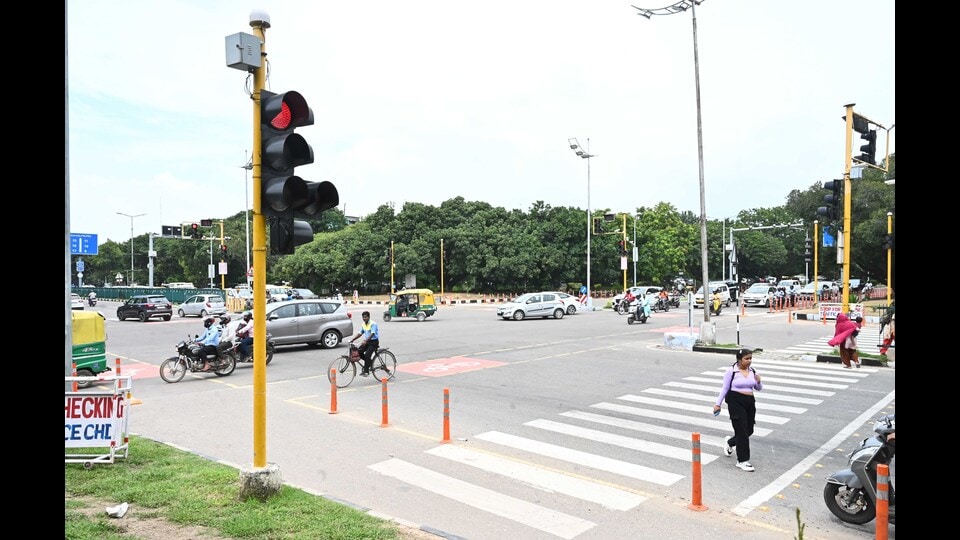
The decision comes in the wake of alarming statistics highlighting the vulnerability of non-motorised traffic on Chandigarh’s roads. As per police data, of the total 64 people killed in road crashes in 2023, 28 were pedestrians and 12 were cyclists, forming 62% of the total victims.
At a recent District Road Safety Committee meeting, the major problems faced by cyclists, including the need to stop midway while crossing intersections, were examined in detail.
Currently, when cyclists approach a signal and start crossing during a red light phase, they often find themselves stuck at the median halfway through.
This happens because while they have the right of way from the traffic signal in one direction, the vehicles on the perpendicular road are still moving. As a result, cyclists are forced to stop in the middle of the road at the median, waiting for another signal change to safely cross the remaining part of the intersection.
This not only causes inconvenience but also poses significant safety risks. Cyclists, who are vulnerable on the road, have to wait in the median surrounded by fast-moving traffic. This pause increases their exposure to accidents and leads to confusion, as motorists may not always anticipate their presence at the median.
Chandigarh has a total of 107 intersections and 58 roundabouts, along with cycle tracks running across 225 km, which is 10% of the total road network of 2,409.7 km.
“The proposed timers will be designed to account for the flow and volume of cyclists and pedestrians at key intersections in Chandigarh. By doing so, the traffic signal cycle will ensure that cyclists and pedestrians get enough uninterrupted time to cross the entire intersection safely in one go, eliminating the need to stop midway at the median,” said an official.
Safer intersections for non-motorised traffic
The timers will provide a dedicated green signal period for cyclists and pedestrians, long enough to allow them to safely cross the entire width of the road, including both the initial lanes and the other side of the median. This ensures they won’t have to stop halfway while the other side of traffic continues to flow.
Cyclists using designated cycle tracks are often outside the immediate field of vision of motorists, particularly when approaching junctions. This creates a dangerous conflict where motorists may not notice cyclists until it’s too late.
SSP (Traffic) Sumer Pratap Singh said, “We have taken up the initiative with the UT engineering department. Initially, we are going to start the project on pilot basis at two major junctions in city and then conduct a survey of all intersections in city to implement it further.”
How the system works
The system will be synchronised with existing traffic lights at major intersections to minimise disruption for motor vehicles while improving safety for cyclists and pedestrians.
When the pedestrian timer turns green, vehicular traffic from all directions will be halted, allowing a dedicated period for people on foot and bicycles to cross safely.
The timers will be adaptive, with durations adjusted based on the traffic density of cyclists and pedestrians at specific intersections. For example, busier intersections like Jan.
Marg and Madhya Marg may have longer crossing times during peak hours, while quieter areas may have shorter timers.
The first installations at Jan Marg and Madhya Marg will serve as a pilot, during which traffic authorities will observe the system’s effectiveness.
Adjustments may be made based on real-time data, such as peak times for pedestrian and cyclist crossings, traffic congestion, and public feedback.
Why Madhya Marg and Jan Marg
Madhya Marg is a major east-west artery that connects key sectors of Chandigarh, linking it to important commercial and residential areas. It also provides access to neighbouring Panchkula and the national highway, making it a vital route for intra-city and inter-city travel.
Jan Marg is one of the city’s primary north-south routes, running through the heart of Chandigarh and connecting the Capitol Complex with Sector 17, the city’s commercial hub. It is also home to several government offices and institutional buildings.
Both roads serve as essential routes for Chandigarh’s public transportation system, including buses and autos. The movement of public transport vehicles contributes to the high volume of traffic, especially during rush hours.


