
 E-Paper



Wildbuzz | Black kites, in a dream so blue
Two chicks of the black kite, Julius and Caesar, are placed with an NGO; porcupines are rehabilitated by the Chandigarh forests and wildlife department


Nurturing stricken wild birds to good health and reintroducing them into the wilderness is no mean task. Ask Dimple Bedi Kamra, an English teacher residing in Chandigarh’s Sector 16 and one whose house is invariably booked with orphaned, abandoned or wounded birds. These winged waifs are delivered in boxes at her gate at unearthly hours, and sometimes even ‘gifted’ anonymously.
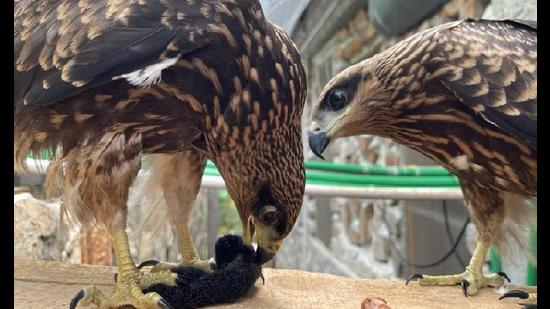
For each species, the diet is different. Overfeeding a chick in a well-intentioned response to its incessant and piteous begging calls for food can lead to its death. Each species and each specimen of a particular species requires a subtle variation in handling. Kamra, who has nursed an estimated 2,000 wild birds, maintains a delicate balance. She consciously restrains the affection that wells up in her for distressed birds. She steadily widens the distance between her and the nurtured ones so that the birds do not get too familiar or dependant on humans and emerge relatively fitter for ‘re-voyaging’ the wilderness. In other words, one cannot love wild creatures to death.
Two chicks of the black kite (cheel), a common raptor glimpsed as dark specks in the tricity’s blue skies, were recently placed in Kamra’s gentle hands by the NGO, Mowgli Aid. The chicks blossomed under her care and are five months old. Kamra has slowly eased them into the wilderness by ensuring they regularly fly away from her home. The kites named, Julius and Caesar, by Kamra come back to her for feeding but she has progressively reduced the feeds so that the kites learn to hunt and scavenge on their own. The complication that has arisen is that Julius and Caesar have found a wild companion kite. They bring the ‘Friend’ to Kamra’s abode to share the feed. However, what augurs well for their tryst with independence is that the human-reared kite siblings have managed to bond with a wild kite.
“Unlike some other raptors I nurtured, the two kites displayed a gentle nature and not once did they attack me or anyone else in the house. They proved to be very playful and vocal about their demands, especially for food. One of their favourite playthings was my black hairband, which they tried to rip to shreds but fortunately did not succeed! Kites are very intelligent creatures and have proved their evolutionary resilience by breeding prolifically and adapting to diverse habitats and contingencies. I am confident Julius & Caesar will embark on a fulfilling life, high up and in the freedom of the blue skies. My heart has to let them go,” Kamra told this writer.
The quill pig
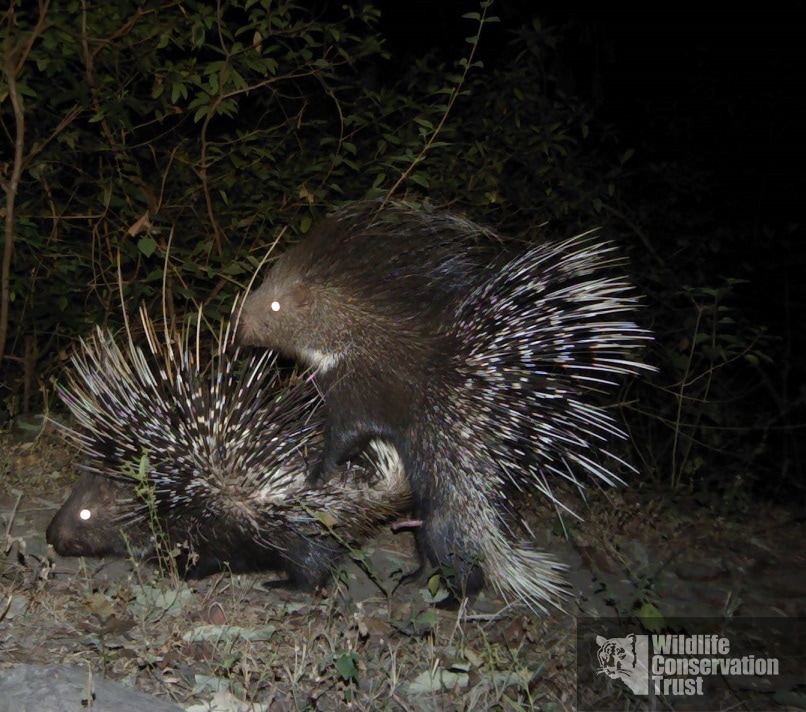
Were a naturalist to seek a ramble along the Leisure Valley before dawn, a chance encounter with an Indian crested porcupine would be on the cards. Porcupines rarely wander into bungalows, unlike snakes, and if they do, they are likely to be rescued from the Northern sectors fronting the scrubland jungles that extend from the Sukhna lake along Uttar Marg. The rescue team of the UT forests and wildlife department is called to remove and rehabilitate porcupines only two or three times a year. A porcupine surfaced in a Sector 4 bungalow on Tuesday leading to surprise and excitement. Porcupines typically forage at night and this one probably had lost its way by wandering afar from the jungles.
Porcupines are reckoned as the prickliest of the rodents and have earned the sobriquet of ‘quill pig’ due to their pugnacious nature, fearlessly taking on tigers and leopards. Porcupines tend to flee rescue teams but on occasion, when cornered, flare their bunch of legendary quills (or spines) like an umbrella, produce an intimidating rattling sound with the quills, and charge in reverse gear at the target while mustering quite a speed. The hollow quills embed in the target’s flesh on impact and get detached. A rescue personnel was attacked in a defensive reaction but fortunately the thick jeans he was sporting deflected the quill. Rescue teams usually manage to pre-empt defensive attacks by throwing a blanket or gunny bag on the porcupine.
vjswild1@gmail.com


