
 E-Paper



Wildbuzz | Lore of the bird in the bush
The emperor was inquisitive about what wild creatures eat, and would order the cutting open of pythons, cobras, birds etc to ascertain stomach contents


The grey partridge (francolin) was a gamebird much sought after by the ‘shikaris’ of yore. Its sudden, speedy and low flight was backed by a tactical use of the bushes to escape hunters, beaters and dogs. It would run in front of the hunting party from bush to bush before taking flight in an ‘explosive whirr of the wings’. On landing, it would make a dash for another bush, and run through it. When the hunting party got to the bush and whacked it with sticks, the partridge would seem to have vanished. Only to be seen sprinting, a long way off!

However, when wounded on the wings by a charge of gunshot, the ‘runner partridge’ would invariably find refuge in a bush and merge perfectly at the base of the clump of dusty-brown flora. Nothing could make the wounded bird move from the bush. On occasion, an unwounded bird would similarly sit tight in a large bush and no amount of shouts, baying of hounds and stone-throwing could dislodge it from the seeming seclusion.
Recounting a memorable anecdote, Dr Salim Ali and S Dillon Ripley wrote in their seminal 10-volume work, “Handbook Of The Birds Of India And Pakistan”, that to “escape a trained falcon, Ali had seen one dive into a thorn bush and refuse to budge even when the bush was set alight and itself all but roasted alive!”
Emperor Jahangir recorded another observation about this interesting species. The male has a sharp spur or two on each of its dull-red legs. But the emperor’s deep experience and sharp eye picked an oddity of nature.
“One day on the hunting ground, the chief huntsman, Iman Wirdi, brought before me a (grey) partridge that had a spur on one leg but none in the other. As the way to distinguish the female lies in the spur, by way of testing me, he asked whether it was a male or a female. ‘A female’, I promptly replied. Then they opened its belly. An immature egg appeared therein.Those present inquired incredulously by what sign I found that. I said that the end of the beak in the female is shorter than that of the male. This dexterity came from frequent observation and comparison,” the emperor wrote in his 17th century memoir, Tuzuhi-Jahangiri.
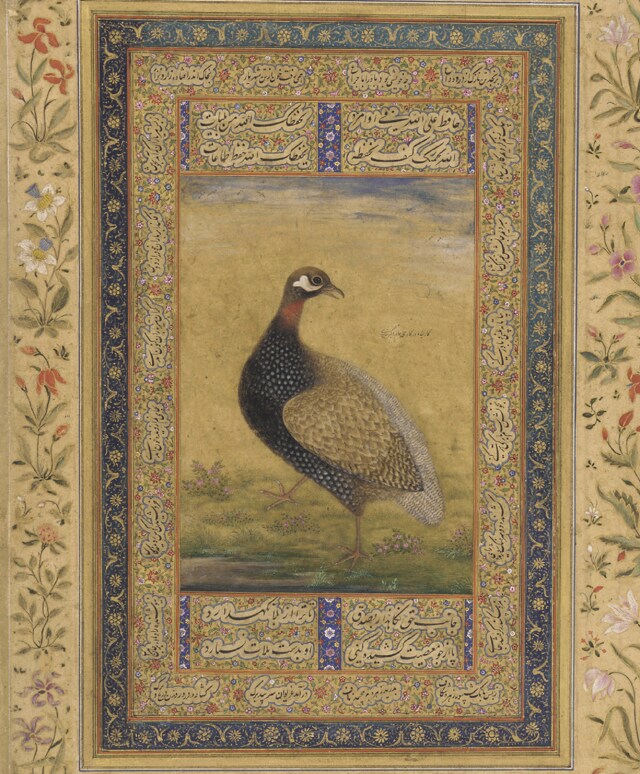
Bird of an emperor’s curiosity
The black partridge (francolin) enjoys an esteemed status in the cultural, royal and shikar lore of India. Its plumage and call have entranced the naturalist. However, what the bird eats may not be quite edible to the mind that romanticises the bird. Apart from the standard seeds and fallen berries/figs, insects etc, legendary birdman Dr Salim Ali, stated that the ‘Kaala teetar’ feasts on human excreta in the vicinity of villages (like wild boars)!
Ali quotes an observation from the naturalist emperor Jahangir to further enhance the teetar’s profile as a kinky gourmet. The emperor was inquisitive about what wild creatures eat, and would order the cutting open of pythons, cobras, birds etc to ascertain stomach contents.
“I got a black partridge caught by a falcon, and ordered its crop to be cut open in my presence. A mouse was found which it had swallowed whole and had not as yet undergone any change. It was astonishing to see how, its oesophagus, being so narrow, could have admitted a full mouse. Without exaggeration, if somebody else had said so, it was impossible to believe. Since I have personally witnessed it, I record it as an unusual thing,” the emperor wrote in Tuzuhi-Jahangiri.
vjswild2@gmail.com


