
 E-Paper



Wildbuzz| The flowers before Gun Hill
A 100 guns of the “Indian topkhana” hammered the enemy’s fighting potential and well-coordinated defences on the Point 5140 Complex prior to the Infantry’s night assault of June 19-20, 1999


At a summit height of 16,864 feet and bearing the official nameplate of “Gun Hill”, this towering mountain looming over Drass town commemorates the battle-winning role played by 22 regiments of artillery in the Kargil War. The gunners had ably supported and rendered successful the Infantry assaults for the peaks and ridgelines of Mashkoh, Drass, Kaksar, Batalik, Chortbatla, Turtuk and Chalunka in summer 1999.
A 100 guns of the “Indian topkhana” hammered the enemy’s fighting potential and well-coordinated defences on the Point 5140 Complex prior to the Infantry’s night assault of June 19-20, 1999. The battle is associated in popular consciousness with the “yeh dil maange more” victory call of Capt Vikram Batra, PVC (P). Point 5140 was officially christened as “Gun Hill” on July 30, 2022, by the Directorate of Artillery (Army HQs, Delhi) to give the gunners a natural monument testifying to their sacrifices, expertise and valour, and to balance the Infantry’s domineering imposition over the Kargil victory.
The axis to Gun Hill is still littered with the remnants of Kargil War munitions: machine-gun belts, artillery splinters of all sorts, mortar fins of 82 mm/ 120 mm calibres, shells and empty rifle casings. Some still bear readable factory markings of 7.62 mm rifle calibre and Pakistan Ordnance Factory.
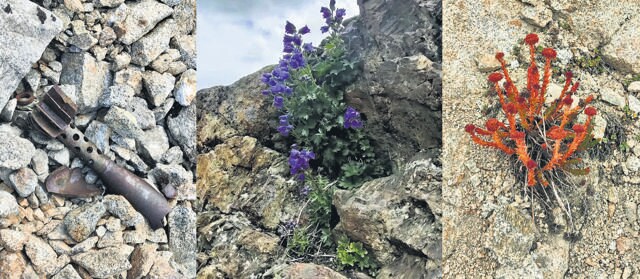
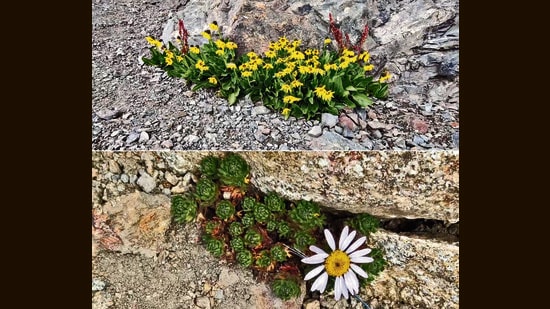
The Kargil peaks are profiled by the clutter of naturally-broken rocks due to geological dynamics and weathering attrition. However, the pounding delivered by massed artillery had broken the rocks further, unleashing a secondary barrage of stone splinters on Pakistani intruders. Amid the strewn remnants of war munitions, and from the crevices of broken rocks and cracks in slippery shale, petite alpine flowers creep out to catch the sun and blossom for a charming interlude of June to September. The flowers bloom at 17,000 ft and above in battlefields such as Gun Hill and Bhimbet LOC. The low, flowering shrubs are in spirit akin to Himalayan / Ladakh skinks and small, hare-like pikas, which also shelter from cold and winds among the retreats in sky-kissing rocks.
Infantry troops man the super-dangerous LOC terrain in link patrols. All they get to relieve the dreariness of numbing mountains is the fox, bear, ibex, pika, ram chukor....and only flowers as they ascend higher and higher. For the lonely soldiers battling enemy and extremity, the flowers turn into symbols of “life and resilience in the barren mountains”, as an infantry major succinctly put it.
Indeed, real tigers are these little lovelies. The diehard spirit of the alpine blossoms had captured the heart of late PM Indira Gandhi, who was a conservationist, naturalist and pilgrimer of the sacred Himalayas. In a March 12, 1973, foreword written for Major HPS Ahluwalia’s book, “Higher Than Everest”, Gandhi lent the flowers a soldierly air of forbearance and courage: “I never cease to be astonished at the sight of wildflowers in the high mountains, their tiny, colourful heads peering out of unlikely nooks and crevices, tenaciously defying the most inhospitable elements.”
vjswild2@gmail.com


