
 E-Paper



Wildbuzz | The price of Diwali’s Baaz
The famous ‘hawk mandi’ of Amritsar would come alive with flutters as a site for the sale of expensive raptors for the sport of falconry, an indulgence particularly of the nobility who considered it not a hobby but as a ‘way of life’.


*Once upon a time, many, many moons ago, the festive season of Diwali would host in the holy city of Amritsar a novel aspect of India’s cultural heritage. The famous ‘hawk mandi’ of Amritsar would come alive with flutters as a site for the sale of expensive raptors for the sport of falconry, an indulgence particularly of the nobility who considered it not a hobby but as a ‘way of life’. Though falconry has ceased in India, the ancient sport is pursued across the world, such as by Arab sheikhs who expend millions of dollars. Falconry’s associations with diverse global cultures has it earned an inscription on the UNESCO’s Representative List of the Intangible Cultural Heritage of Humanity. November 16 marks ‘World Falconry Day’.
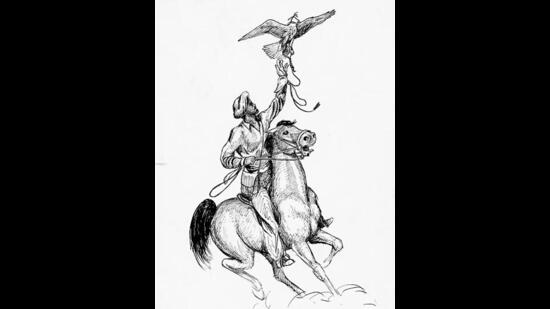
Along with other flourishing trades, as Amritsar was renowned for, its hawk mandi was the primary source of raptors in the sub-continent. A vivid glimpse into the mandi’s esoteric wares was provided by sketches executed by an American falconer and artist, Robert A Widmeier, while on an Army tour to India, 1942-’44. One of his sketches, made in Amritsar on Diwali that fell on November 1, 1943, bore an inscription in Widmeier’s hand listing the astronomical sum -- ₹400 -- that a female Northern goshawk (the true Baaz) commanded. This was so because it was a raptor highly-esteemed by emperors, kings and princes and identified with the cultural legacy of four of the Sikh Gurus (in 1989, the Baaz was declared State Bird of Punjab).
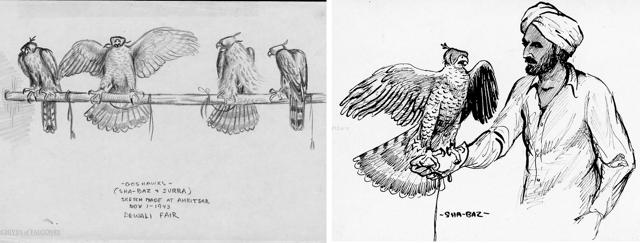
The 1943 price listed by Widmeier was consistent with the outlandish sums the Baaz commanded earlier as documented by British naturalists: (i) Shahbaaz is an expensive bird...sometimes costing as much as a (sum) fully equal to £200 in England, Sir Richard Burton, 1852, Falconry in the Valley of Indus (ii) prices varying from ₹20-50 (for female, the Baaz) and ₹10-30 for the male (known as Zurrah), TC Jerdon, 1862, The Birds of India (iii) Every Indian prince in whose state falconry survives does not consider his menage complete without a goshawk, and it is the zenith of every Indian falconer’s ambition to possess a goshawk... ₹150-200 being paid for a young female, CH Donald, 1920, The Birds of Prey of the Punjab.
According to Jerdon, the Amritsar mandi was reputed for the sale of uncommon and esoteric migrant raptors. “This fine (Saker) falcon is a winter visitor to the plains of India and though by no means a common bird, even in mid-winter in most parts of the Punjab, a good many are caught and brought into the Amritsar market for sale from western Punjab and Bikaner,” wrote Donald.
In 1967, the Afghan nobleman, reputed falconer and author, SM Osman, penned a swan song for the lost mandi: “There used to be a time when the hawk market of Amritsar would, in the months of October and November, offer for sale numerous hawks and falcons of different kinds. The clientele were the representatives of all the sporting princes of the country, who vied with one another for some really good hawk or falcon. Today, the number of hawk enthusiasts in the country could be counted on the fingers of one hand and the hawk market of Amritsar has ceased to exist.”
vjswild2@gmail.com


