
 E-Paper



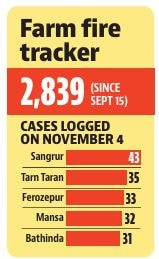
With 321 fresh farm fires, Punjab’s tally rises to 2,839
Sangrur once again recorded the highest number of stubble burning incidents, reporting 43 new cases, while Tarn Taran reported 35 fresh cases, followed by 33 in Ferozepur.


The state recorded 321 cases of stubble burning on Tuesday, taking the tally to 2,839 incidents this season so far. On the same date last year, the state had recorded 262 cases. The number was 1,360 in 2023.

Sangrur once again recorded the highest number of stubble burning incidents, reporting 43 new cases, while Tarn Taran reported 35 fresh cases, followed by 33 in Ferozepur.
On Tuesday, as many as 131 FIRs have been registered against the farmers under Section 223 (disobedience to an order duly promulgated by public servant) of the Bharatiya Nyaya Sanhita (BNS).
Sangrur has logged the highest 510 cases, followed by 506 in Tarn Taran, 296 in Ferozepur, 249 in Amritsar, 197 in Bathinda, and 167 in Patiala to date this season.
Last year, the Punjab Pollution Control Board (PPCB) had recorded a total of 10,909 farm fire cases in the state, with Sangrur topping the chart with 1,725 incidents.
Meanwhile, light rainfall in the different parts of the state has brought some respite from the low air quality in the evening. Most of the cities recorded an Air Quality Index (AQI) in the moderate category.
Amritsar reported an AQI level of 131, Mandi Gobindgarh 137, Jalandhar 159, Ludhiana 195, Patiala 190, and Rupnagar 98. Khanna recorded the worst AQI level in 251, which falls in the poor category.
Punjab Agricultural University (PAU) recommends that the sowing of wheat should ideally be completed between October 15 and November 15.
“Even as the AQI has been improved but the rainfall is going to impact the harvesting of paddy, which is at its fag end. It will lead to a shorter window for the farmers to prepare land for the wheat crop,” a PAU expert, who didn’t wish to be named, said.
PPCB executive engineer, Rohit Singla, said, “The AQI is expected to improve after the rains.”
India Meteorological Department (IMD) Chandigarh director Surinder Paul noted that rain started around 5pm in parts of Punjab, covering areas like Fazilka, Ferozepur, and Bathinda, as well as Sirsa and Fatehabad in Haryana.
He said that stubble burning and festivals certainly contribute to the deterioration of air quality, but meteorological conditions also play an important role. “Though pollution is an annual phenomenon. After the monsoon season, temperature drops and the speed of wind slows down, which reduces the vertical air movement, thus pollutants stay close to the ground,” Paul said.
Sharp drop in stubble burning incidents in Punjab Haryana: CAQM
New Delhi The Commission for Air Quality Management in NCR and Adjoining Areas (CAQM) said stubble-burning incidents in Punjab and Haryana, one of the major contributors to winter pollution in Delhi-NCR, have shown a significant decline compared to last year.
Between September 15 and November 3, Punjab reported 2,518 fire counts against 4,132 during the same period in 2024, while Haryana saw a drop from 857 to 145.
The commission noted that this reduction in farm fires coincides with a slight improvement in Delhi’s air quality.
The capital recorded an AQI of 291 on Monday, down from 309 on Sunday and 366 a day earlier, indicating a shift from the ‘very poor’ to ‘poor’ category.
To curb stubble burning, enforcement actions have been intensified across the northern states. Authorities have inspected 2,161 fields in Punjab and 121 in Haryana, imposing environmental compensation of ₹52.75 lakh and ₹3 lakh, respectively.
Additionally, 946 FIRs under Section 223 of the Bharatiya Nyaya Sanhita, 2023, have been filed in Punjab and 42 in Haryana.
The CAQM said it has set up a dedicated monitoring cell in Chandigarh and deployed 31 flying squads across Punjab and Haryana to oversee field-level implementation and compliance. PTI


