
 E-Paper



With declining bed availability, fear looms over J&K hospitals
Citing fragile health infrastructure, doctors urge administration to enforce Covid protocol strictly, ban tourism


As states across India witness a surge in Covid cases, the Jammu and Kashmir administration has maintained that there is enough oxygen available in case of a potential health emergency in the Union Territory.
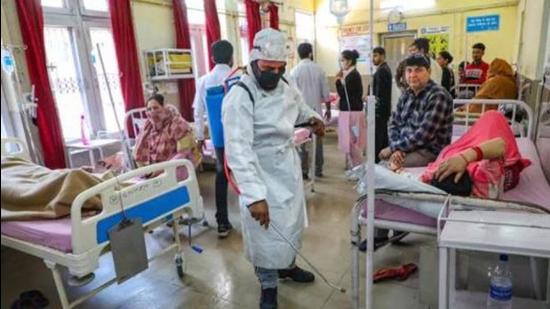
“No one shall die of oxygen unavailability here and there is absolutely no need for people to panic,” Rajan Prakash Thakur, the principal secretary, industries and commerce, said on April 20.
However, on the ground, even records of the J&K government don’t seem to agree with the not-to-panic message.
Also read: Weekend curfew in Jammu and Kashmir from tonight 8pm to Monday 6am
With incremental increase in Covid patient admissions to Jammu and Kashmir hospitals, the healthcare infrastructure of the erstwhile state is still the same as it was six months earlier when the country was struggling with the first wave.
While the J&K government’s daily media bulletin claims to have 244 ICU beds available, a five-month-old similar media bulletin of November 21, 2020, shows 284 ICU beds being available, which is 40 more than what is available at present.
All this depicts that there has not been much of an addition in making more ICU beds available in the UT.
Rising cases, declining bed availability
Following the trend of the country, there has been a daily exponential rise of cases from 991 on April 12 to 1,965 on April 22.
The rise in cases is, therefore, showing an impact on the limited bed availability and an analysis of the data provided by the government is alarming. A look at the inflow and bed occupancy at J&K hospitals shows a rapidly declining figure of bed availability in Kashmir.
On April 17, the total available beds were 1,979 out of 2,620 Covid-dedicated beds, which means 75% of the beds were unoccupied.
On April 22, this availability figure receded to 1,592. This time, the bed availability fell to 62.8%, meaning a 12.2% decrease in just five days.
So, with a total of 387 beds getting occupied over five days, meaning more than 70 beds a day, at such continuing trend it would not take more than 20 to 23 days for the UT to run out of beds.
Increase beds on a war-footing
The president of the doctor’s association in Kashmir, Dr Suhail Naik, says. “We are still left with more than 60% beds but considering the number of patients getting hospitalised, the situation is critical. We got a boost in healthcare infrastructure last year and it’s because of that alone that we are surviving such a rush. Considering the situation today, it’s imperative for the UT administration to increase beds. We are heading towards a catastrophe and people are unaware of it,” Naik said, advocating an increase in oxygen bed availability on a war-footing.
“Oxygen is the only drug of choice that Covid demands,” he said, adding that the administration was lax on enforcing the protocol. “When the country was gasping for oxygen, the administration was busy conducting tourist events instead of imposing the protocol,” he added.
Tourists contributing to spike
Naik said people need to behave responsibly given the fragile health system that can’t take the brunt Delhi is facing. “If the spike does not decrease in the UT, we will be left with no beds in a few weeks,” he said, seeking a ban on tourist gatherings.
With the onset of the second wave, 1,050 of the 4,519 people who tested positive in March were travellers. This means 23% of Covid cases in J&K were travellers. In April, of the 21,482 positive cases so far, 4,390 were travellers.
The inflow of tourists has been rising in the UT despite contributing more than 20% to Covid cases for two months.
Recovery rate not more than 70%
Dr Naveed Nazir Shah, the head of the department of Kashmir’s Chest Disease Hospital, said that the situation in the Valley is fragile. The hospital, which is the top Covid facility in J&K, is struggling with the rush of patients with more than 90% of its beds occupied.
“If the spike comes to a halt, we may get a breather to plan things. Right now, the statistic recovery rate is not more than 70% unlike 98% in the past, given the huge detection of cases,” he said.
Vaccination should be ramped up and people should follow Covid-appropriate behaviour strictly. “The recovery rate is lesser this time because there is a huge rush of admissions, and few are getting discharged as compared to it. If the rise of cases stops, we will have a better recovery rate. We will have more beds available. Our infrastructure is not feasible for the potential load that it may face in the coming days,” Dr Nazir said. “We definitely need more beds and this needs to be initiated from this moment,” he added.
The director of health services, Kashmir, did not respond to repeated calls for a comment.


