
 E-Paper



Cotton arrival in Punjab’s mandis this season double than last season
10.92 lakh quintals arrive in purchase centres till November 2 against 5.71 lakh quintals in 2019


As the third and final phase of harvesting of cotton balls is gaining momentum in the semi-arid region of Punjab, the arrival in mandis this season is already nearly double when compared with the corresponding period last season.
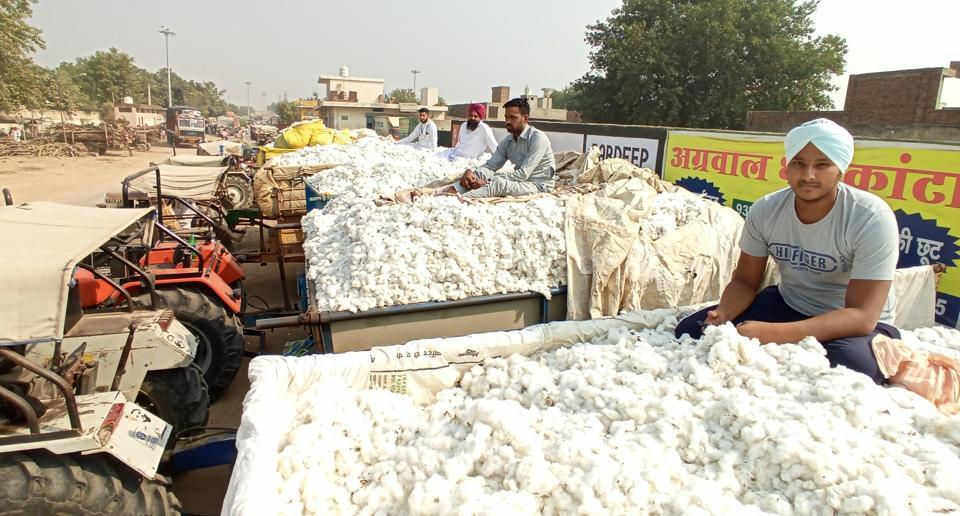
According to the Punjab Mandi Board data till November 2, total 10.92 lakh quintal kharif crop was brought by the farmers to various purchase centres of the cotton-growing belt in south Malwa. For the same period in 2019, the arrival was 5.71 lakh quintals.
Sources attribute the major spike in cotton arrival to apprehension that Cotton Corporation of India (CCI) may get out of the market where private buyers are offering much less than the minimum support price (MSP) of ₹5,745/quintal with 8% moisture level.
Sources said traditionally farmers used to hold back crop harvested after October 15 for sale in mandis after the paddy harvesting phase.
“But the ongoing farmers’ agitation panicked cotton-growers and they rushed to mandis in an unprecedented manner. But the purchase by the central agency is going on smoothly and payments are being released in farmers’ bank accounts within a week,” says a government functionary.
Official data says a major chunk of the produce was purchased by the CCI and the private players have bought only 2.36 lakh quintals and nearly 99% of the crop reaching mandis was purchased.
CCI assistant general manager and Punjab in-charge Neeraj Kumar on Monday said that a sharp spike of cotton arrival was unexpected. “As it was analysed that private players may hardly play any role in the cotton purchase as the global market was unstable due to Covid-19 outbreak, the CCI made elaborate arrangements to buy the almost entire cotton production. It is probably for the first time after 2008-09 season that this year by October-end, mandis are flooded with cotton,” he said.
Sensing high-target of purchase, the CCI increased the number of ginning and pressing mills from 42 in 2019 to 83 this time.
“By buying more than 80% of total arrival at the MSP, CCI has rubbished the unfounded speculations that the central agency will back out from the market,” said Kumar.
Officials say the surge in cotton arrival may weaken this week as paddy harvesting in the area has entered the last stage and farmers may resume taking cotton to the mandis after Diwali on November 14.
Record production unlikely
State cotton coordinator Rajnish Goel said this year, the cotton production may remain on a par with last year’s figure of about 45 lakh quintal.
“About 17,000-hectare cotton-growing area in Abohar area of Fazilka district witnessed widespread flooding. Though the extent of crop damage is being assessed, the situation may impact overall production,” he said.
Punjab this year had set a record by bringing 5.01 lakh hectares under cotton cultivation, which is the highest since 2010-11 kharif or summer-sown crop season. Following the addition of 25% area under cotton, the state authorities were expecting to touch record 50 lakh quintal production.
Yield stable
Officials of the state agriculture department say this year’s yield was between 7-10 quintal per acre. “Like the last year, this season also did not see any major pest infestation. But the average per acre yield remained 8 quintals,” said Bahadur Singh Sidhu, chief agriculture officer of Bathinda, the district with the maximum area under the cotton cultivation.
According to the progressive farmer from Bathinda’a Bajak village, Baldev Singh, said untimely rains during ball-burst period affected the yield.
“The rains led to unwanted extra growth of plants that adversely affected the fruit. Farmers were expecting higher yield but the climatic conditions were not conducive,” he added.


