
 E-Paper



17th edition of India Art Fair puts spotlight on emerging practices
The latest edition of the India Art Fair, which opens on Feb 5 and continues over the weekend, is hosting host 135 exhibitors, including 27 first-time participants

 Prefer HTon Google


At the stately Triveni Kala Sangam in central Delhi, one room looks dug up and pitch dark. Sculptures and installations are visible, but when you enter the room, it’s quite likely that you will trip. As your eyes adjust to the dim light, you realise that the smooth floor of the once pristine white cube has been transformed into an uneven one made of exposed brick, gray sand and wooden platforms.
“I want the viewer to be uncomfortable,” said curator Wribhu Borphukon, who has been in charge of the India Art Fair’s ambitious Young Collectors’ Programme (YCP) for the past three editions. The YCP’s mandate is to bring lesser-known contemporary artists to the attention of the art-going public. It is also to bring new collectors into the mix. With works priced between ₹20,000 and 26 lakh, the YCP is the IAF’s investment in the future of Indian art. With no pressure to make profit or sales, it is also its most ambitious gamble, and much like this exhibit, it offers room to stumble.
In the press of foundation and gallery-represented artists in the ever-growing India Art Fair, emerging practices that are experimental and new need a place of their own.
The 17th edition of the India Art Fair, which opens on February 5 and continues over the weekend, will host 135 exhibitors, including 27 first-time participants. The numbers rise each year — 15 more than last year, 50 more than even three years ago. Of the 105 national and 30 international participants this year, at least 22 are foundations and 14 are design studios.
“The expansion in the 17th edition reflects a measured and strategic response to the evolution of the region’s art landscape. As South Asian art, design and culture gain greater global visibility and institutional attention, the fair has expanded to accommodate a broader range, geographically diverse voices, formats, and conversations, without diluting focus and quality. What’s important is that growth at India Art Fair is not only in the addition of new booths, but in the strengthening of long-term structures and our extensive programming,” said fair director Jaya Asokan.
Back at Triveni, the design of this specific exhibit, titled “Omens, Organisms, Objects, Order,” is intentionally futuristic. Parag Tandel’s Worli Koliwada is a series of cyanotype prints that take off from traditional Koli recipes (davla and dried Shrimp, umbar and eggplant curry, roasted Bombay duck and potatoes curry), a nod to the artist’s own fishing community ethnicity.
Deepak Kumar’s “Neglected Reality” is an installation of drawings, found objects and metal sculptures that use the metaphor of detritus (tiny bird skeletons, an emptied nest, bones) to show his preoccupation with the passage of time. Berlin-based Sam Madhu’s digital installation — the highest priced among this lot at ₹26 lakh including the screens — combines cyberpunk aesthetic with an Eastern symbology. A sharply angled rhinoceros-shaped bar made of cane by Aku Zeliang, offers a design intervention that points to the IAF’s own recent pivot towards exhibiting designers and ateliers on a much larger scale.
“The exhibition considers the idea of collecting in the future, with some pieces specifically made for this concept,” Borphukon said.
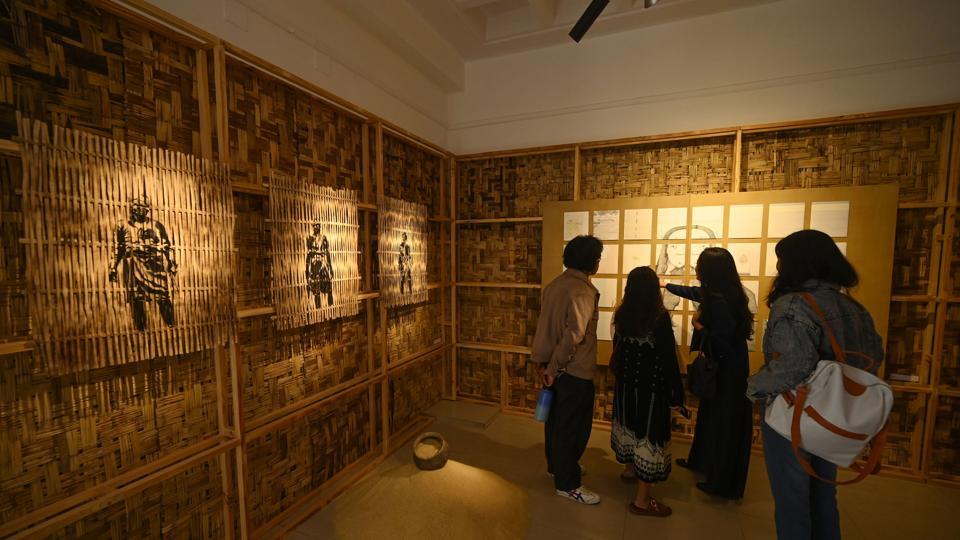
The YCP has used different rooms in Triveni Kala Sangam to showcase works by a host of young and upcoming artists, as well as a few established ones. In one, the works of five women artists from the Northeast are displayed, whose materials include textile weaves, bamboo, pen on paper, red seeds, and graphics. The exhibit, titled Northeast Southeast, draws our attention to the ways in which the mainland can flatten identity, and reduce the various communities into a singular pejorative. To view widely divergent practices, then, is how a potential art collector understands nuance, and forms an emotional bond with art. For instance, both Fileona Endoxa Dkhar and Arieno Kera are indigenous artists from Nagaland, but the former is a lens-based practitioner whose work occupies different interstices of the digital and physical worlds (Ode to Lei), while the latter has put pen to paper and made delicate portraits for this exhibit (Red Around My Neck and Sister Stones).
Triveni’s open air amphitheatre has been repurposed into an exhibition space to show a selection of works of artists and collectives. Yusmarg Collective Kashmir, formed after the abrogation of Article 370 of the Indian Constitution in August 2019, for cultural practitioners to engage in a dialogue about Kashmir, has displayed photographs and a video installation by Bushra Mir, Khursheed Ahmad, Lubna Bashir, Salman B Baba and Saqib Bhat. The Ether Project, founded in 2022 to foster artistic communities beyond metropolitan art centres, offers intergenerational display of artists like Rithika Pandey, Abela Ruben, Nasir Sheikh, Elodie Alexandre and Cyrus Penuganti.
Triveni is only one of the many sites where the India Art Fair has extended its programming. The YCP has also teamed up with the Fashion Design Council of India, roping in independent curator Sreyansi Singh who has put together an exhibition titled “Disobedient Objects: The Biography of Clothes” for the YCP. The exhibition opened earlier this week at STIR art gallery in DLF Chattarpur Farms, and shows clothes-making as a methodology in contemporary art. The idea is to make the viewer think of textile (material), labour (the process, and the maker) and ultimately, design (function) as sites of meaning. Richa Arya’s 10ft metal installations of women point to the reality of women’s work in the upcycling ecosystem; Debashish Paul’s sculptural installation deploys paper to create a fantastical and voluminous gown; Shraddha Kochhar’s self-woven kala cotton installation mimics the Kachhi Ghori costume that Rajasthani male performers wear in their folk dance.
“These works show contemporary art practices that engage critically with textiles, drawing our attention to material, process and labour. I want the viewers to know that though this is not a fashion show, this is a way of seeing clothes,” Singh said.
Indeed, this perspective will also reflect in the façade of the IAF’s venue at the NSIC Grounds, where Afrah Shafiq’s “A Giant Sampler” draws on the visual language of an embroidery sampler to foreground not just textile motifs but also practices that have historically shaped women’s lives. Besides the exhibition booths, the fair will also offer talks, panel discussions and guided tours in multiple languages.

Stay updated with all top Cities including, Bengaluru, Delhi, Mumbai and more across India. Stay informed on the latest happenings in World News along with Delhi Election 2025 and Delhi Election Result 2025 Live, New Delhi Election Result Live, Kalkaji Election Result Live at Hindustan Times.


