
 E-Paper



2013 rerun: Unsure of FYUP in Delhi University, say teachers
The AC passed the broad course structure along with a multiple entry-exit scheme (MEES) and academic bank of credits (ABC) on Tuesday amid dissent from 16 members.

 Prefer HTon Google


Even as Delhi University’s Academic Council, on Tuesday, passed the agenda to start a four-year undergraduate programme (FYUP) from the next academic session amid dissent, stakeholders, including college principals and teachers have expressed concern over how the model will be implemented after a tumultuous year caused by a global pandemic.
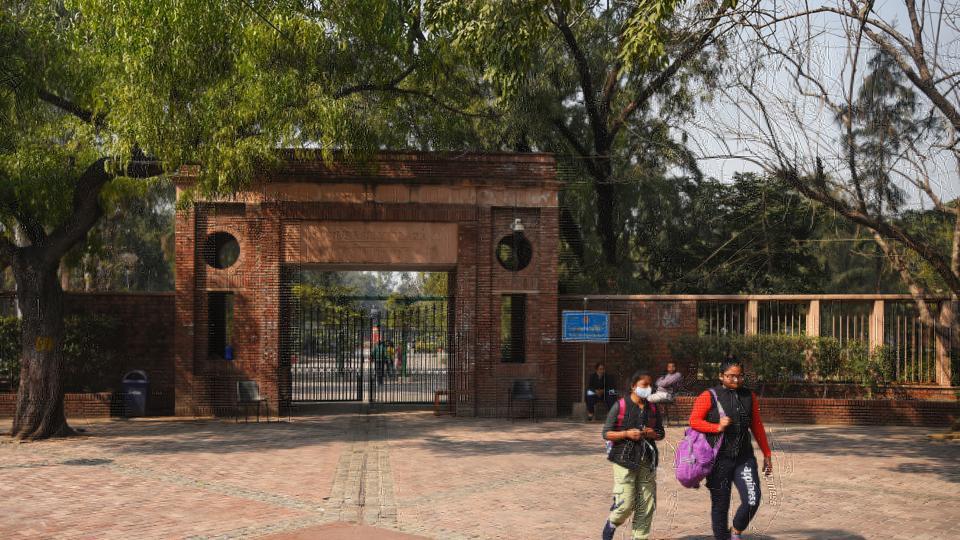
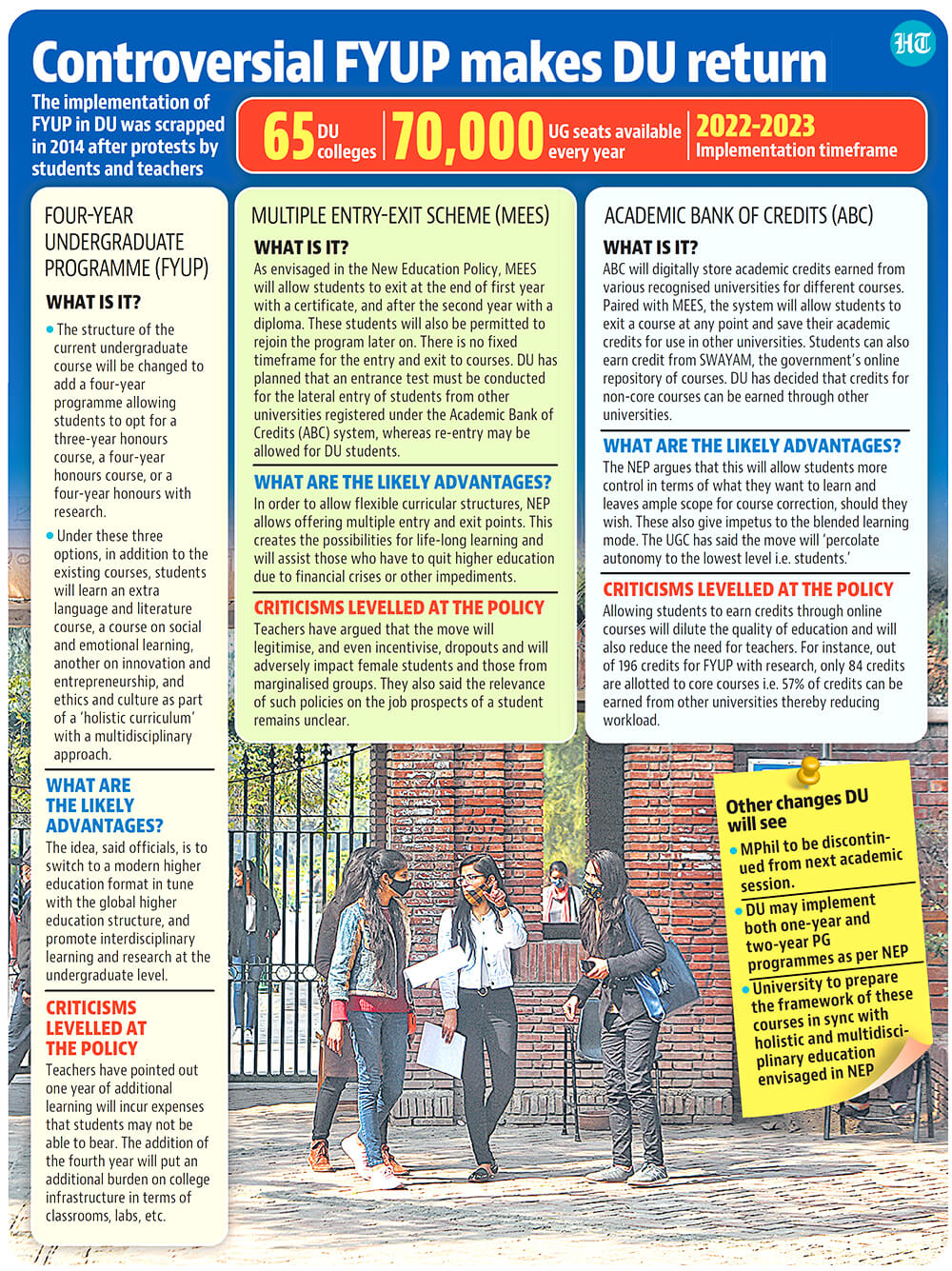
The AC passed the broad course structure along with a multiple entry-exit scheme (MEES) and academic bank of credits (ABC) on Tuesday amid dissent from 16 members, but the matter is now scheduled to be placed in the Executive Council on August 31. AC member Alok Pandey said that since EC only has two elected teacher representatives out of around 40 members, it is likely to be passed there too.
“While FYUP emphasises on research, there is no model to teach students research methodology or how to do dissertation work. This may also lead to students opting for dishonest means to submit their theses. The Covid-19 pandemic has already been a challenge for the stakeholders; this will just add to the crisis. The National Education Policy (NEP) encourages blended learning, but if our students do not have devices or internet as was evident in the past year, how will they conduct research? On their phones?” Pandey said.
Acting vice-chancellor PC Joshi said DU has only adopted a broad course structure for now and the university will finalise the modalities in the coming days.
“Departments and faculties will be allowed to introduce alterations in the broad structure as we have only accepted this in principle for now. We have a year to see how the framework can be operationalised in the context of DU. We will change our system gradually to adapt to it and for now, we are moving in the direction of NEP,” he said.
Currently, the recommendations adopted by AC provide little clarity on the system of examination and student intake across regular and non-collegiate courses. Teachers also said that the progression of papers will have to be changed as the entry-exit process has to be self-contained every year.
AC member Naveen Gaur explained, “If students opt for MEES, they would want a self-contained unit every year so that they could learn everything and go for the interdisciplinary approach stated in NEP. But as per the current structure, if a student exits after the first year where there is no general elective paper, the student will not study another subject allowing multidisciplinary approach in the first year.”
In the agenda document passed on Tuesday, the university had stated that it would decide upon the modalities for the ABC – MEES later based on further dialogue within statutory bodies. The two schemes allow students to gain credits as per their learning, store them in a digital vault, and use them to switch courses and resume their study at any point if they have to exit the course after the first, second, or third year. Officials said they were yet to decide on the list of universities it would allow for the ABC system or the entrance test that would be mandatory for students of other universities to switch to DU through MEES.
While the teaching community raised concern over the reduction of workload that would arise due to the implementation of these provisions, university officials said they had deferred the agenda items as there had been no consensus. For instance, 57% of credits under FYUP with research can be earned from other universities or institutes including Swayam, an online repository of courses.
“Since there were concerns over Swayam and MOOC, that agenda item was deferred and it hasn’t been adopted. Since UGC has allowed up to 40% online learning, we will hold more discussions with stakeholders to see what should be implemented in the university so that both teachers and students benefit from it,” Joshi said.
EC member Seema Das said that colleges do not have the infrastructure to implement an additional academic year. “Higher educational institutes have been facing a fund crunch for a long time. Implementing the provisions laid down in NEP would require infrastructure expansion. It cannot be done without resources,” she said.
In the dissent note submitted on Tuesday, 16 AC members collectively noted, “Most colleges do not have any space or scope for further expansion. Neither is there any promise of additional grants for creating infrastructure nor has any study been done of the current state in the institution.”
Manoj Sinha, principal of Aryabhatta College and general secretary of DU principals’ association, said, “We will need increased human resources and infrastructure in a gradually phased manner in the next three-four years. Since NEP calls for developing research facilities, we require labs and lab attendants but the non-teaching positions are not being sanctioned by the authorities for the last few years. While older colleges have sanctioned posts and lab attendants, newer colleges like ours has zero attendants. In order to encourage research, more grants will have to be facilitated as well.”
However, SP Aggarwal, principal of Ramanujan College who was part of the 42-member committee formed by Delhi University to formulate recommendations on NEP, said major changes will come into effect in the fourth year when one semester would increase per semester cycle. This means colleges have time to make the necessary upgrades.
“Since FYUP was in place before as well, we have some experience in how the teaching schedules work. Colleges will have three years to develop the infrastructure and will require funding to boost infrastructure because if there is an additional academic year, we will need classrooms, labs, staff and information technology facilities. Some colleges require major investment in IT facilities as the university is also adopting ABC credits and many students may opt for online learning,” Aggarwal said.
Addressing teacher concerns on the reduction of workload, Aggarwal said that the proposed NEP structure still has more credits than other four-year programmes in foreign universities. “Learners will be affected if they are burdened with more credits. Instead of focusing on increasing credits to counter the loss of workload, we should focus on bringing the teacher-student ratio to international standards,” he said.
Several AC members and teachers also said that introducing another academic year meant an increase in additional costs. Registrar Vikas Gupta said, “The four-year option is not mandatory. Students can exit after three years with an honours degree. This means that students would not be burdened with additional living costs.”


