E-Paper


Captive elephants in processions: The law, the cases and the robotic alternative
After a string of incidents, what the rules say, what activists and officials argue, and why animal welfare groups have pitched for mechanical elephants.

 Prefer HTon Google


In Karnataka’s Shivamogga, an elephant carrying a ceremonial seat, apparently startled by a crowd and loud noises, bolted during a religious procession on October 21, damaging half-a-dozen vehicles on its way before he could be tranquilised.
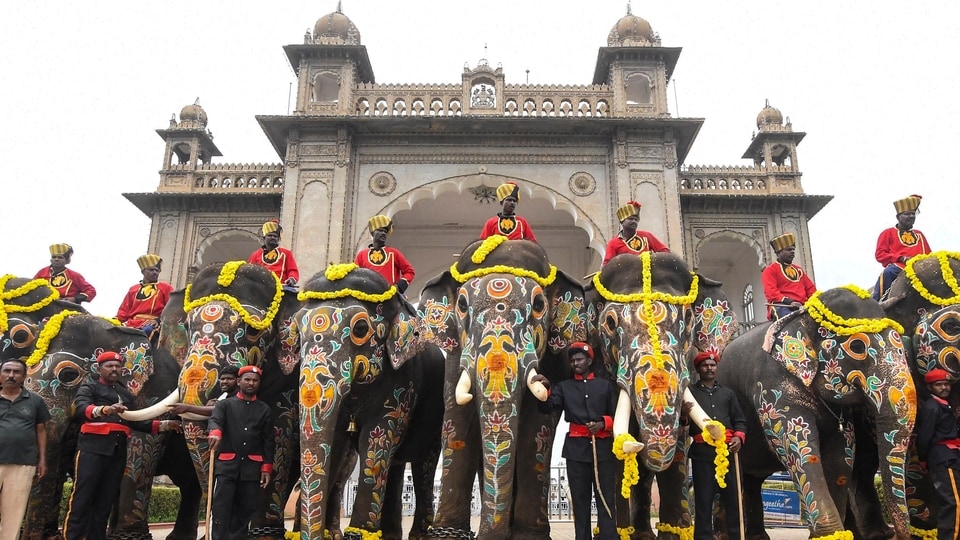
Weeks before that, on October 4, an elephant named Srinidhi attacked her handler, called a mahout, at a temple in Tiruchanoor, Andhra Pradesh. The mahout later died of his injuries.
The incidents have once again brought attention to the use of captive elephants in events, even as questions over the movement of elephants between states have intensified. After the Shivamogga incident, the state government and forest officials said they will introduce stricter measures before allowing the use of elephants in the cultural events, including proper training for elephants and veterinary checks.
In September, five captive elephants from Assam were moved to temples and religious institutions in Tamil Nadu, with animal welfare groups questioning the circumstances of their transfers.
A look at what the law allows and why activists are pushing for a rethink:
The law
Captive elephants can be shifted from one state to another, but it is not an unrestricted right. India had 2,725 captive elephants in 2026, up from 2,675 in 2019, according to figures conveyed by the environment ministry to the Supreme Court in August.
Elephants are protected as a Schedule I species under the Wild Life (Protection) Act, 1972, which places strict restrictions on their possession, transfer and transport.
Section 43(1) of the Act bars the transfer of a captive animal “by way of sale or offer for sale or by any other mode of consideration of commercial nature”. But an amendment that came into force on April 1, 2023, created a specific provision under Section 43(2) and allowed the transfer or transport of a captive elephant for a “religious or any other purpose” by a person holding a valid certificate of ownership, subject to conditions prescribed by the central government.
In March 2024, the Centre notified the Captive Elephant (Transfer or Transport) Rules, 2024, under the Act, laying down a formal process for moving captive elephants within or between states.
For a transfer, the owner has to apply to an officer not below the rank of deputy conservator of forests. A veterinary practitioner has to examine the elephant, while officials have to conduct an inquiry and physical verification of the existing and proposed facilities.
For an inter-state transfer, the chief wildlife warden of the state where the elephant is housed forwards the application and reports to the chief wildlife warden of the recipient state, who examines the proposed facility. The recipient state’s warden then sends a recommendation back, and the warden of the state where the elephant is housed issues the final order permitting or rejecting the transfer.
The rules also require the elephant’s genetic profile to be entered into the Centre’s electronic monitoring system before a transfer is permitted. Transfers may be allowed where the owner can no longer maintain the elephant, where the elephant would have better upkeep at the proposed destination, or where the chief wildlife warden considers the transfer fit and proper for better upkeep.
Transport is subject to additional safeguards. The elephant must travel with a mahout and an elephant assistant, have a veterinary fitness certificate, be free from musth (a periodic phase in male elephants marked by a surge in hormones and aggression) or infectious or contagious disease, and have arrangements for food and water during the journey. Sedatives can be used for nervous or temperamental elephants only on a veterinarian’s prescription.
Also read: Explained: Will it get easier to experiment on animals in India? What the draft rules propose
What activists and the government say
Animal welfare groups say the bar on commercial transfers makes the line between a genuine donation and a sale passed off as one crucial.
Animal rights activist Gauri Maulekhi, trustee of non-profit People for Animals (PFA), said an elephant does not lose the protection of the law because its owner is a religious entity. “The 2022 amendment permits captive elephants to be transferred for religious purposes, but Section 43(1) still prohibits any transfer for commercial consideration. A sale dressed up as a ‘donation’ remains an offence,” she said.
The concerns, activists say, go beyond whether an elephant has the necessary permission to move between states or take part in a religious event. They argue that the central question is what happens once the animal is moved and whether putting a captive elephant in a crowded setting can ever be considered a welfare-friendly use.
“The real question is what life awaits the animal. Food and a shed cannot compensate for chaining, isolation and coercion… MoEFCC should require every transfer permission, inspection report and follow-up welfare assessment to be made public, and amend the Rules to end new acquisitions of elephants by religious institutions, with proper rehabilitation for those already captive,” Maulekhi said.
Elephants are known to be intelligent and social animals. Activists say prolonged chaining, isolation, coercive handling, long-distance transport and exposure to crowds, loud music, fireworks and other unfamiliar stimuli can cause severe physical and psychological stress.
“Numerous studies on elephants conducted in India and all over the world show that these large and intelligent animals do not fare well in captivity. Elephants chained for long hours show severe signs of stereotypic behaviour, involving repeated swaying, head bobbing and bouts of violent behaviour,” Shubhobroto Ghosh, wildlife project manager at non-profit World Animal Protection, said.
He alleged that legal loopholes and ambiguity enable unnecessary transfers of captive elephants across the country.
Debadityo Sinha, lead, climate and ecosystems at Vidhi Centre for Legal Policy, said the misuse of exemptions has long been a concern.
“In 2010, the ministry’s own elephant task force highlighted that many captive elephants were born in the wild and were exploited for private purposes, including tourist rides, circuses and festivals. It recommended amending the law to plug the loopholes to address such misuse. Yet, instead of closing these loopholes, the 2022 amendment to the Wildlife (Protection) Act, 1972 widened them. We must begin phasing out private ownership of elephants and their exploitation, with those remaining in captivity placed exclusively under State custody,” he said.
The government maintains that the process has checks built in. An environment ministry official who spoke on the condition of anonymity said the system was different from the transfer of animals from zoos, where the Central Zoo Authority has a role. “For captive elephants, one requires consent from the chief wildlife warden of both states,” the official said.
The official also pointed out that religious processions are only one reason for movement. Elephants may be moved when owners shift states, when ownership changes, or when elephants are used as kumkis or trained captive elephants used for wildlife management.
The chief wildlife warden, the official said, has to be satisfied with the reason and the conditions before any transfers.
Forest officials of Assam and Tamil Nadu said the elephant transfers in September were carried out as per the law. “Both chief wildlife wardens mutually agreed to the transfer and conditions set. In all five cases, the mahout said he was unable to pay for the upkeep of the animal. This is a fairly common occurrence too, where mahouts – if they have to transfer ownership, cite this as a reason. In only one out of the five cases was it mentioned or explicitly stated that the elephants will be used at a temple. As per the rule, even that is not mandatory to disclose,” an Assam forest department official said.
The cases before the courts
The transfer of five privately owned elephants from Assam to Tamil Nadu temples in September was challenged in the Gauhati high court by conservationist Rohit Choudhury.
Choudhury already had a petition pending before the court, filed in 2023, which challenged provisions of the Wild Life (Protection) Act governing the ownership and custody of captive elephants. As the five elephants were about to be moved this September, he filed an application within that petition, asking the court to halt the transfer.
On September 17, a bench of Chief Justice Ashutosh Kumar and Justice Arun Dev Choudhury declined, finding no reason to pass a restraint order “unless it is clearly shown that necessary clearances have not been obtained”.
Assam’s counsel told the court that all clearances had been given and that all possible care would be taken during transport.
The broader questions are before the Supreme Court, which has been hearing a public interest litigation (PIL) on captive elephants since 2014. Filed by the Wildlife Rescue and Rehabilitation Centre, the petition alleges that captive elephants across the country are treated cruelly, illegally sold and transferred “under the guise of gifts or donations”, used for commercial and religious activities, and kept in poor conditions.
Hearing the case on August 18, a bench of Chief Justice of India Surya Kant and justices Joymalya Bagchi and V Mohana directed that no change in ownership or transfer and transportation of captive elephants be permitted except “in accordance with the applicable statutory scheme and rules”. Each such change, the court said, “shall contain the complete particulars of the transferee and transferor along with the purpose of such transfer”. It also directed the Centre to work with states to set up “elephant clinics”, where owners would have to take their elephants for periodic check-ups, and asked the environment ministry to report whether all captive elephants had been DNA-profiled.
The case is listed again on October 29.
Separately, the Tripura high court, while hearing a petition that sought to stop the transfer of captive elephants from to Gujarat, had set up a high-powered committee chaired by retired SC judge Deepak Verma in 2002.
In 2023, the Supreme Court extended the committee’s remit to the whole country, directing that complaints about the transfer, import, procurement or welfare of wild animals, including captive elephants, be sent to it. The committee can then recommend that animals be handed over to a rescue centre or zoo.
Also read: Community dogs and shelters: A reality check
The pitched alternative
Some groups have pitched life-size robotic elephants as a way to take animals out of ceremonies.
In September, Delhi’s Forest and Wildlife department, prompted by People for the Ethical Treatment of Animals (PETA) India, issued an advisory encouraging religious institutions and event organisers to use mechanical elephants, especially in urban areas.
PETA and other non-profits have donated about 40 such elephants to temples across India, at about $6,000 each, the Associated Press reported in July.
The response has been mixed. Traditionalists and elephant owners argue that an animal cannot be replaced by a mechanical model because it represents the divine. Others see no religious bar. The head priest of a temple in Kerala, which uses a mechanical elephant, told AP that the texts governing daily rituals do not require live elephants.