
 E-Paper



CAQM cites pollution, asks SC to review relief for end-of-life vehicle owners in Delhi
In its latest report submitted to the court, CAQM has recommended excluding BS-III and older vehicles from the relief granted in August.

 Prefer HTon Google


The Commission for Air Quality Management (CAQM) in the National Capital Region (NCR) and Adjoining Areas has cited noxious air and asked the Supreme Court to review its August 12 direction for no coercive action against those driving 10-year-old diesel and 15-year-old petrol vehicles in Delhi.
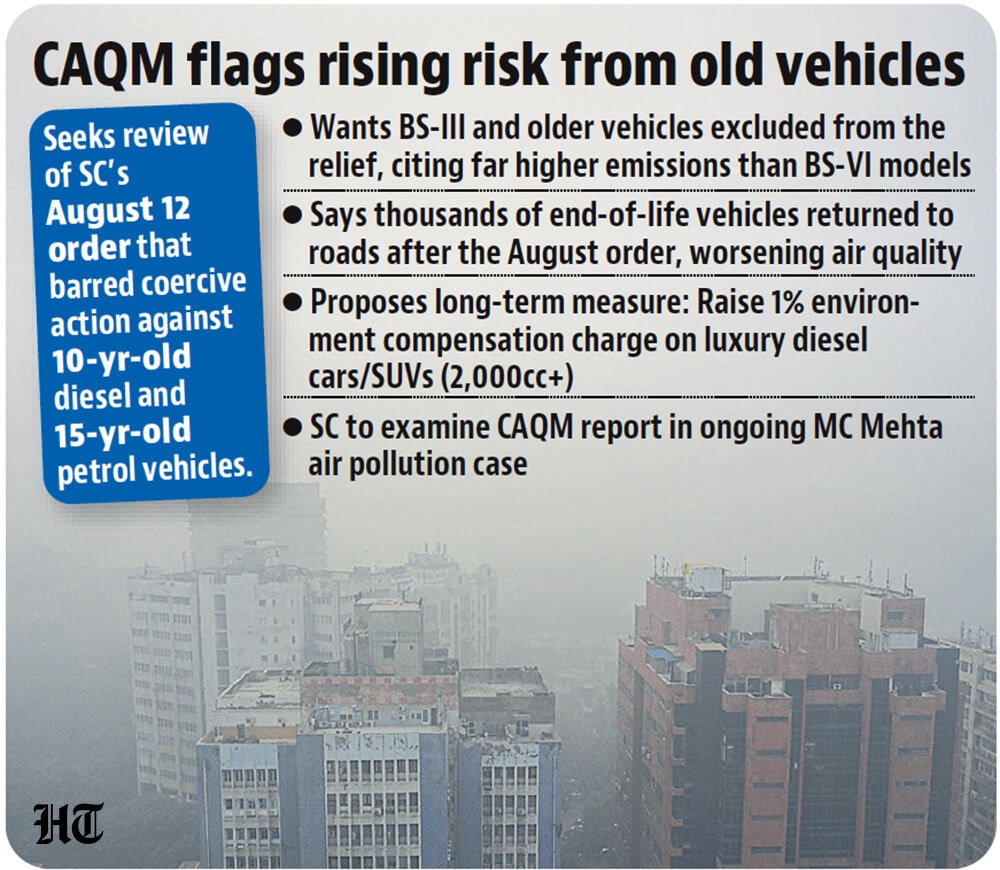
The commission has also proposed a long-term measure to raise the Environment Compensation Charge – currently 1% – on luxury diesel cars and SUVs with engine capacities of 2,000cc and above, as mandated in a 2016 court order.
The court in August effectively stayed the implementation of its October 2018 order, which affirmed a 2014 National Green Tribunal (NGT) judgment seeking to keep polluting vehicles – end-of-life vehicles (ELVs) with outdated emission standards of BS-III and below – off the roads to combat the noxious air. The order led to thousands of ELVs returning to the roads, prompting CAQM to analyse their emission load in comparison to vehicles compliant with the current BS-VI standards.
In its latest report submitted to the court, CAQM has recommended excluding BS-III and older vehicles from the relief granted in August. “For controlling vehicular emissions, BS-III and below standard vehicles are required to be kept out of the purview of the order dated August 12, 2025… considering their emission potential in comparison to BS-VI emission standards,” the report stated. The commission said such short-term curbs are necessary given the persistent deterioration in Delhi-NCR’s winter-time air quality.
Vehicular emissions, CAQM noted, remain one of the most significant contributors to the region’s poor air during the cold months, and the operation of ELVs has long been a concern. NGT had issued a series of orders during 2014–2015 restricting the plying of such vehicles in NCR, a position upheld by the Supreme Court in October 2018, after which violators were routinely impounded.
The commission, in its analysis, highlighted how outdated standards magnify the problem. BS-III vehicles have been in use for more than 15 years, BS-II vehicles for over 20 years, and BS-I vehicles for around 24 years. “Since Delhi-NCR faces an extraordinary situation, especially during the winter season due to poor dispersal of pollutants, there is a need to restrict plying of polluting vehicles based on emission standards,” the report said.
CAQM also pointed out that nearly 93% of the region’s vehicles are light motor vehicles and two-wheelers, forming the bulk of the outdated fleet. To enforce compliance with earlier court orders, the commission had directed in April 2025 that fuel stations deny fuel to all EOL vehicles in Delhi from November 1 this year, and in five high-density NCR districts from April 1, 2026.
The Supreme Court bench led by Chief Justice Surya Kant is expected to take up CAQM’s report in the ongoing MC Mehta air pollution proceedings.

Stay updated with all top Cities including, Bengaluru, Delhi, Mumbai and more across India. Stay informed on the latest happenings in World News along with Delhi Election 2025 and Delhi Election Result 2025 Live, New Delhi Election Result Live, Kalkaji Election Result Live at Hindustan Times.


