
 E-Paper



CAQM: Will make Delhi, 8 NCR cities dust-free
The eight other cities include Gurugram, Noida, Greater Noida, Ghaziabad, Rewari, Sonepat, Faridabad and Bhiwani. CAQM, in collaboration with Raahgiri Foundation, will set up resource labs to train engineers from all road-owning agencies to design sustainable streets

 Prefer HTon Google


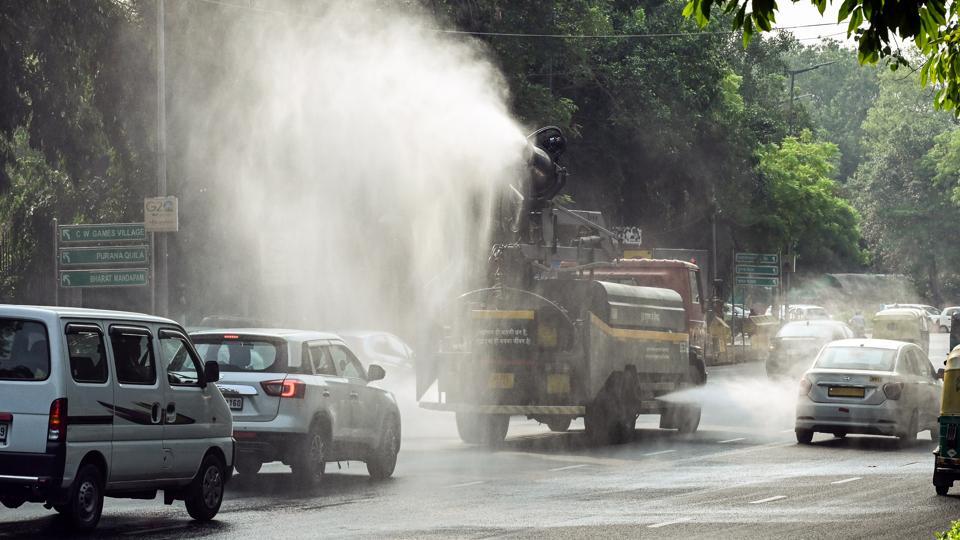
The roads of Delhi and eight other cities in the National Capital Region (NCR) will undergo a redesign to make them dust-free, which will help in improving public health, the Commission for Air Quality Management (CAQM) said on Tuesday.
The announcement was made by CAQM member Sujit Kumar Bajpayee at Urban Adda 2025, a three-day urban mobility conference in Delhi organised by the Raahgiri Foundation in partnership with the International Council on Clean Transportation (ICCT) and GuruJal, and supported by Nagarro. HT is the media partner for the event.
The eight other cities include Gurugram, Noida, Greater Noida, Ghaziabad, Rewari, Sonepat, Faridabad and Bhiwani. CAQM, in collaboration with Raahgiri Foundation, will set up resource labs to train engineers from all road-owning agencies to design sustainable streets.
This will include designing intersections, drainage, spaces under flyovers and seamless footpaths among other things.
The cities have already submitted action plans in this regard as CAQM had issued the direction in January itself, and the designing is expected to start soon.
“The idea is to create dust-free roads by retrofitting, reimagining and redesigning streets. This will be achieved by end-to-end paving and greening of roads. All the nine cities have submitted action plans. We will now be helping with framing guidelines, in accordance with the Indian Road Congress norms, to help in redesigning of roads,” said Bajpayee.
He added that the objective of the program is to reduce dust pollution and particulate matter, improve public health, promote sustainable transportation, build capacity for sustainable urban development, create replicable models and adapt for climate change and resilience to disasters.
“The Resources Lab will serve as a training ground for officers, agencies and stakeholders from NCR cities under the jurisdiction of CAQM, empowering them to implement sustainable road design principles in their respective regions for abatement of dust pollution from roads and open areas around it leading to overall improvement in air quality,” said Sarika Panda Bhatt, co-founder of Raahgiri Foundation.
She added that the transformation of urban streets offers a powerful, localized approach to mitigating air pollution and fostering healthier communities.
Dust pollution remains a key source of pollution in NCR, particularly in the summers, leading to a spike in PM10 concentration as coarser particles get introduced in the air. Dry summers and strong surface winds not only allow local dust upliftment, but often bring dust from the neighbouring Rajasthan and Haryana towards Delhi, spiking PM10 concentration in Delhi and its neighbouring areas.
A source apportionment study by IIT Kanpur in 2016 had shown that dust from roads, digging and agriculture accounts for the highest suspended particulate matter sources in Delhi, contributing 38% of PM2.5 and 56% of PM10 in Delhi.
A 2018 The Energy and Resources Institute (TERI) source apportionment study also found dust to be playing a significant role in the summer months, contributing to around 42% to PM 10 in the season.
To tackle dust in the region, CAQM in January asked Delhi, Haryana, Uttar Pradesh, and Rajasthan to prepare area-specific action plans. The directives included essential measures such as regular road sweeping, the greening of roadsides, and strict dust control mandates for construction sites, to curb road dust emissions effectively.


Stay updated with all top Cities including, Bengaluru, Delhi, Mumbai and more across India. Stay informed on the latest happenings in World News along with Delhi Election 2025 and Delhi Election Result 2025 Live, New Delhi Election Result Live, Kalkaji Election Result Live at Hindustan Times.


