
 E-Paper



Centre to set up stations to monitor Yamuna e-flow in Delhi, Haryana
The Indian government will set up two monitoring stations on the Yamuna River to track its ecological flow and combat pollution, funded under the Namami Gange Mission.

 Prefer HTon Google


New Delhi
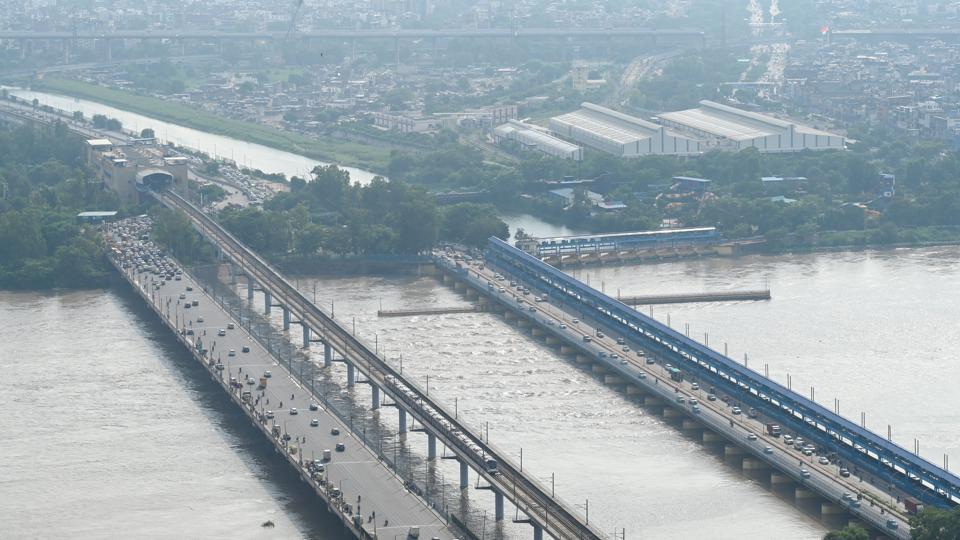
The central government will set up and operate two monitoring stations on the Yamuna River, near the Hathnikund and Okhla barrages, in an attempt to establish an independent monitoring mechanism for tracking the e-flow of the river, government officials said on Tuesday.
Restoring the ecological flow of the highly polluted Yamuna is a key component of the river rejuvenation plan. Once complete, the two stations will enable real-time monitoring of the river parameters and its flow, officials said.
An official aware of the matter said that the National Mission for Clean Ganga (NMCG) has granted administrative approvals. “The project will be executed under the Namami Gange Mission with central government providing ₹1.56 crore for both the stations. Around ₹1 crore would be spent on equipment while remaining money on boards and other assets,” the official said.
Environmental flow, or e-flow, refers to the minimum flow of water required in a river to sustain its ecological health. The Yamuna in Delhi has long fallen short of this benchmark. Experts argue that the 10 cumecs (190 million gallons per day) currently allocated to Delhi is grossly insufficient, leaving the river dry and unable to flush out pollutants. Studies, including those by the National Institute of Hydrology, have pointed to a more realistic figure: 23 cumecs (437 million gallons per day). Doubling the flow of the river in Delhi, experts said, will help the river breathe, dilute toxins in the river and give it hope to sustain at least some aquatic life.
In 2023, a parliamentary panel on water resources had called for an e-flow of at least 23 cumecs to ensure basic ecological functioning and prevent visible symptoms of pollution such as frothing.
The official said that the two monitoring stations will be developed over the next six months, and the deadline for the project is September 2026. The NMCG e-flow monitoring centre is a real-time digital system to track the environmental flows (e-flows), ensuring mandated water levels for river health, aquatic life, and sustainable use. It is integrated with the online portal for overall water quality and project management. “It provides real-time data on water flow, quality, tracks water quality and flow in the river,” the official said.
The Yamuna’s journey begins near the Banderpooch peak of the Yamunotri glacier, 6,387 metres above sea level in the Himalayas. It travels 1,376 kilometres before merging with the Ganga at Allahabad. Along the way, it is controlled by a series of barrages that divert water into canals. By the time it reaches Delhi, particularly in peak summer, only around 10% of its original volume remains.
One of the main points of contention on the river is the Hathnikund Barrage in Haryana, which acts as the primary regulation point for the release of water to Delhi. It has been the grounds for frequent disputes between the two states over the past, with each disputing the actual quantum of water released from the barrage. Officials say that for most of the year, the Yamuna’s flow downstream of Wazirabad Barrage is minimal. “The little water present during non-monsoon months is almost entirely sewage.”
The Okhla Barrage is the last of three barrages in Delhi where the river is highly polluted. The 22km stretch from Wazirabad to Okhla contributes more than 76% of its pollution load.
Under the Delhi government’s Yamuna rejuvenation plan, multiple projects are under consideration for increasing the e-flow of the river, including adding more treated water to the river downstream of Wazirabad and Okhla Barrages, diverting some Ganga water to the Yamuna, as well as renegotiation of the 1994 water-sharing agreement, which is due this year.

Stay updated with all top Cities including, Bengaluru, Delhi, Mumbai and more across India. Stay informed on the latest happenings in World News along with Delhi Election 2025 and Delhi Election Result 2025 Live, New Delhi Election Result Live, Kalkaji Election Result Live at Hindustan Times.


