E-Paper



Cold comfort for a change: Monsoon lands in Delhi
Safdarjung, the observatory representative of Delhi’s weather, was also the national capital's wettest station, receiving 116.6mm of rain between 8.30am and 5.30pm on Thursday, followed by Lodhi Road, which got 107.6mm. A bulk of this rain was between 8.30am and 2.30pm, the Met department said.

 Prefer HTon Google


Monsoon arrived in the Capital on Thursday, the Met department said, and made its presence known with over 116mm rain all day, leaving roads in some parts of the city waterlogged and slowing rush hour traffic to a standstill. But, there were few complaints — Thursday’s showers pushed the minimum temperature down by nearly 12 degrees Celsius (°C), not just stopping a punishing spell of stocky heat, but also giving Delhi its coolest day in 116 days.
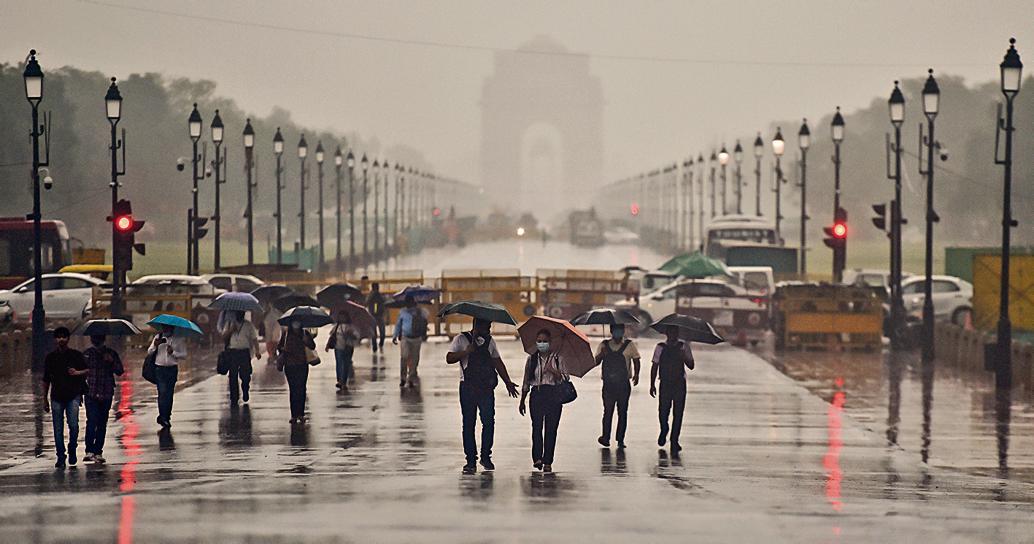
Safdarjung, the observatory representative of Delhi’s weather, was also the national capital's wettest station, receiving 116.6mm of rain between 8.30am and 5.30pm on Thursday, followed by Lodhi Road, which got 107.6mm. A bulk of this rain was between 8.30am and 2.30pm, the weather office said.
Overcast skies and the nearly unfettered spell of rain all morning and afternoon on Thursday meant that Delhi’s maximum temperature plummeted to a cool 29.4°C, a precipitous drop from 40.9°C just a day ago. This was the city’s coolest day this year since 28.2°C on March 6, around the time winter was on its way out.
Pollution levels dropped steadily all day as well, with the air quality index (AQI) falling from 163 at 4pm on Wednesday to 91 by 9pm on Thursday.
Also Read | Parts submerged, waterlogged roads force Delhi traffic to a standstill
The India Meteorological Department (IMD) classified Thursday’s rain as ‘very heavy’, the last of the weather office’s bands to categorise precipitation in a region.
IMD classifies rainfall between ‘trace’ and 2.4mm as ‘very light’, between 2.5 and 15.5mm as ‘light’, between 15.6 and 64.4mm as ‘moderate’, between 64.5mm and 115.5mm as ‘heavy’ and ‘very heavy’ when it is 115.6mm or higher.
So far this year, Delhi had not received a single spell of even heavy rainfall this year, let alone a very heavy one.
In fact, for perspective, Delhi recorded just 24.5mm of rain in the first 29 days of June.
Before Thursday, January 8 was Delhi’s wettest day of the year, when the city received 40.6mm of rain. Delhi last logged a ‘very heavy’ rainfall on September 2 last year, when 117.7mm of showers lashed the city.
IMD scientists said they expect rains to continue across northwest India, including Delhi, till July 6, with an ‘orange’ alert currently in place for Saturday, and a ‘yellow alert’ in place for the other days in that interim.
“Monsoon covered all of Delhi, all of Uttar Pradesh, all of Himachal and Jammu & Kashmir, along with some parts of Punjab, Haryana and Rajasthan. For Delhi, this was an intense spell of rain, with over 100mm recorded in a six-hour period between 8.30am and 2.30pm. Some light rain could continue until Friday morning,” said RK Jenamani, scientist at IMD, adding that Delhi is expected to see low temperatures till next week.
“The mercury will stay in the low- to mid-30s, and though humidity levels will remain high, Delhi will not be uncomfortably hot, as it was for much of the last week of June,” he added.
Much of Delhi is expected to record moderate rainfall on Friday, said the Met’s weather forecast, with the maximum temperature expected to be around 32°C.
The Met department issues a yellow alert to warn the general public of a weather phenomenon in place, a category that is upgraded to an orange alert, if preventive action is required.
Pitampura was the Delhi’s hottest spot on Thursday, with a maximum temperature of 30.0°C, and Jafarpur was the coolest, at 25.8°C. In terms of minimum temperature, Safdarjung recorded a difference of only 1.8°C between the maximum and the minimum temperature, with the minimum settling at 27.6°C.
Amon the other weather stations, the Ridge station also recorded heavy rainfall, receiving 65.2mm of rainfall, while Ayanagar (51.9mm), Delhi University (58.5mm), Pitampura (55.5mm) and Pusa (44.5mm) all recorded moderate rainfall.
In terms of air quality, Delhi’s air quality index (AQI) dropped, but remained in the ‘moderate’ category, recording an AQI of 116 as per Central Pollution Control Board’s daily 4 pm bulletin. It was 163 (moderate) at the same time on Wednesday. This is likely to drop down to the ‘satisfactory’ category in the next 24 hours, owing to more rain.