The Delhi Development Authority (DDA) on Wednesday approved the Master Plan for Delhi-2047 (MPD-2047), which relaxes protections for one chunk of the Yamuna floodplain, allows commercial construction in 70 villages on the edges of the Capital and permits reconstruction and redevelopment of old two-storey DDA units.
The plan, which sets out a long-term framework for the Capital’s housing, mobility, infrastructure, environment and economic development will now be sent to the Union ministry of housing and urban affairs (MoHUA) for final approval and subsequent notification.
Also read: DDA approves Master Plan Delhi 2047; 2041 deadline moved
“With Delhi’s population projected to grow significantly by 2047, the Master Plan adopts an integrated approach towards housing, economic growth, mobility, environmental sustainability, infrastructure, heritage conservation, urban regeneration and citizen-centric governance,” DDA said.
The decision was taken at a DDA meeting chaired by lieutenant governor Taranjit Singh Sandhu and attended by vice-chairman N Saravana Kumar and other members of the authority. DDA also approved the policy allowing reconstruction and redevelopment of old DDA-built two-storey dwelling units, amendments to the 2016 Unified Building Bye-Laws (UBBL), which seek to simplify the building plan approval process and reduce procedural requirements, as well as a change in land use for a metro depot for the Rithala-Kundli corridor in Narela.
“The new Master Plan for Delhi 2047 was approved for further consideration, aligning Delhi’s long-term vision with Hon’ble PM Shri @narendramodi Ji’s mission of #ViksitBharat@2047. Deliberated on a roadmap for sustainable and inclusive urban growth, with greater Ease of Doing Business, Ease of Living, and a cleaner, greener capital for all. Delhi has a pivotal role to play in shaping this journey,” Sandhu posted on X.
{{/usCountry}}“The new Master Plan for Delhi 2047 was approved for further consideration, aligning Delhi’s long-term vision with Hon’ble PM Shri @narendramodi Ji’s mission of #ViksitBharat@2047. Deliberated on a roadmap for sustainable and inclusive urban growth, with greater Ease of Doing Business, Ease of Living, and a cleaner, greener capital for all. Delhi has a pivotal role to play in shaping this journey,” Sandhu posted on X.
{{/usCountry}}Also read: Master Plan amendments: Floor area ratio norms to be decided on consultant’s report
Yamuna floodplain divided into two zones under new plan
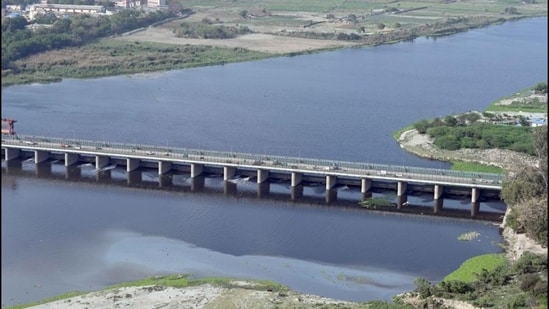
The most significant change proposed by the agency was to the definition of the 22km-long Yamuna floodplain, earlier treated as a single protected O zone where development was largely restricted. MPD 2047 divides it into O-1 and O-2, HT has learnt. While no construction or development will be permitted in O-1 — which falls within the defined 1-in-25-year floodplain, or the manner in which the banks are proposed to be defined based on the probability of floods once in 25 years — O-2, the area outside this zone, will allow specified recreational activities, including parks and green spaces, subject to regulations, an official aware of the matter said.
Also read: O-zone split with recreational activities to be allowed along floodplains
DDA has revealed details of the Master Plan yet and it is unclear how the O zone will be demarcated.
The draft MPD-2041 had proposed that the Yamuna floodplain – a low-lying riparian zone with a 4% annual probability of flooding and designated as O-Zone by successive master plans – would be included in the city’s database of green-blue infrastructure. The draft plan had specifically stated that “no permanent construction shall be permitted in the floodplain” and proposed public access through 75-100 metre-wide greenways along embankments, with cycling and walking trails and spaces for passive recreation. But the new plan, officials explained, creates a distinction between the “core floodplain” and the “outer buffer”.
70 peripheral villages to get regulated commercial development
Another significant change will be in 70 villages on the city’s periphery through a Green Development Area (GDA) framework, allowing regulated commercial and institutional activity in areas where such development was earlier restricted, HT has learnt.
These will include all 70 villages on the outskirts or periphery of Delhi, including Tikri Kalan, Mitraon Dhansa, as well as areas with farmhouses like Mehrauli, Chhatarpur and Satbari.
Also read: New master plan to allow commercial development in 70 peripheral villages
Higher density planned through vertical development
The GDA framework, which was detailed in the earlier 2041 plan brings together around 70 villages falling in the Green Belt and Low-Density Residential Area (LDRA) under a common planning framework. Of these, 47 were earlier governed by rules that restricted new residential and commercial construction, and 23 didn’t.
Now, the new plan has paved the way for commercial development in all 70 villages along the periphery of Delhi with Gurugram and Noida-like vertical development, allowing higher Floor Area Ratio (FAR), said an official aware of the matter.
“The emphasis on vertical development is linked to the limited availability of land in the already urbanised parts of Delhi. Instead of continued horizontal expansion, redevelopment can allow existing plots and built-up areas to accommodate more housing, commercial activity and other uses through higher-density forms of development, subject to infrastructure and development-control norms,” another official added.
A senior DDA official said, “The policy will encourage green development and will ensure seamless development of infrastructure and road network within and around GDA. For these areas, minimum 12m, 18m and 30m roads are being considered.”
Also read: DDA plans major urban overhaul with 8-point development roadmap for Delhi
Old DDA homes to get redevelopment rights
The authority also approved a uniform policy for reconstruction and redevelopment of old DDA-built two-storey units on individual plots. The policy will apply to older housing schemes such as Naraina Vihar.
According to DDA, several housing schemes developed under MPD-1962 have two-storey built-up units on individual plots that are more than five decades old and have become structurally deficient. Under the new policy, such units will receive redevelopment rights on par with vacant residential plots.
DDA also approved amendments to UBBL-2016 to simplify the building plan approval process and reduce procedural requirements. The changes seek to de-link the requirement of obtaining prior no-objection certificates from the Delhi Pollution Control Committee, Chief Inspector of Factories, Delhi Jal Board and Forest Department for obtaining building permits.
“This is part of the government’s broader deregulation exercise and is aimed at reducing compliance burden and facilitating faster approvals,” a DDA official said.
Narela metro depot gets land-use approval
Another major decision involved 19.63 hectares of land in Narela Sub-City in Zone P-I. DDA approved its change in land use from “recreational” and “public and semi-public” to “transportation” for development of a metro depot for the Rithala-Kundli corridor.
The proposed extension of the Delhi Metro’s Red Line from Rithala to Kundli is expected to connect north-west Delhi, Rohini and Narela with areas of Haryana.
“The authority also approved several other land-use changes. A 7,978 sq metre parcel in Roshanpura will be considered for construction of the Veterinary Council of India headquarters, with the proposed change from residential to public and semi-public use to be placed before the public for objections and suggestions,” an official said.
Similarly, a 24,400 sq metre plot adjacent to the Sarojini Nagar residential area was approved for change from transportation (rail circulation) to residential use. Public notices will be issued for objections and suggestions. Three plots at Copernicus Lane, measuring 8,494.35 sq metres and allotted by the Land and Development Office to Bharatiya Vidya Bhavan, were approved for change from residential to public and semi-public use. The proposal is linked to the institution’s plans to expand into higher education and research related to Indian traditional knowledge systems.
Stay updated with all top Cities including, Bengaluru, Delhi, Mumbai and more across India. Stay informed on the latest happenings in World News along with Delhi Election 2025 and Delhi Election Result 2025 Live, New Delhi Election Result Live, Kalkaji Election Result Live at Hindustan Times.
Stay updated with all top Cities including, Bengaluru, Delhi, Mumbai and more across India. Stay informed on the latest happenings in World News along with Delhi Election 2025 and Delhi Election Result 2025 Live, New Delhi Election Result Live, Kalkaji Election Result Live at Hindustan Times.