
 E-Paper



Delhi AQI improves marginally, but remains in ‘severe’ category at 413
Of the 34 functioning stations at 7am on Saturday, 25 were in the ‘severe’ category, with Dr Karni Singh Shooting Range (455) the worst impacted, followed by Shadipur (451) and Anand Vihar (448)

 Prefer HTon Google


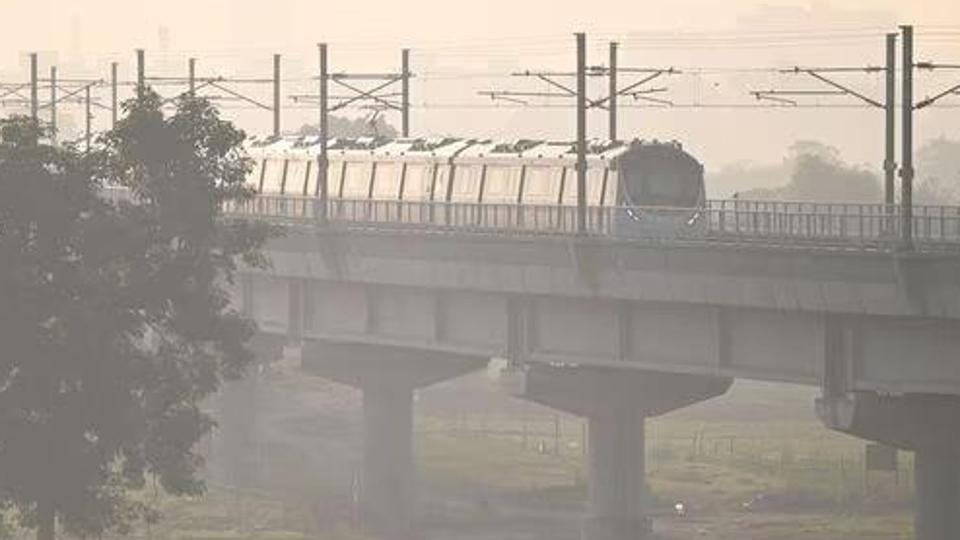
Delhi on Saturday woke up to a thick hazy morning dominated by a mixture of fog and pollutants, with air quality still in the ‘severe’ category for the third consecutive day after it crossed the 400 mark on Thursday evening for the first time this season.
The 24-hour average air quality index (AQI) recorded in Delhi stood at 413 at 7am on Saturday. This, however, was an improvement from Friday’s 4pm reading of 468– the city’s worst AQI since November 2021.
Of the 34 functioning stations at 7am on Saturday, 25 were in the ‘severe’ category, with Dr Karni Singh Shooting Range (455) the worst impacted, followed by Shadipur (451) and Anand Vihar (448). In most cities around Delhi, the AQI was in the ‘severe’ category. Faridabad’s AQI was 460 and Noida- 440, Sonipat’s AQI was 374 and Greater Noida’s was 494.
Wind speeds were almost calm in Delhi on Friday but picked up in parts of the city after 2pm, leading to a gradual improvement in the overall air quality and a dip on Saturday morning.
Also Read: Calibrating pollution meters vital in Delhi, NCR: Experts
This downward trend also meant the Commission for Air Quality Management (CAQM) in the National Capital Region (NCR) did not invoke measures under the ‘severe plus’ or stage 4 of the Graded Response Action Plan (GRAP) on Friday, despite the AQI touching a peak of 475 at noon.
Measures under this category can be invoked when the AQI crosses the 450 mark or is expected to cross this threshold, based on forecasts.
Grap categorises actions into four stages: Stage I – ‘Poor’ (AQI 201-300); Stage II – ‘Very Poor’ (AQI 301-400); Stage III – ‘Severe’ (AQI 401-450); and Stage IV – ‘Severe Plus’ (AQI >450).
On Thursday, the Centre’s pollution control panel invoked the stage 3 of Grap, directing a halt on non-essential construction work, stone crushing and mining in Delhi-NCR. Under this stage, restrictions are also imposed on the operation of BS III petrol and BS IV diesel four-wheelers in Delhi, Gurugram, Faridabad, Ghaziabad, and Gautam Budh Nagar.
Also Read: Delhi pollution: Several areas in national capital in severe category
The measures under Stage 4 include a complete ban on the entry of trucks into Delhi and stopping construction activities, including linear projects like highways and roads– which are allowed under Stage 3. Further, a ban on plying of Delhi registered diesel goods vehicles and a ban on light commercial vehicles outside Delhi (unless essential), and shutting down of schools and government offices.
Forecasts by the Early Warning System (EWS) for Delhi, which CAQM relies on for taking action under GRAP, showed AQI was likely to remain ‘severe’ till Monday.
“Delhi’s air quality is likely to improve marginally but will remain in the ‘severe’ category from Saturday till Monday. The outlook for subsequent six days shows the air quality is likely to remain in the ‘severe’ to ‘very poor’ category,” it said.
Data shared by the India Meteorological Department showed Delhi’s visibility at Palam was between 800 and 1,000 metres at 7am on Saturday. The lowest visibility on Friday at Palam was 500 metres.
Data from the Decision Support System (DSS), which comes under the ministry of earth sciences (MoES) and is being used by the CAQM in NCR, had on Friday estimated the highest contribution of Delhi’s PM 2.5 to be stubble burning on the day, with 35.4% coming from fields in northwest India. This was followed by 11.6% from Delhi’s vehicular sector and the third largest contributor was Jhajjar at 6.8%, it said.
Meanwhile, taking note of deteriorating air quality across northwest India in particular, the National Green Tribunal (NGT), has directed the chief secretaries of states where the AQI in cities has dipped to ‘severe’, ‘very poor’ and ‘poor’, to take immediate remedial action and submit action taken reports before November 11.
On Friday, Delhi Lt Governor VK Saxena chaired a meeting with the Delhi environment minister and the chief secretary to review the air quality situation and asked all government departments and agencies – irrespective of their mandate, to prioritise pollution mitigation activities.
The LG also asked the environment department to issue advisories asking children and elderly to remain indoors as much as possible and for others to travel only if necessary, further asking for water sprinklers, anti-smog guns and mechanised road sweepers to be used in double-shifts.


