E-Paper



Delhi Budget: Solar is govt’s new mantra for cheaper, reliable power
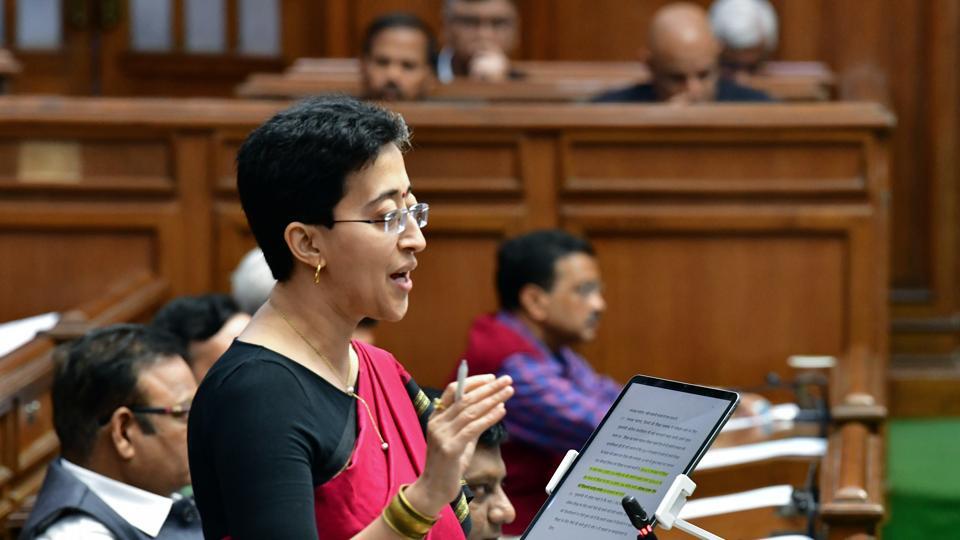
Atishi said that the government’s power subsidy scheme will continue in 2024-25, allowing a large population of Delhi’s consumers to continue receiving zero electricity bills

 Prefer HTon Google


The Delhi government will set up solar plants on the rooftops of all government buildings in 2024-25 to give a targetted push towards green energy, finance minister Atishi said during the Delhi Budget address on Monday, adding that a target of generating 4500 MW or around 25% of Delhi’s total power supply through solar energy by 2027 has been set.
Atishi added that the government’s power subsidy scheme will continue in 2024-25, allowing a large population of Delhi’s consumers to continue receiving zero electricity bills. The Delhi government has allocated ₹3,353 crore, the budget estimate to the power sector for the financial year 2024-25, a marginal increase from ₹3,348 crore allocated last year (BE). The revised estimate for last year was ₹3,446 crore.
Atishi said there were around 5.86 million domestic electricity consumers in Delhi, out of which around 68.33% or 4.02 million domestic electricity consumers are receiving benefits of the subsidy from the Delhi government. Out of these, over 2.2 million consumers were also receiving zero bills, she said.
“In 2023, around 3.41 crores (34.1 million) zero electricity bills were issued to consumers. We will continue this subsidy scheme this year also,” Atishi said during her speech, adding that the government was inspired by the principles of “Ram Rajya”, where the “government’s responsibility was not just towards the people but also the environment”.
Additionally, the government said it has planned a sustained push towards green energy and the Delhi Solar Policy 2024 will be notified soon. According to the policy, any consumer using more than 400 units of electricity can receive zero bills if they install adequate solar panels.
“The government will not only give subsidies for installation of solar panels but also give money for per unit electricity production from solar panels. Today, about 30% of Delhi’s power supply comes from green and renewable energy. At present, 255 MW of electricity in Delhi is produced from rooftop solar power plants and around 1,280 government buildings have solar rooftop plants installed on them. I am delighted to share that by 2024-25, every building under the Delhi government will have solar plants on its roof,” she said, adding that an ambitious target of achieving 4,500 MW from solar rooftops by 2027 — around 25% of Delhi’s total power supply — has been set.
Atishi said that in 2014, the residents of Delhi were grappling with power outages when the peak power demand was around 5,800 MW. “Delhi was able to meet a peak power demand of 7,438 MW on August 22 last year, without any load shedding... not only had the government managed to keep electricity prices and bills low, but the power distribution companies were also faring well,” the minister added.
“In the January rating released by the central government, all three discoms (distribution companies) in Delhi received an ‘A+ rating.’ Delhi’s Discoms rank among the top three in the country... All of them operate at a profit and the people receive free electricity. If this is not Ram Rajya, what is?” she added.
Experts said that the target of 4,500 MW by 2027 was ambitious — one that will require substantial support from citizens. ”Even if all Delhi government buildings are covered, the target is not likely to be met and one would still require Delhiites to adopt solar rooftop panels, in line with the new policy. We also have to ensure there is proper planning in terms of strengthening the distribution network as excess energy will be pumped back into the grid,” said Binit Das, deputy programme manager, renewable energy, Centre for Science and Environment.
Meanwhile, Delhi Bharatiya Janata Party chief Virendra Sachdeva said that the finance minister was misleading the residents of Delhi by saying that the Kejriwal government was providing power subsidy to 2.2 million consumers even as discoms made a profit.
“Atishi should know power discoms are not giving any subsidy to consumers. In fact, the Delhi government pays discoms from the taxpayers hard earned money for this subsidy,” he said.