
 E-Paper



Livia Manera Sambuy: “Many people didn’t want me to discover what happened”
The author of In Search of Amrit Kaur on rescuing the Rani of Mandi, who sold her jewels to save Jewish lives in WW2 Paris, from becoming a footnote in history

 Prefer HTon Google


What was the role of personal, material, and historical memories in trying to tell the tale of Rani of Mandi?

Every piece of memory is a piece of the mosaic. We need to collect stories, and we need to share them. This is what storytellers are for.
The book engages with details that several authors wouldn’t have considered exploring. You made connections between Albert Kahn and the rani’s story, looked at Khushwant Singh’s A History of the Sikhs, and stories regarding extraction of diamonds that several English people deemed fictional. How important was documenting each of these details?
When I started working on this book I understood that, while details about the life of the Rani of Mandi were scarce, something else was evident: she had crossed the lives of many important and interesting characters — the Alsatian banker and philantropist Albert Kahn, the groundbreaking artist, Amrita Sher-Gil, the Russian guru-artist-enterpreneur, Nicholas Roerich, and the hero of French resistance, Jean Rosenthal, among others. I realised I was looking at a very special group picture as opposed to a portrait of a beautiful, doomed woman.
I found the way these lives developed and intersected with the tragic arcs of hers extremely interesting. And I made a choice: my book would not be a straighforward biography, but the story of a quest — the quest for Amrit Kaur of Mandi, a princess whom history and other forces had obscured. Through this quest, it would also be a cross-cultural portrait of an era: the era of the end of the British Empire, India’s Partition, and the tragedy of WW2 in France.
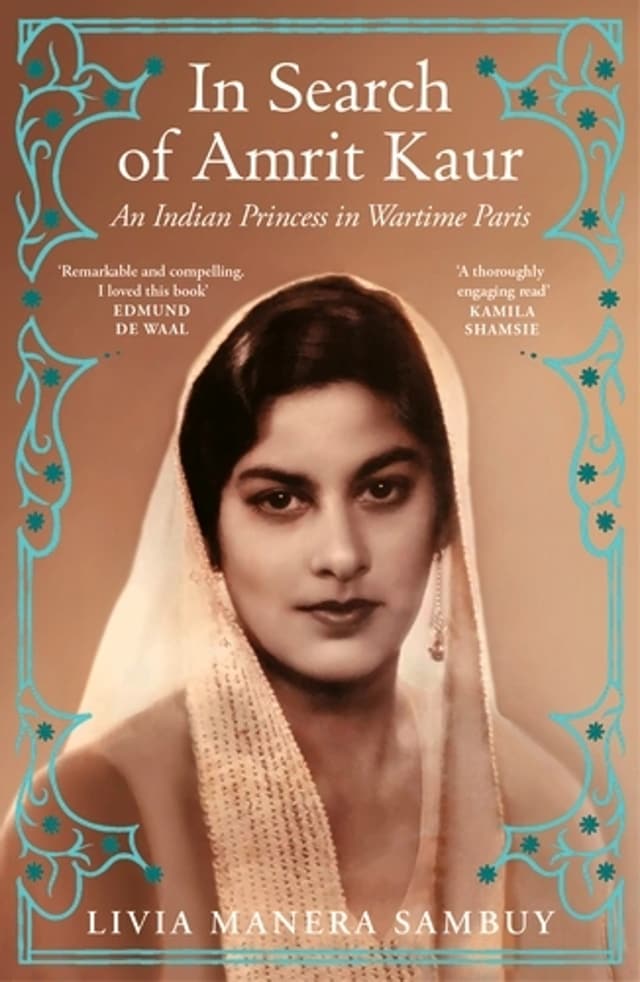
So, each and every story became important to me: from that of a great visionary and utopist like Albert Kahn, in Paris, who believed that encouraging knowledge of foreign cultures would lead people to practice tolerance, to those of the Rosenthal brothers, the most important gems and pearls dealers of the time, whose destiny intertwined with those of many Indian princes.
This quest for the Rani of Mandi came along when you were grieving. How were you able to channel your energy towards telling Amrit Kaur’s story?
They were certainly difficult years for me. I was grieving the loss of my brother; I separated from my husband; I started a new life in Paris just weeks before the financial crisis of 2008 hit the world, with hard consequences on my finances. But this didn’t stop me from being productive. I couldn’t afford to stop. While researching the life of the Rani of Mandi, I wrote and published another book (of profiles of American writers), and wrote and co-directed two documentary films about the American novelist Philip Roth. Not to mention my journalistic work, as cultural reporter and literary critic for the leading Italian daily newspaper, Corriere della Sera.
At some point, I did doubt that I would ever find the truth about the story of the Rani of Mandi selling her jewels to help Jewish friends leave France during the German Occupation, and paying for her courage with her life. Too many people didn’t want me to discover what really happened. In the worst moments, what sustained me was my stubbornness and my commitment towards Bubbles, the Rani’s daughter, who, in her eighties, wished to leave this world only after knowing why her mother abandoned her in 1933, and was never spoken about again in her family. Bringing closure to her and showing her, through some letters I found, that the Rani did want to go back to her daughter and son, but was stopped by major forces, was a worthy reward for me.
That said, yes, there were moments when I despaired and thought I would never get to the bottom of this story. The Rani of Mandi could have well remained a footnote in history. But she didn’t. And giving her her due, not only brought peace to her daughter, as I hope, but also brought peace to me, breaking a spell that had haunted me for years, and whose revelation comes as a surprise to the reader as well as to myself, at the end of the book.
The Rani of Mandi could’ve been a celebrated and iconic figure for LGBTQIA+ people. In noticing how a crucial part of her personal life was purposely or inadvertently hidden, would you consider it as an act that derailed the advocacy for queer-feminist rights in India in some way?
No, I wouldn’t. It was a different era; we cannot judge it with today’s values. She was bold in choosing to live more uxorio with the woman she loved — a white woman, an American, and a Protestant. And she was equally bold in refusing to compromise. She paid a very high price for her choices. But she wasn’t an activist, and she certainly wasn’t open to sacrificing her privileges to the cause, as activists must do.
You say it never struck you that Anita Delgado could’ve played a role in sanitising the rani’s past or in making it difficult to trace the threads of history related to Amrit Kaur. What other assumptions were challenged while exploring Amrit Kaur’s undocumented life?
I don’t think Anita Delgado had any interest in sanitising the Rani’s past, and I don’t believe she made it difficult to thread her history. Delgado, too, had fled a Kapurthala marriage for a life of freedom in Europe.
I had no assumption of any kind regarding the life of the Rani of Mandi. I entered this quest with an open mind. Her life was surrounded by legend and mystery, and it intrigued me also because so much of it was concealed. Had I known that it had been concealed on purpose, and that the reason involved not only her homosexuality, but family betrayals, I would have stayed away from the subject.
How did you demonstrate your ability to handle sensitive information concerning the family while you researched and wrote this book?
With my conscience. And with putting loyalty to the Rani’s daughter, Bubbles, first. No one else, and nothing else, in the end, mattered. Not everybody was pleased, but that’s something you have to accept.
You kept Bubbles posted about developments regarding her mother’s story. Were you in touch with anyone else from the family?
Well, if it weren’t for Bubbles, this book wouldn’t exist. I was moved by her profound need to understand why her mother had disappeared in 1933. Bubbles is an exceptional woman, perhaps the wisest and most open-minded I’ve ever met. She has survived many hard blows with dignity, and I admired her deep will to never surrender to regret. I was in touch with other members of the family: Sunny and his wife, Lina, helped at the beginning; Jack and Kshama Bilkha were always very welcoming to me. But the truth is that the one who really counted was Bubbles. She is in her nineties now, and we are still in touch.
Please talk about the time you spent working on Amrit Kaur’s story, and about the life of this book since it’s been published.
As I said, it was a very busy time. A new life in Paris, another book, two films, my journalistic work, my two children going through adolescence. In a way, because of Bubbles’ involvement and because of the personal motivations that drew me into this story, which I share in the last chapter of the book, the quest for the truth about the Rani of Mandi became an obsession. But the obsession ceased with the publication of the book.
It was very rewarding to see what a huge, passionate audience — mostly of young professionals of Indian origin — came to the UK launch at Daunt Books in London. Or how the Italian readers responded to a story so far away from their cultural horizon. As for the United States, two young American producers of Indian origin (from Sikh families from the Punjab) are working on a project to bring the story to the screen. I don’t know if they’ll succeed. But they are brilliant young women. I couldn’t ask for more. I wish them luck.
What can organizations do to help authors faced with blocks like you did while working on Amrit Kaur’s story?
Organizations should ensure that archives are maintained and accessible. But archives are also repositories of truths, including unpleasant ones. I was struck by how, in Paris, the records of the Gendarmerie regarding the arrest of 3,600 women and children with British passports in December 1940 — among them the Rani of Mandi — have disappeared, allegedly, in a fire. Maybe because they were hard proof of the collaboration the French offered the Nazis?
I have also encountered a lot of sloppiness, both in France and in India: emails answered only after months, and with inconclusive answers, unsustained vetoes, unnecessary bureaucratic obstacles, etc.
I’d say that the model to follow is that of the British Library. The Brits have a lot to make up for, concerning the time of the Empire. But I can hardly think of a richer and more efficient place for a writer to work than the British Library in London. At least, this was my experience.
Saurabh Sharma is a Delhi-based writer and freelance journalist. They can be found on Instagram/X: @writerly_life.


