
 E-Paper



Delhi EV draft targets petrol bikes, CNG autos in big policy shift
Officials said stakeholders and citizens have been invited to submit suggestions within 30 days, with the consultation window open until May 10.

 Prefer HTon Google


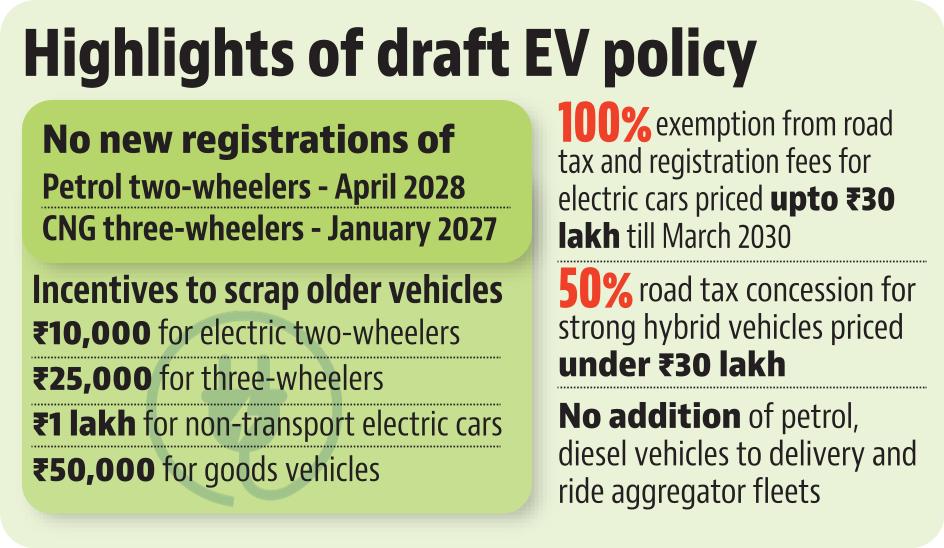
New Delhi : The Delhi government on Saturday released its draft Electric Vehicle (EV) Policy 2026 for public consultation, maintaining its proposal to ban the registration of new petrol two-wheelers from April 2028 and new CNG three-wheelers from January 2027 — requiring new vehicles in both categories to go fully electric by those dates.
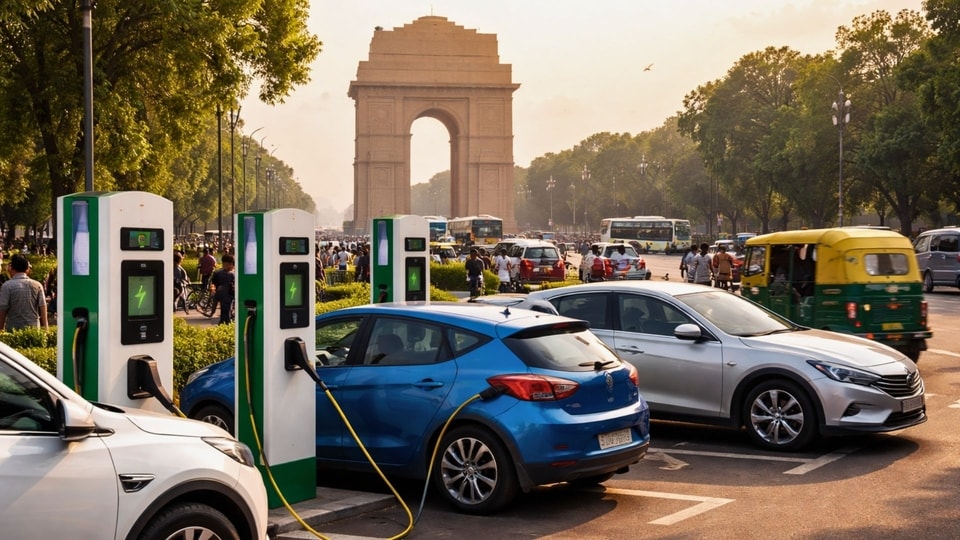
The mandate stands to affect millions of commuters and gig workers but these categories, especially two-wheelers, are among the largest contributors to vehicular pollution in Delhi, and form a significant share of the existing fleet consisting of older vehicles that fall below current emission standards.
Officials said stakeholders and citizens have been invited to submit suggestions within 30 days, with the consultation window open until May 10. “Two-wheelers constitute approximately 67% of the total vehicle stock in Delhi, making their rapid electrification critical for achieving meaningful reductions in vehicular emissions. Further, three-wheelers, commercial cars, and N1 category goods vehicles exhibit high daily utilisation and mileage, resulting in a disproportionate contribution to urban air pollution,” the policy draft stated.
Also Read | Layout plan prepared for Delhi’s 27 industrial areas: MCD
For private EV car buyers, the government has not renewed its subsidies but said it will waive road tax and added a 50% road tax waiver for hybrid cars costing up to ₹30 lakh.
Chief minister Rekha Gupta said the draft policy presents a comprehensive framework combining fiscal incentives, regulatory provisions and infrastructure development to support a shift to cleaner modes of transport.
“The proposed Delhi EV Draft Policy 2026 is a significant step towards establishing a clean, accessible and sustainable transport system in the capital. Extensive financial incentives, tax exemptions, mandatory provisions and infrastructure development have been emphasised to promote electric vehicles in Delhi,” she said.
Also Read | 300 police booths to be set up across Delhi’s flyovers, subways, FOBs to boost public safety
The draft arrives against a backdrop of unfinished business from its predecessor. The Delhi EV Policy 2020 expired in August 2023 and was extended several times before the current draft was finalised. It had set a target of 25% EV share in new vehicle registrations by 2025 — a figure the government fell well short of, reaching an estimated 13-14% even now. On charging infrastructure, the 2020 policy had targeted 45,000 charge points across the city; approximately 10% of that figure is currently in place, many of which remain non-functional.
A key change is the lack of subsidy for private EVs. The 2020 policy gave subsidies to the first 10,000 vehicles to be registered after the policy was announced.
But the new policy contains incentives for electric two-wheelers, three-wheelers and goods vehicles. Electric two-wheelers priced up to ₹2.25 lakh (ex-factory) will be eligible for purchase incentives of up to ₹30,000 in the first year, ₹20,000 in the second year, and ₹10,000 in the third year. Electric three-wheelers in the L5M category will receive incentives of ₹50,000, ₹40,000 and ₹30,000 over three years. For electric goods vehicles, incentives of ₹1 lakh, ₹75,000 and ₹50,000 have been proposed across a three-year period.
Private EVs, however, get some limited relief. The draft proposes a 100% exemption from road tax and registration fees for electric vehicles registered in Delhi during the policy period.
Electric cars priced up to ₹30 lakh will be eligible for full exemption until March 2030.
For the first time, the policy also proposes a 50% road tax concession for strong hybrid vehicles. Vehicles priced above ₹30 lakh will not be eligible for such benefits.
The government has earmarked a total outlay of ₹3,954.25 crore for implementation of the policy. This includes ₹1,236.25 crore for purchase incentives, ₹1,718 crore for scrapping incentives, and ₹1,000 crore for the development of charging infrastructure. The expenditure has been distributed across four years, with ₹965.5 crore planned for the first year, ₹1,012.75 crore for the second, ₹1,231.5 crore for the third, and ₹744.5 crore for the fourth.
The largest single budget head — ₹1,718 crore — is allocated for scrapping existing vehicles, underscoring the scale of the fleet transition the government is anticipating.
Officials said the policy seeks to combine demand-side incentives with supply-side interventions to accelerate EV adoption across categories. In addition to mandating electrification of two- and three-wheelers in a phased manner, the policy also outlines targets for electrifying other segments. School buses are to undergo gradual electrification, with 10% conversion targeted by the end of the second year, 20% by the third year, and 30% by March 2030.
For aggregator platforms and delivery service providers, the draft policy states that no new internal combustion engine (ICE) vehicles running purely on petrol or diesel will be inducted into existing fleets, a condition that has been in place through provisions of the Delhi Motor Vehicle Aggregator and Delivery Service Provider Scheme, 2023.
Transport minister Pankaj Singh said the government would also prioritise electrification within its own operations. “The government has also proposed prioritising electric vehicles in its own fleet. All vehicles hired or leased by departments under the Government of NCT of Delhi will be electric, except those granted specific exemptions. Additionally, all new inter-state buses inducted by the Delhi Transport Corporation and the transport department will be electric,” he said.
Amit Bhatt, India managing director at the International Council on Clean Transportation (ICCT), said, “Subsidies have played an important role in initiating the EV transition, but global evidence clearly shows that they alone are insufficient to drive large-scale adoption. A shift towards regulatory measures, including the gradual phase-out of ICE vehicles in cities, is essential. In this context, the Draft Delhi EV Policy 2026 has the potential to be a game changer.”
Extended producer responsibility
In a provision that did not exist in the previous policy, the draft introduces battery recycling infrastructure requirements, placing responsibility on vehicle manufacturers and other obligated entities to comply with the Battery Waste Management Rules, 2022. The environment department will oversee adherence to Extended Producer Responsibility (EPR) norms, including reporting, tracking and recycling of used batteries.
The Delhi Pollution Control Committee (DPCC) has been tasked with facilitating the establishment of battery collection centres across the city through public-private partnerships. The policy also proposes the use of unique identification systems to track batteries and support reuse and second-life applications.
The policy also introduces scrapping incentives aimed at phasing out older vehicles: ₹10,000 for electric two-wheelers, ₹25,000 for three-wheelers, ₹1 lakh for non-transport electric cars and ₹50,000 for goods vehicles. The benefits will be applicable to vehicles up to Bharat Stage IV (BS-IV) standards, subject to conditions such as submission of scrapping certificates and adherence to timelines. All incentives will be disbursed through direct benefit transfer (DBT).
Delhi Transco Limited (DTL) has been designated as the nodal agency responsible for planning and implementing EV charging and battery swapping networks. DTL will also develop standard operating procedures covering technical standards, approval processes and monitoring mechanisms, supported by a dedicated digital portal. All original equipment manufacturers (OEMs) operating in Delhi must install at least one public EV charging station at each dealership.
An EV fund is proposed to be created to finance the policy, drawing from budgetary allocations, central and state government schemes, environmental funds and other sources. An apex committee chaired by the transport minister will oversee implementation and fund utilisation, while a high-level committee headed by the chief secretary will coordinate among departments.
The draft policy has been uploaded on the transport department’s website. Representations received after the May 10 deadline will not be considered. The policy, once finalised, will be approved by the cabinet before being enforced.


Stay updated with all top Cities including, Bengaluru, Delhi, Mumbai and more across India. Stay informed on the latest happenings in World News along with Delhi Election 2025 and Delhi Election Result 2025 Live, New Delhi Election Result Live, Kalkaji Election Result Live at Hindustan Times.


