E-Paper



In affidavit to SC, Delhi govt cites studies to back odd-even
The government has defended the scheme, citing independent studies that show it is an effective emergency measure to reduce pollution and congestion.

 Prefer HTon Google


Two days after the Supreme Court termed the odd-even scheme to curb vehicular emissions in the Capital as “optics”, the Delhi government has defended the scheme, submitting that “the policy works as an effective emergency measure”, citing some independent studies.
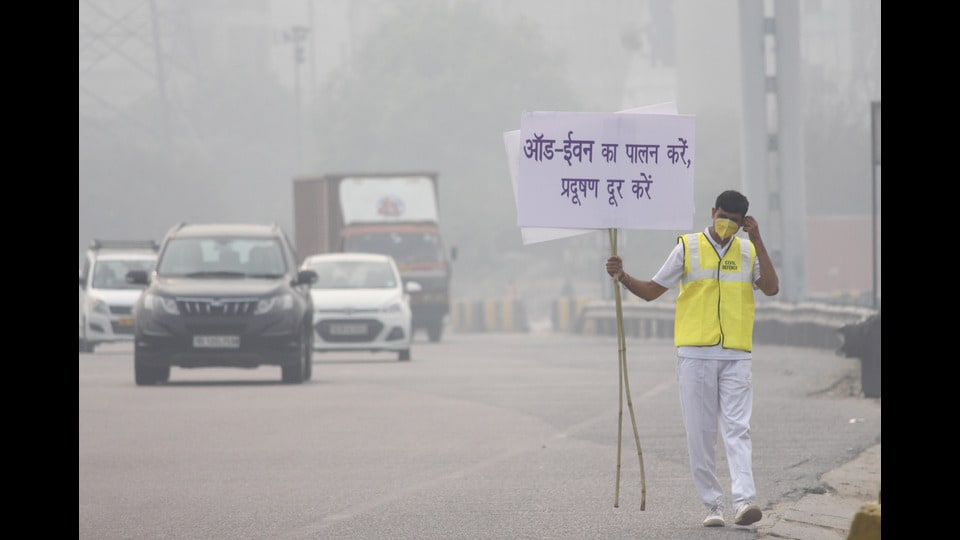
On Tuesday, a Supreme Court bench led by justice Sanjay Kishan Kaul had questioned the efficacy and success of the odd-even scheme in the past.
While the court fixed the next hearing on Friday, its poser prompted Delhi environment minister Gopal Rai to make a statement that they will wait for the court’s orders, based on which a decision on the implementation of the scheme will be taken.
In an affidavit filed on Thursday, the Aam Aadmi Party (AAP) government conceded that it did not carry out any scientific evaluation of the odd-even system, but shared two independent impact evaluations conducted during the first two implementations of the scheme — during January 1-15, 2016, and April 15-30, 2016.
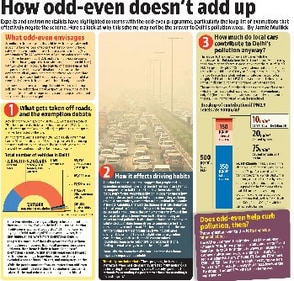
The government further relied on a traffic impact study carried out by M/s Delhi Integrated Multi-Modal Transit System (DIMTS) for the scheme in November 2019 to maintain that the policy has had positive impact in reduction of vehicular pollution, and brings down congestion on Delhi roads.
The first study, it said, was conducted by researchers Michael Greenstone, Anant Sudarshan (both from Energy Policy Institute at the University of Chicago), Santosh Harish (Centre for Policy Research), and Rohini Pande (Harvard Kennedy School), which found that PM2.5 levels on average dropped by 13% between 8am and 8pm during the odd-even scheme in January 2016. No impact was detected when the programme was repeated in April, most likely because the warmer month of April is marked by greater dispersion of particulates, stated the affidavit.
It added that the researchers concluded that the scheme “is as an emergency measure during winter months when car emissions play a more prominent role in affecting air quality.”
The second study, as referred to by the government, was carried out by researchers from IIT-Delhi, IIT-Kanpur, Indian Institute of Tropical Meteorology, CSIR-National Physical Laboratory, and the Energy Resources Institute (TERI).
“The study concluded that the traffic restriction between January 1-15 in 2016 reduced PM2.5 by 4-6% with a maximum of up to 10%, primarily at three local hotspots in Delhi,” highlighted the affidavit.
On request of the Delhi government, a study on ‘Traffic Impact Assessment of Odd-Even Scheme in Delhi’ was conducted by DIMTS — an urban transport and infrastructure development company that is an equal equity joint venture of the Delhi government and IDFC Foundation.
The traffic data analysis during the odd-even scheme in November 2019 indicated a 30% reduction in personal car traffic. However, there was an increase of 6.5% in two-wheeler traffic, 19.5% in taxis, 7.5% in auto and 4.7% in buses (a total of 38.2%).
The affidavit cited the DIMTS study to state that there was a decrease of about 6% vehicle kilometres travelled (VKT) during the odd-even scheme. VKT is a unit of measure of traffic flow, determined by multiplying the number of vehicles on a given road or traffic network by the average length of their trips measured in kilometres.
“Reduced vehicle km travelled would also result in reduced fuel consumption. It has been estimated that there was about 15% decrease in fuel consumption on average day during the odd-even scheme implementation,” it said.
According to the government, the DIMTS report shed light on the positive impact in reduction of the air pollution contribution of vehicles, besides a reduction in congestion on Delhi roads as well as increase in share of public transport during the period of the odd-even scheme.