
 E-Paper



Delhi govt finalises its 25-point ‘winter action plan’ to combat air pollution
The plan focuses on seven key areas – including dust control, vehicular emissions, industrial regulation, waste management, and citizen participation

 Prefer HTon Google


The Delhi government has finalised a 25-point “Winter Action Plan” to combat air pollution from October to February, environment minister Manjinder Singh Sirsa announced on Thursday.
The plan, drawn from the Air Pollution Mitigation Plan 2025, focuses on seven key areas – including dust control, vehicular emissions, industrial regulation, waste management, and citizen participation.
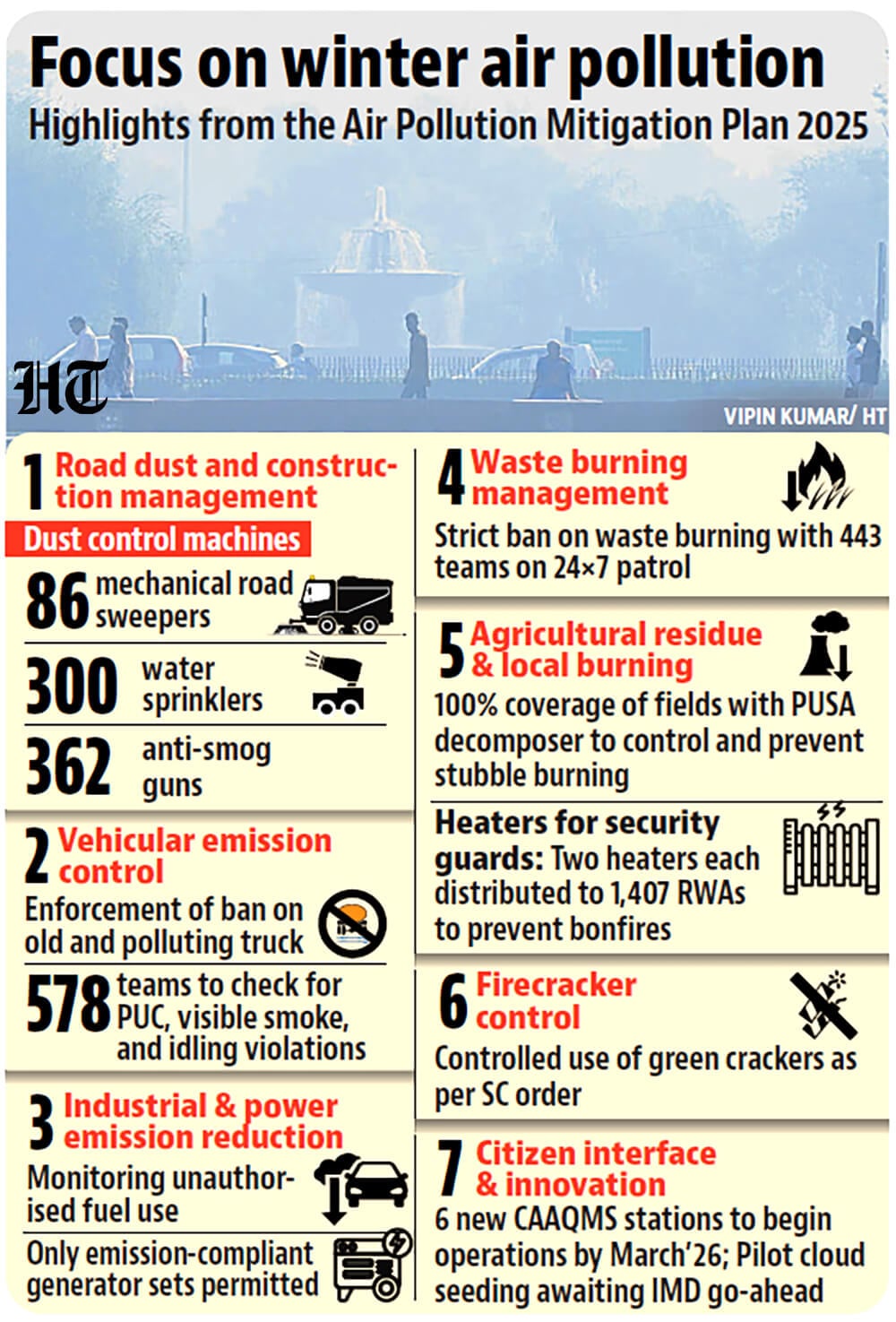
The key measures in the plan, which HT has seen, includes deployment of 86 mechanical sweepers, 300 sprinklers and 362 anti-smog guns to curb dust; 578 enforcement teams to check vehicular pollution; six new air-quality monitoring stations to be operational by March 2026; and a pilot cloud-seeding project to help disperse smog.
Sirsa said the plan would be enforced “with vigour” through coordination between multiple civic and government agencies and Delhi Police. “The goal is to ensure that pollution levels remain under control even when meteorological conditions are adverse,” he said. The first meeting to prepare this plan was held on September 9.
Under the dust-control measures, the government will deploy 86 mechanical road sweepers, 300 water sprinklers and 362 anti-smog guns across the city. An additional 70 sweepers and truck-mounted anti-smog guns are to be procured in the coming months. The plan also mandates strict enforcement of 14-point dust-control norms and makes online registration compulsory for all construction projects above 500 square metres. All major roads will be vacuum-swept, with routes monitored through the “green war room” to track compliance.
To curb vehicular pollution, 578 enforcement teams will check for pollution under control (PUC) certificates, visible smoke and idling violations. “Double parking fees will be imposed during GRAP Stage III and IV to discourage private vehicle use,” Sirsa said.
Also Read | Hazed and confused: NCR cities top country’s most polluted list
The government will also link 953 PUC centres to a real-time dashboard under the transport department, ensuring instant monitoring of emissions data. The Delhi Metro’s electric auto fleet is set to grow to 2,299 vehicles, with EV registrations staying above 12% of all new vehicles.
Industrial and power emissions will continue to face strict scrutiny, with the government reiterating that all industries must operate only on PNG. Dual-fuel or emission-compliant diesel generators will be permitted, with their use tracked by DPCC and other agencies.
On waste burning and landfill fires, the plan calls for 443 enforcement teams to patrol round the clock. Permanent watch towers and hydrants have been set up at landfill sites to detect and douse fires quickly. “Zero landfill fires have been recorded in 2025 so far,” Sirsa said, adding that timelines have been fixed for clearing legacy waste – Okhla by July 2026, Bhalswa by December 2026, and Ghazipur by December 2027. Till September 30 this year, 13.6 million tonnes of legacy waste have been biomined.
The government will also tackle local burning and agricultural residue by covering 100% of Delhi’s fields with the IARI-developed decomposer solution. Five night-vigilance teams will monitor stubble burning, while citizens can report violations through a mobile app. To discourage winter bonfires by staff in residential colonies, heaters will be distributed to over 1,400 resident welfare associations (RWAs).
On the festive front, the government reiterated that only QR-coded, NEERI-certified green crackers from licensed vendors will be allowed, in line with the Supreme Court’s order. Enforcement will be jointly handled by the Delhi Police, DPCC and the Revenue Department.
A major addition to this year’s plan is the pilot cloud-seeding project, which aims to artificially induce rainfall to disperse pollutants during severe smog episodes. The city will also see six new air-quality monitoring stations, expected to be functional by March 2026, expanding the monitoring network and improving real-time pollution data.
Officials said the Green Delhi app, which has resolved over 96,000 complaints since its launch, will remain the key citizen interface for reporting pollution sources and ensuring follow-up action.
While the Aam Aadmi Party government has released similar winter-specific plans in previous years, Sirsa said this year’s version places greater emphasis on on-ground coordination and real-time tracking. “This time, we are focused on achieving visible improvement in air quality through stronger accountability and continuous monitoring,” he said.


Stay updated with all top Cities including, Bengaluru, Delhi, Mumbai and more across India. Stay informed on the latest happenings in World News along with Delhi Election 2025 and Delhi Election Result 2025 Live, New Delhi Election Result Live, Kalkaji Election Result Live at Hindustan Times.


