
 E-Paper



Delhi logged third worst dengue outbreak in 2023
A quick perusal of MCD bulletins over the past 15 years reveals that the Capital had its worst dengue season on record in 2015


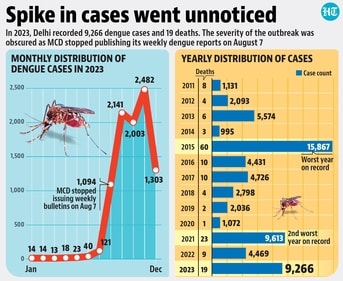
In 2023, the Capital recorded 9,266 cases of dengue and 19 deaths due to the viral disease, making it the third worst outbreak of the infection in the city, annual data on mosquito-borne diseases shows. The severity of this outbreak, however, has been obscured with civic bodies withholding weekly data on vector-borne disease after August 7, suspending a decades-old exercise which was hitherto conscientiously followed even during the pandemic.
A quick perusal of Municipal Corporation of Delhi (MCD) bulletins over the past 15 years reveals that the Capital had its worst dengue season on record in 2015, when the city logged 15,867 cases and 60 deaths — an unusual spike fuelled by a virulent strain.
As a comparison, Delhi recorded 4,469 dengue cases in 2022. This number was 9,613 in 2021 (the second-worst dengue season, with 23 deaths), 1,072 in 2020, 2,036 in 2019, 2,798 in 2018, 4,726 in 2017 and 4,431 in 2016. Through all these years, MCD shared weekly dengue numbers without fail.
In 2023, however, MCD stopped publicly releasing data on vector-borne diseases on August 7; five months on, the practice is yet to be resumed. In the last bulletin, Delhi reported 348 dengue cases — double the 174 cases reported during the same period in 2022 — and was at the initial stages of a spike.
In a house of councillors meeting on September 26, Aam Aadmi Party member Mukesh Goyal alleged that there were “strict instructions from the top” to not release Delhi’s dengue numbers for the year due to the G20 Summit held earlier that month. Over the last five months, the MCD executive wing has maintained that the weekly reports were not being issued because it was not a statutory mandate, and things were under control. However, MCD’s own numbers belie this claim.
A senior municipal official, on condition of anonymity, said that the civic body continued to prepare its weekly report of dengue cases in the city — however, this report was not shared publicly. According to the report, the official said, dengue cases in the Capital started picking up in September, and peaked in November. This period, the data shows, accounted for 71.5% of Delhi’s annual caseload.
Publicly released bulletins till August 7 reveal Delhi recorded 14 cases each in January and February, 13 in March, 18 in April, 23 in May, 40 in June, and 121 in July. Thereafter, according to MCD data that was not publicly shared until now, Delhi’s dengue count to 1,094 cases in August, which doubled to 2,141 cases in September, followed by 2,003 cases in October, and a peak of 2,482 cases in November. The cases dipped to 1,303 in December.
To be sure, once the temperature drops to about 20°C, adult mosquitoes become less active in open environments, and stop functioning once the mercury drops below 10°C.
According to the data, of the 9,266 dengue cases recorded for the year, 7,250 reports came from MCD areas, 177 from New Delhi, 280 from Delhi Cantonment, and 41 cases from areas falling under the railways.
The MCD official quoted above said 1,518 cases (16.38%) could not be traced. Apart from the 9,266 reported cases, MCD classified another 2,645 where the infection was acquired from other states. Among the 12 MCD zones, the south zone was the worst affected with 1,194 cases.
Health experts attribute the high caseload and deaths to various factors, including the flooding in the Yamuna in July, and legal changes making it mandatory to report all dengue cases, even as experts said that a virulent strain of dengue could have led to the spike.
On July 28, health minister Saurabh Bharadwaj said the genome sequencing of 20 samples showed that 19 had a severe Type 2 strain, which can lead to fatal haemorrhagic fever.
Dr Sumit Ray, head of the department of critical care medicine and medical director at Holy Family Hospital, said the Type 2 strain may be relatively more dangerous, but the severity of illness is determined by an individual’s immune response.
“Type 2 infections leads to capillary leak and liver dysfunction. At our hospital and other healthcare facilities, we noticed many dengue-related deaths were due to these causes and not bleeding. In capillary leakage, the fluid leaks out of capillary and causes swelling of tissue, it goes to abdomen and BP starts dropping,” he said.
Dr Ray urged MCD to be more transparent about the dengue cases as public awareness is a critical component in preventing the disease. “People should know about the real situation on the ground. It is the best way to prevent dengue cases,” he said.
Despite several attempts, an MCD spokesperson did not comment on the matter.
Mayor Shelly Oberoi said: “I will talk to the department why the numbers are not being shared. We will seek the annual report and I will issue that order”.

Stay updated with all top Cities including, Bengaluru, Delhi, Mumbai and more across India. Stay informed on the latest happenings in World News along with Delhi Election 2025 and Delhi Election Result 2025 Live, New Delhi Election Result Live, Kalkaji Election Result Live at Hindustan Times.


