
 E-Paper



‘Everything in our house ruined’: Delhi's low-lying residential hubs flooded as Yamuna's water rises
On Tuesday morning, the Yamuna touched a seasonal peak of 205.95 metres at 4am, before receding slightly.

 Prefer HTon Google


For 20-year-old Mamta Singh, the sound of rushing water in the early hours of Tuesday was familiar, but the familiarity made it no less terrifying. As the Yamuna swelled through the night, it surged into her family’s modest home in Yamuna Bazaar, destroying nearly everything inside. By morning, Singh and seven members of her family were moved into one of the temporary tents erected by the Delhi government opposite the old ghats, where most houses now stood half-submerged.
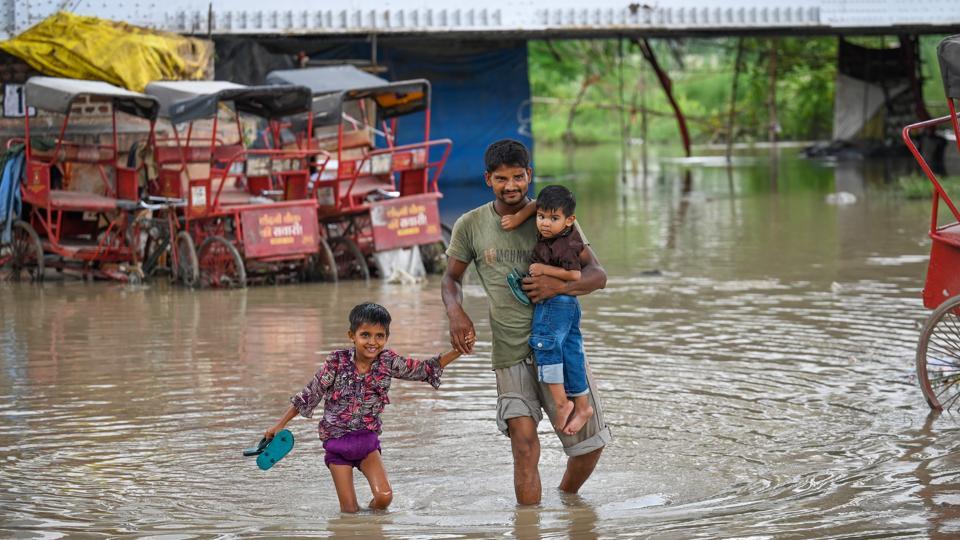
“Everything in our house -- our fridge, our cooler, our clothes, our furniture -- is ruined. We will have to buy everything again, which is impossible for us right now,” Singh said, sitting inside the cramped tent, still dazed.
On Tuesday morning, the Yamuna touched a seasonal peak of 205.95 metres at 4am, before receding slightly. However, the river still remained comfortably above the danger level of 205.33 metres throughout the day.
Delhi chief minister Rekha Gupta visited the locality in the morning, walking through water-logged lanes and speaking with affected families. Even after her departure, the scenes of devastation were stark: people wading through knee-deep murky water, children helping elderly parents balance on slippery pathways, and residents frantically retrieving whatever belongings had not already been swept away.
Electricity in the area was cut off to prevent electrocution, further complicating life for residents. “People cannot go to work or school, they have not eaten properly since the morning, and walking through the lanes is dangerous. We are also spotting snakes in the water,” said a student who asked not to be named.
According to government officials, temporary tents have been set up at several locations along the river since Monday night. These include Sonia Vihar in northeast Delhi, near the Inter-State Bus Terminal at Kashmere Gate, on the Geeta Colony flyover, and close to the Delhi-Noida Direct flyover in east Delhi.
The water’s surge
The sudden rise in the Yamuna’s level followed a massive release of water from the Hathnikund barrage. For nearly 12 hours between Sunday afternoon and early Monday morning, more than 100,000 cusecs were discharged, peaking at nearly 180,000 cusecs -- the season’s highest so far. Central Water Commission (CWC) data showed that discharges later dropped to 30,000–50,000 cusecs on Monday.
Irrigation and Flood Control (I&FC) officials said the situation appeared under control, with no fresh surge anticipated. CWC forecasts indicated the river would drop to around 204.49 metres by Wednesday evening. “As per current trends, the water will keep receding,” an official said.
Yet, in Yamuna Bazaar, residents watched anxiously from staircases and rooftops, trying to gauge whether the river was indeed falling. For many, the worry was not only about the water but about diseases, displacement, and the disruption of everyday life.
Flooding in Yamuna Bazaar is not new. Many residents, born and raised here, have grown accustomed to the yearly disruption. But the hardship remains. “It is especially difficult for the elderly, as they cannot move quickly. This dirty water also spreads disease,” said Moni, a 24-year-old pursuing a degree in social work. She added that she had not been able to study for several days. “Everyone’s work has been put on hold.”
For others, the struggle feels overwhelming. Rani, a 30-year-old housewife, gestured at her two young children standing barefoot in the water. “The electricity being cut makes sense, but now there is no light. The lanes are full of snakes. How can my children even walk here?”
Relief efforts
District Disaster Management Authority (DDMA) officials said over 20 tents were set up late Monday night, including one functioning as a medical command centre and another as an incident command centre. “Food was served to residents by 2pm on Tuesday, and water tankers have been deployed. If needed, we will add more tents,” said Harish Mathur, district project officer.
But residents said such measures only partially eased their troubles. Their daily lives -- food, schooling, and jobs – have screeched to a halt.
“These tents are a temporary fix. We know the water will eventually recede, but we also know this will happen again next year,” said a resident.
The vulnerability of Yamuna Bazaar stems from its location -- its ghats sit right on the edge of the river. When water levels rise, the surge into homes is abrupt and often without warning.
In July 2023, the Yamuna swelled to 208.66 metres, its highest-ever level, submerging most of the locality. By contrast, last year’s peak was only 204.38 metres in late September, below the warning level. For residents, the unpredictability of the river is as troubling as the water itself.
As night fell on Tuesday, Singh sat quietly with her family in their temporary tent, staring at the river’s dark waters. Though forecasts promised relief, the damage was already done. “Even if the river goes down tomorrow, everything in our home is gone. We will have to start all over again,” she said.


Stay updated with all top Cities including, Bengaluru, Delhi, Mumbai and more across India. Stay informed on the latest happenings in World News along with Delhi Election 2025 and Delhi Election Result 2025 Live, New Delhi Election Result Live, Kalkaji Election Result Live at Hindustan Times.


