
 E-Paper



Delhi makes rainwater harvesting mandatory; penalties for violators
Delhi mandates rainwater harvesting across the city, offering financial incentives and penalties for non-compliance, aiming to boost groundwater recharge.

 Prefer HTon Google


The Delhi government has made rainwater harvesting (RWH) mandatory across the city, with water minister Parvesh Verma chairing a high-level meeting at the Delhi Secretariat on Monday to outline enforcement measures, timelines and financial incentives.
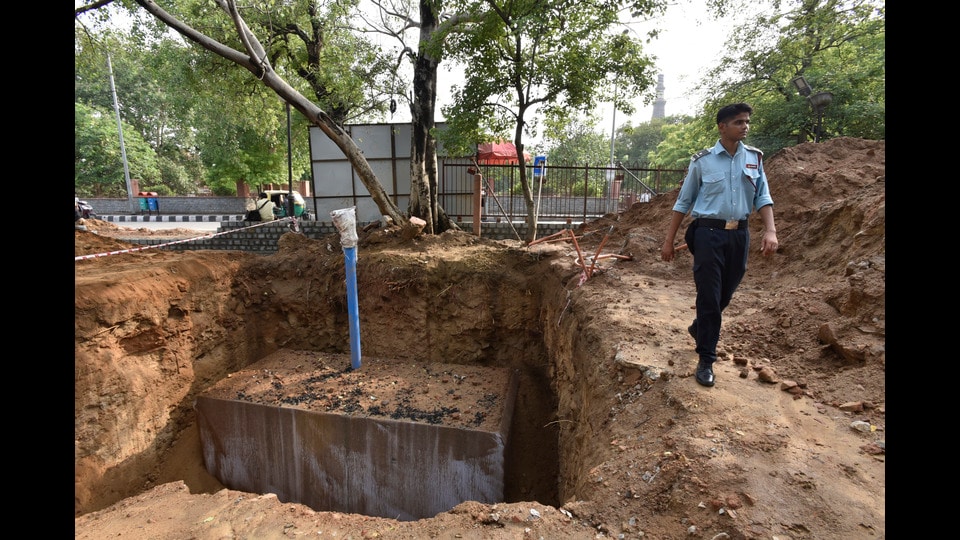
Under an existing financial assistance scheme, consumers with plots of 100 square metres and above are eligible for subsidies for installing rooftop RWH systems. For plots between 100 and 499.99 sqm, assistance is capped at 50% of the cost or ₹25,000, whichever is lower, while for plots of 500 sqm and above, the cap increases to ₹50,000.
To further incentivise adoption, the Delhi Jal Board (DJB) is offering a 10% rebate on water bills for functional systems, which increases to 15% if both rainwater harvesting and wastewater recycling systems are installed. Non-compliance may attract penalties, including a 1.5-times increase in water bills and disconnection of supply in persistent cases.
The minister said rainwater harvesting in government establishments must be implemented in a serious and time-bound manner. Failure to comply will invite strict action, including an initial 10% cut; if lapses continue, the connection will be disconnected. Verma said Delhi receives adequate rainfall but lacks effective conservation mechanisms.
“For four months every year, rainwater flows through our drains and goes to waste. If we channel this water into the ground, we can recharge our groundwater and reduce the crisis we face every summer,” he said while addressing officials during a meeting on Monday.
Officials from more than 60 departments of the Delhi government and the Centre attended the meeting, where departments were directed to ensure installation and functionality of RWH systems in government buildings, parks, residential colonies and institutional campuses before the onset of the monsoon.
The minister added that departments have been given time-bound targets and accountability measures.
“Every department has been assigned responsibility. First, government buildings must lead by example. If systems are not installed, they must be put in place immediately. If they exist, we will ensure they are working properly before the rains arrive,” Verma said.
The Delhi Jal Board (DJB) will be the nodal agency for implementation, monitoring and financial support. Verma said the board will provide partial funding support and rebates to encourage compliance.
“Delhi Jal Board will share part of the cost and provide a 10% rebate where rainwater harvesting systems are functional. At the same time, if systems are not installed or not maintained, that rebate can be withdrawn. Till now, there was a rule but no real checking. That will change. We will introduce a system of verification and accountability so that this is implemented on the ground, not just on paper,” he said.
A self-disclosure mechanism is also being planned, under which property owners will annually certify that their RWH systems are functional. Authorities said this is aimed at ensuring continued compliance and improving monitoring.
According to DJB officials, adequacy and functionality certificates are issued after inspection and require periodic renewal. “If irregularities are found during inspections, rebates can be withdrawn and penalties imposed as per norms,” an official said.
The government will also focus on large residential plots, group housing societies and institutional areas, where RWH systems can significantly contribute to groundwater recharge. Public outreach is being carried out through Jal Shakti Kendras, which provide technical assistance and awareness on installation and maintenance.
Data shared by DJB show that ₹204.46 crore in rebates was disbursed between 2017 and 2024. Officials said RWH systems have been installed in 4,343 out of 4,861 schools and colleges, with a deadline of June 30, 2026, for the remaining institutions. In other government departments, 2,564 installations have been completed out of 3,598 identified sites.


Stay updated with all top Cities including, Bengaluru, Delhi, Mumbai and more across India. Stay informed on the latest happenings in World News along with Delhi Election 2025 and Delhi Election Result 2025 Live, New Delhi Election Result Live, Kalkaji Election Result Live at Hindustan Times.


