
 E-Paper



Delhi’s Bhagirath Palace — once a mansion, now a wholesale market
As the structure completes 200 years in existence, HT traces how the palace evolved into the Capital’s most popular market for electrical goods

 Prefer HTon Google


Nestled between the crowded, chaotic lanes of Chandni Chowk is a time-worn building that looks no different from the crumbling structures that line the nooks and crannies of this Mughal-era market square.
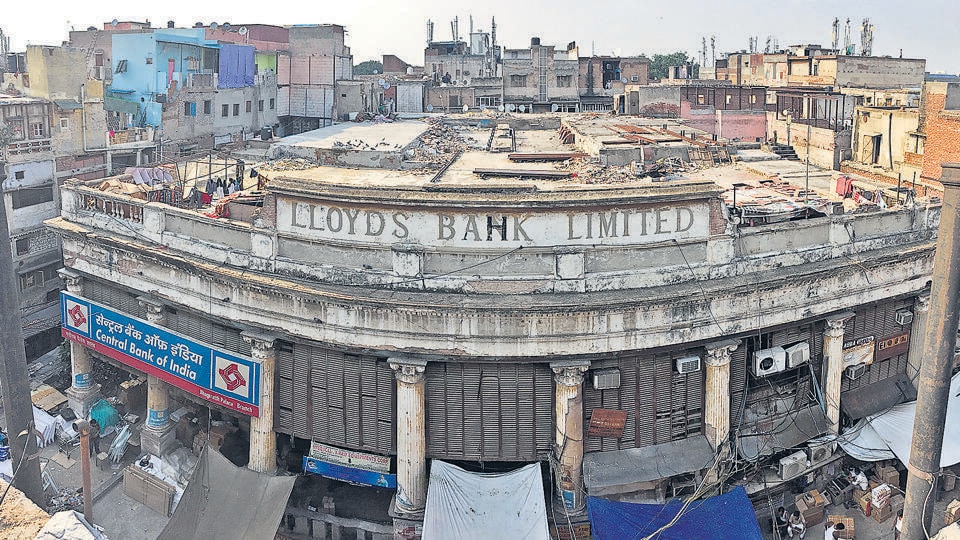
The worn-out building once served as the palace of Begum Samru, a powerful figure who presided over a mercenary army comprising both Indians and Europeans in the 18th century. Today, it is popular as Bhagirath Palace, home to one of Delhi’s largest wholesale markets.
Read here: FIR against 3 for assaulting DU student over poll sloganeering
As the structure completes 200 years in existence, HT traces how Samru’s palace evolved from its earlier grandeur into the Capital’s most popular market for electrical and electronic goods.
Life, times and legacy of Begum Samru
A prominent power broker in the early 1800s, Begum Samru rose through the ranks and eventually presided over the principality of Sardhana in Meerut. She also ruled over the Jharsa-Badshahpur pargana in the 1800s.
Historian and author Swapna Liddle, in her book Chandni Chowk: The Mughal City of Old Delhi, writes that Samru purchased the piece of land where Bhagirath Palace stands today in 1807.
According to Liddle, Samru was a strong ally of the British, and her fiefdom was confirmed by the East India Company. “Named Farzana, Begum Samru was a Kashmiri dancing girl who married a European military freelancer Walter Reinhardt ‘Sombre’. Sombre had come to India in the middle of the 18th century and made his fortune as a military soldier. His nickname, Sombre, was corrupted to Samru, and his widow is best known by this name,” Liddle wrote.
Begum Samru commanded nearly 3,000 troops, including European mercenaries and Indians. In 1787, Samru broke the siege of Red Fort by Rohilla chieftain Ghulam Qadir, compelling Qadir to retreat. She ordered her artillery to be drawn up along the parapets of the Red Fort and directed her officers to guard the Diwan-i-Khas. Impressed by her intervention, then emperor Shah Alam gave her the title of Zeb-un-Nissa, which means “jewel among women”.
According to author Julia Keay’s book Farzana: The Tumultuous Life and Times of Begum Sumru, she died on January 27, 1836, at Sardhana in Meerut due to age-related concerns. It is believed that she was 86 years old.
Samru’s heir was David Dyce Ochterlony Sombre. Shortly after his death, his wife Mary Anne Jervis sold the palace to a bank, whose English manager and his family were killed during the 1857 mutiny (first war of Independence), writes Keay.
After the battle was over, the palace, which sustained damage, was restored by Lloyds Bank, writes Keay, and traces of the name Lloyds Bank continue to adorn the parapets of the building.
Today, a small plaque outside the palace identifies the complex as Begum Samru’s Palace-Central Bank and announces it as a heritage building. According to the plaque, Bahadur Shah Zafar, the last Mughal ruler, stayed at the complex after he was captured for his alleged involvement in the 1857 mutiny.
Eventually, in 1940, businessman Seth Bhagirath Mal purchased the palace and renamed it Bhagirath Palace.
There is no historical record about how the palace went from being a private property to a wholesale market.
Despite its rich historical legacy, the building today has been neglected, with little conservation support over the years.
Electronics shops, surgical shops, drugstores, and a motley cluster of outlets occupy it, and several of the establishments run out of enclosures that are a part of the palace’s original structure. According to local lore, the enclosures were used as stables during Begum Samru’s time. “The shops that are running out of the enclosures have not tampered with the original structure of the complex,” said a shopkeeper selling surgical instruments, asking not to be named.
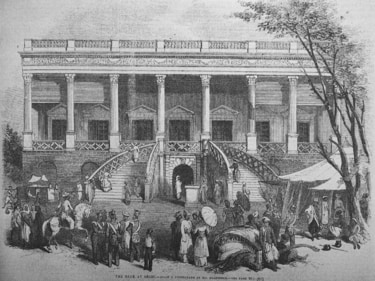
Decay over time
Hundreds of people visit the Bhagirath Palace market on any given day and jostle past motorcycles, hand-driven carts, and porters carrying cartons as they navigate the busy stretch. Most visitors know little about the historical significance of the palace or Begum Samru.
Over the decades, the building developed cracks running across its walls and pillars; the ceiling is broken in some parts; and the plaster lining the Corinthian pillars has peeled, revealing the original lakhori bricks underneath. While rows of cartons, sacks, bicycles, and heaps of garbage occupy one part of the first floor of the building, a large section of the floor is taken up by a Central Bank of India branch, and scores of drugstores and electrical shops line the corridors and the remaining parts of the structure.
The stairs and columns leading up to the building have turned a dirty shade of red as a result of countless paan stains, while display boards of various electrical shops mar the front view of the palace.
Anil Chugh, president of the Delhi Drug Traders Association, said the area’s character changed over the years as residents moved out and commercial establishments flourished. “Earlier, there were residential properties. People used to live in haveli-like residences but they gradually vacated the premises and the entire area transformed into the market as we see it today,” he said.
According to Chugh, the Central Bank of India is the custodian of the palace. “Previously, Lloyds Bank used to operate from here. Over the decades, shops proliferated in the area surrounding the bank,” said Chugh, who has been operating a shop from the market for the past 31 years.
A tea seller, who has a kiosk on the first floor of the structure, said he’s read about the palace’s history on the internet. “I have been working out of this place for almost 18 years but no exercise was ever undertaken to repair this place,” he said, asking not to be named.
In desperate need of conservation
A drugstore owner, whose shop has been in the area for over six decades, said that while the building’s original structure was still in place, the terrace has been encroached over time.
“Our shop has been in operation for 65 years. I have been around for the past 25 years and I have not seen any conservation or repairs. Luckily, no part of the structure broke down during the period. But with encroachments on the terrace, one can’t be sure till what time the structure will sustain like this,” he said, asking not to be named.
However, not everyone is enthused by possible intervention from the authorities. Conservation, they say, will disrupt the market’s functioning. “Unless the government decides to conserve the entire area starting from the Baptist Church, how will they demonstrate the continuity of the palace? Conservation will not make sense until the authorities decide to spruce up the old Delhi area and ensure that pedestrianisation is undertaken in the interiors as well,” said a second shopkeeper.
Read here: Covid-19 in Delhi: What shopkeepers at Bhagirath Palace market say about lockdown
Liddle said Samru’s palace was an important heritage site that has not received adequate support. She alleged that heritage properties falling in the Municipal Corporation of Delhi’s (MCD) list often remain neglected in the absence of a vision that incentivises conservation for locals.
“The heritage by-laws are great and they outline what can be done or what not. However, we need to ask if there is a vision to do something for the upkeep of monuments or not. The question is if support is being given to the owners of heritage properties and what kind of support. Right now, we are lacking a vision that prioritises conservation of heritage structures,” said Liddle.
MCD officials did not respond to requests for a comment.


