
 E-Paper



Delhiwale: In search of Ghalib’s kin
Explorations in the poet’s graveyard

 Prefer HTon Google


You cannot get close to Mirza Ghalib by sitting beside his marble grave. That intimacy can only be attained by reading the poet’s ghazals and letters, if not in original Persian and Urdu, than in translations.
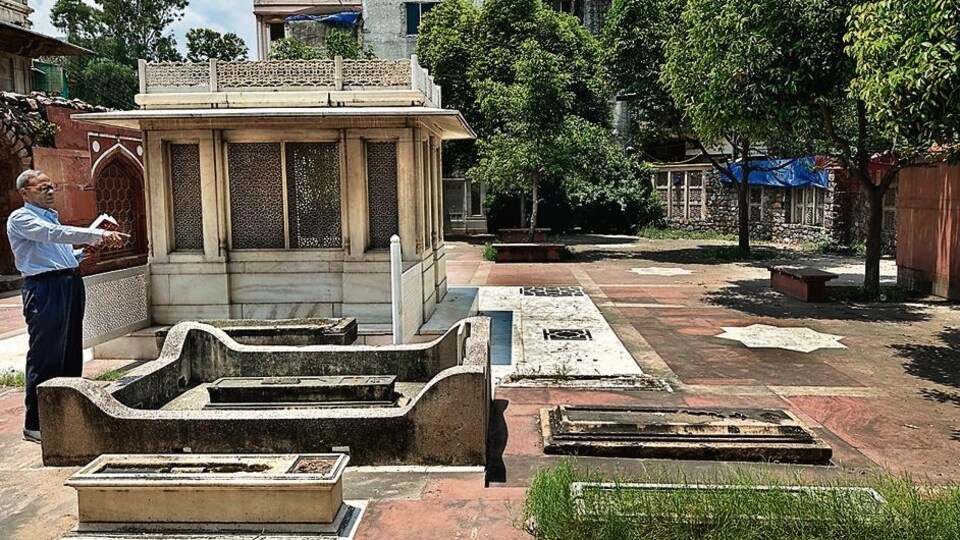
Even so, you must be familiar with the mazar of Delhi’s greatest verse writer, at this walled courtyard in Hazrat Nizamuddin Basti. Some of us might also be familiar with the grave right behind the tomb— the final resting place of Umrao Begum, the poet’s wife.
But we have 10 more graves here. All are from the Ghalibian era (19th century), except for one from the 1980s — that of poet Sagar Nizami, a Padma Bhushan awardee.
Walking into the enclosure, Aqil Ahmad, who heads the Ghalib Academy next door, nods towards lesser-known graves. “That qabar is of Zain ul Abidin Khan Aarif, he was Ghalib’s wife’s bhanja (nephew). This qabar is of Ghalib’s father-in-law, Ilahi Baksh Maroof, he was the nawab of Loharu, in Haryana.”
Time has erased the inscriptions on some of these graves. The exuberant Sunil Kumar, a guard at the tomb, confidently identifies the unidentifiable graves as belonging to Ghalib’s seven children. But not a single child could survive beyond 15 months, Aqil Ahmad mumbles, doubting that those infants could have had such large graves.
With Shams Badayuni’s book Mazar-e-Ghalib as his guide, Aqil Ahmad notes that till the early 20th century, this graveyard, belonging to the Loharu nobility, was originally a grove of anar trees called Bagicha-e-Anarkali. Turning to another page, he says Ghalib, who died aged 73 at his rented two-room house in Old Delhi’s Ballimaran, had his funeral prayers performed outside Dilli Gate. (His wife died on his first barsi, the death anniversary according to the Islamic calendar.)
Shutting the book, Aqil Ahmad walks to the grave of Ghalib’s nephew, and stands in silence.
In their book Ghalib: Life and Letters, scholars Ralph Russell and Khurshidul Islam noted that following the successive deaths of his children, Ghalib gave a father’s love to this nephew. A Persian poem by him described the nephew as “the flame of the candle that lights my house.” As fate would have it, Ghalib wrote his saddest ghazal on this young man’s death, ending it with these lines:
“It makes no sense to ask me ‘why are you alive Ghalib?’
It is my fate to go on longing for death, a few more days.”
Because the nephew’s wife had died a few months before the nephew, Ghalib and his wife took over the custody of the couple’s little sons—Baqir Ali and Husain Ali. The older child also died soon, making Ghalib so protective about the remaining child that “he never let him out of his sight”— according to poet Hali, author of Yadgar-e-Ghalib, the first book written on the poet. This child grew to be a poet acquiring the takhallus (nom de plume) of Raqim, “the writer.” He outlived Ghalib, but died young, aged 30. According to Hamida Sultan’s book Khandan-e Loharu ke Shora, Raqim too lies buried here.


