With onions retailing at around ₹48 per kilogram in Delhi, the demand for subsidised onions in the Capital continued to remain high, with stocks supplied by the Centre selling out quickly, retailers across Delhi told HT on Friday.
The high demand was best evidenced by a stock of about 120kg of onions selling out within four hours at an NCCF outlet inside the Rajiv Chowk Metro station. Salesman Harsh Gautam said that the stock was received at around 4pm on Thursday and it sold out by 8pm.
Another outlet in Pocket A of Vasant Kunj said that even though their stock arrived at Friday noon, about 50kg of subsidised onions had already been sold by 4pm.
Also read: Delhi seeks buffer onions from Centre amid price rise
Subsidised onions sold at ₹35 per kg
To be sure, the subsidised onions are being sold at ₹35 per kg through NAFED, NCCF and Kendriya Bhandar outlets, as well as Safal stores.
{{/usCountry}}To be sure, the subsidised onions are being sold at ₹35 per kg through NAFED, NCCF and Kendriya Bhandar outlets, as well as Safal stores.
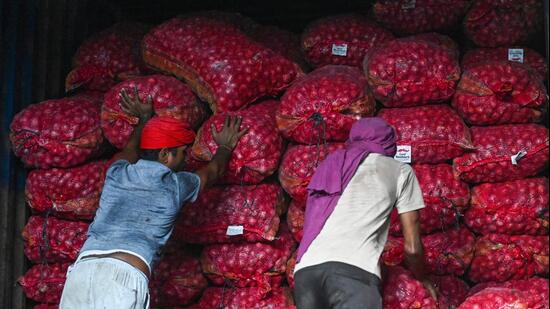
{{/usCountry}}Although the government flagged off the sale of subsidised onions in Delhi on Thursday, most of its stock—about 450 tonnes—reached Delhi via the season’s first Kanda Express on Friday. “The train had faced some delay and only reached Delhi around midnight. Trucks are transporting these stocks to the NAFED storehouse in Narela, from where retail transfers to selected outlets will begin,” an official of the Northern Railways, who was overseeing the delivery of onions at the Adarsh Nagar station, told HT on condition of anonymity.
Also read: 'Kanda Express' with 453 tonnes of onion from Nashik reaches Delhi to help cool prices
Children allegedly steal onion consignment from railway rakes
Amid a lack of security at the spot, children from a nearby slum were seen taking away a consignment of onions from the railway rakes in the morning. E-rickshaw drivers at the site said the theft continued through the night and that the children may have taken about 50-70 gunny bags of onions by 7am.
People familiar with the developments said that the consignment that arrived in Delhi included both Grade-A onions and onions procured under relaxed quality specifications. Consumer affairs secretary Nidhi Khare said the government was supplying quality onions in Delhi as part of its effort to bring down prices.
Centre struggled to meet onion procurement target
The intervention follows a difficult procurement season for the Centre, as government agencies had procured only around 13,000 tonnes against a 200,000-tonne target by July 7, despite beginning purchases on May 15. This prompted the government to relax Grade-A specifications and repeatedly raise its minimum assured procurement price, as wholesale prices continued to remain higher than the government-decided procurement price.
The procurement prices had to be raised seven times this year, from ₹12.7 per kilogram (kg) at the start to ₹26.45 per kg in August. The government finally closed its procurement operation at 121,000 tonnes this month. The quality norms were also widened, with the permissible bulb diameter for Grade-A onions relaxed from 45-65 mm to 35-70 mm. The government termed onions procured under the relaxed specifications “Grade-URS”.
Khare had earlier told HT that the changes were aimed at addressing procurement and storage-related concerns after the Centre shifted storage responsibility from NAFED and NCCF to the Central Warehousing Corporation. The government has said that the overhaul was intended to remove a conflict of interest in the earlier system, as widespread corruption was alleged by farmers and traders in Nashik mandis.
The first Delhi-bound Kanda Express had initially been planned to ferry 800 tonnes, but only 450 tonnes were delivered in the first consignment. About 360 tonnes arrived separately, in trucks.
Centre blames hoarding, black marketing for price rise
Khare said the recent price rise was driven by black marketing, hoarding and profiteering, and maintained that onion availability was adequate to meet domestic demand during the festive season. Onion production is estimated at 30.6 million tonnes in 2025-26, broadly unchanged from 30.7 million tonnes in the previous year.
The Centre has been moving buffer stocks to major consuming centres through dedicated rail rakes as part of its market intervention. In 2025-26, 86 such rakes ferried about 88,000 tonnes of onions to 16 cities, up from 14 rakes and 12,000 tonnes delivered to five cities in 2024-25.
Stay updated with all top Cities including, Bengaluru, Delhi, Mumbai and more across India. Stay informed on the latest happenings in World News along with Delhi Election 2025 and Delhi Election Result 2025 Live, New Delhi Election Result Live, Kalkaji Election Result Live at Hindustan Times.
Stay updated with all top Cities including, Bengaluru, Delhi, Mumbai and more across India. Stay informed on the latest happenings in World News along with Delhi Election 2025 and Delhi Election Result 2025 Live, New Delhi Election Result Live, Kalkaji Election Result Live at Hindustan Times.