
 E-Paper



DPCC data shows Yamuna pollution worsened in Nov–Dec after October dip
Faecal coliform rose sharply as winter flows dropped, prompting experts to question data trends and possible changes in sampling methods.

 Prefer HTon Google


More than two months after its last disclosure, the Delhi Pollution Control Committee (DPCC) on Sunday released the Yamuna’s monthly water quality reports for November and December 2025. The reports showed a clear deterioration from October, even though the river remained significantly cleaner than during the same period last year.
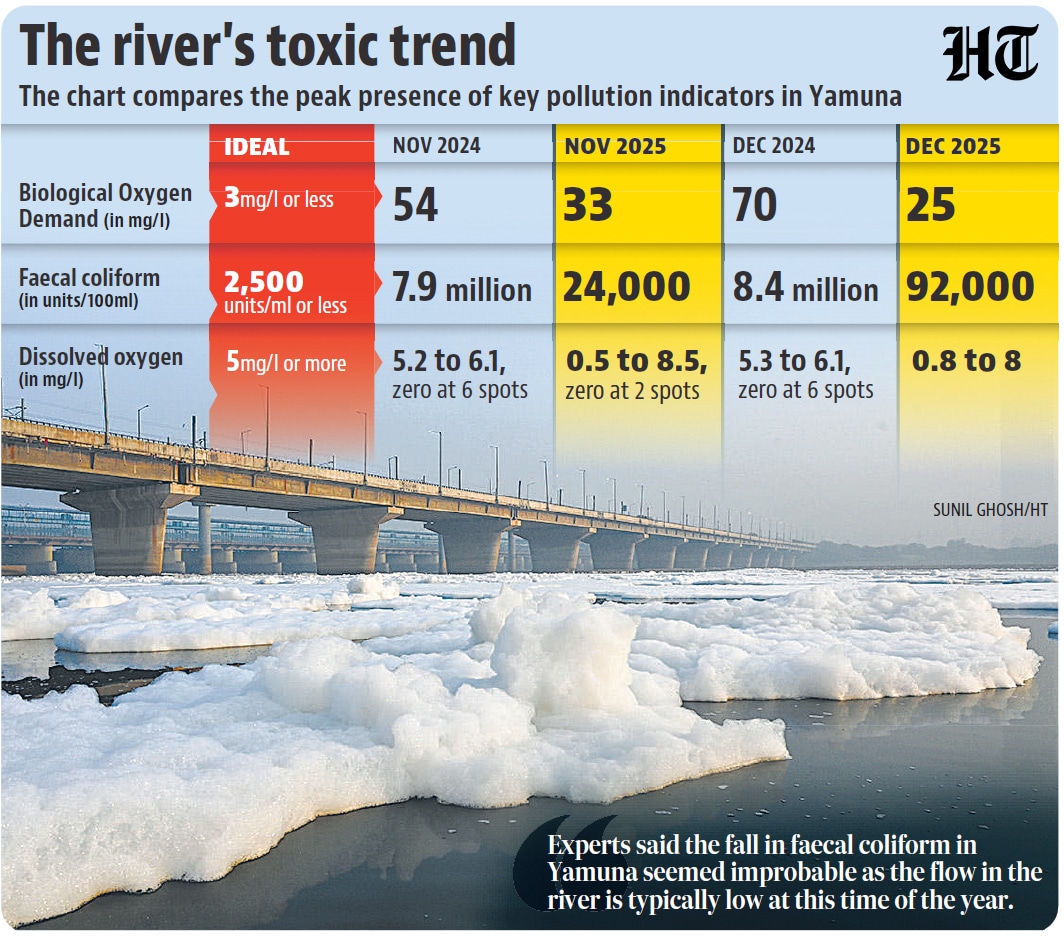
The data shows faecal coliform levels – an indicator of untreated sewage entering the river – rising sharply over the two months. In December, faecal coliform peaked at 92,000 units/100 ml, up from 24,000 units/100 ml in November, and just 8,000 units/100 ml in October, when excess water was released upstream during Chhath Puja. The safe limit is 2,500 units/100 ml, while the desired standard is 500 units/100 ml.
Still, the numbers showed a remarkable decline when compared to 2024 when it was at 8.4 million units in December and 7.9 million units in November. However, experts said the decline seemed improbable as the flow in the river is typically low at this time of the year.
The reports further showed that the biological oxygen demand (BOD), another key pollution indicator, was at 25 mg/l in October, climbed to 33 mg/l in November, and eased back to 25 mg/l in December. Even so, this remains over eight times the acceptable limit of 3 mg/l. Dissolved oxygen (DO) – essential for aquatic life – ranged between 0.5 mg/l and 8.5 mg/l in November, dropping to zero at two locations, and between 0.8 mg/l and 8 mg/l in December, against a required minimum of 5 mg/l.
BOD last December touched 70 mg/l and DO levels were within permissible limits at Palla and Wazirabad, before dropping to zero at six locations. In November last year, BOD was at 54 mg/l while DO was zero at six locations downstream of Wazirabad.
To assess Yamuna’s river quality, water samples are collected manually from the Yamuna from eight different locations – beginning at Palla, where the river enters Delhi, followed by Wazirabad, ISBT Kashmere Gate, ITO bridge, Nizamuddin bridge, Okhla barrage, Agra Canal, and finally Asgharpur, after which the river exits Delhi. HT had on December 23 reported how the data had been missing for over two months – since the last report in October.
The data also comes soon after the National Green Tribunal in its December 22 order, asked DPCC to share Yamuna water quality data for the Yamuna stretch from Wazirabad till Asgharpur.
Experts said, while the Okhla sewage treatment plant (STP), which was fully operationalised in April last year, may have played a role, the stark improvement was still surprising. “It is a major difference in comparison to last December, even though flow in the river is not too high. The river still stinks. One may have to ask the DPCC, whether there is a change in the methodology,” said Bhim Singh Rawat, a Yamuna activist and member of the South Asia Network on Dams, Rivers and People (SANDRP).
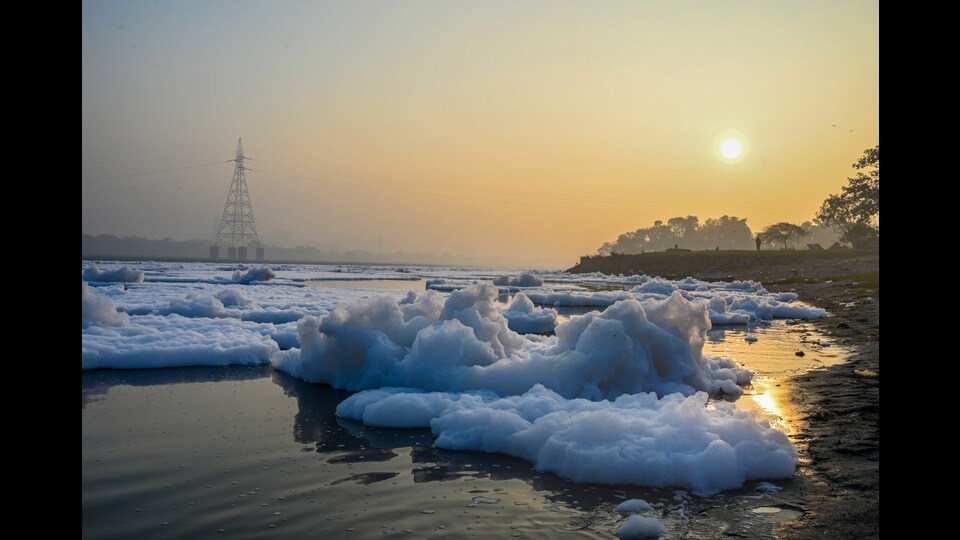
Ahead of Chhath Puja, the river received a surge of fresh water from upstream barrages. Between October 21 and 25, more than 668,000 cusecs of water was released into the Yamuna to dilute pollution levels. The increased flow visibly cleaned the river, lifted BOD and DO levels, and made the familiar froth – a sign of the pollution – disappear. By early November, however, as flows reduced, frothing and the stench returned.
Other experts also pointed to apparent inconsistencies between visual conditions and reported improvements at some locations. At Okhla Barrage, for instance, BOD was reported at 20 mg/l in October, when the river was visibly cleaner due to high flow. Yet, in November and December, when frothing had returned, BOD reportedly improved to 14 mg/l and 17 mg/l, respectively.
“At some points, we have higher readings in October as compared to November and December. We know there was greater release of fresh water in October and the flow is less in November and December. Yet, there are stations which are cleaner in November and December,” said Pankaj Kumar, a Yamuna activist.
The DPCC did not respond to HT’s queries on these discrepancies.


Stay updated with all top Cities including, Bengaluru, Delhi, Mumbai and more across India. Stay informed on the latest happenings in World News along with Delhi Election 2025 and Delhi Election Result 2025 Live, New Delhi Election Result Live, Kalkaji Election Result Live at Hindustan Times.


